Teac V-5000: The Quiet Masterpiece of Reel-to-Reel Engineering
In the late 1970s, when cassette tapes were gaining popularity for convenience and portability, Teac stood firmly behind the fidelity of analog tape with a commitment to high-end reel-to-reel engineering. The Teac V-5000, released in 1978, emerged as one of the company’s most refined and technically accomplished open-reel tape decks — a machine built not for casual listeners, but for serious audiophiles, recording enthusiasts, and studio engineers who demanded the highest possible sound quality from magnetic tape.
While Teac is often celebrated for its consumer cassette decks and later CD players, the V-5000 represents a pinnacle of their reel-to-reel lineage — a category that, though niche, defined the cutting edge of home audio fidelity before the digital era. Part of Teac’s professional-leaning V-series, the V-5000 was engineered to deliver studio-grade performance in a home environment, blending precision mechanics with audiophile sensibilities.
Technical Specifications
The Teac V-5000 was designed to support multiple tape speeds and formats, ensuring compatibility with a wide range of recordings while maximizing fidelity. It featured dual capstans, three-head configuration, and quartz-controlled speed stabilization — hallmarks of high-end tape decks of the era.
| Specification | Detail |
| Model | V-5000 |
| Manufacturer | TEAC Corporation, Japan |
| Year Introduced | 1978 |
| Type | 1/4" 2-track stereo reel-to-reel tape deck |
| Tape Speeds | 7.5, 15, 30 ips (inches per second) |
| Head Configuration | 3-head (separate record, playback, erase) |
| Tape Tracking | Manual with front-panel vernier control |
| Capstan Drive | Dual capstan, direct drive |
| Speed Accuracy | ±0.15% (quartz-locked servo system) |
| Wow and Flutter | < 0.07% (15 ips, WRMS) |
| Frequency Response | 30Hz – 20kHz (+2/-2dB, 15 ips, 3% THD) |
| Signal-to-Noise Ratio | > 65dB (Dolby B) |
| Input/Output Levels | Line: 0.3V (input), 0.8V (output); Mic: 1.2mV (input) |
| Equalization Settings | 120μs (7.5 ips), 60μs (15/30 ips) |
| Recording Bias | Adjustable front-panel trim pots |
| Outputs | RCA (line), 1/4" headphone jack |
| Inputs | RCA (line), 1/4" mic |
| Power Requirement | 120V AC, 60Hz (North American version) |
| Dimensions | 440mm (W) × 160mm (H) × 390mm (D) |
| Weight | 14.5 kg (32 lbs) |
Sound Characteristics and Performance
The V-5000 was engineered for transparency and dynamic realism. Its three-head design allowed for precise monitoring of the recorded signal — a critical feature for both home tapers and semi-professional users. The separate playback head meant that recordings could be evaluated immediately after laying down, without relying on the record head’s compromised frequency response.
With a frequency response extending to 20kHz at 15 ips and a wow and flutter rating under 0.07%, the V-5000 delivered a remarkably stable and detailed sound. At 30 ips, the performance approached near-CD quality by analog standards, with lush stereo imaging, low distortion, and an expansive soundstage. The deck’s ability to capture subtle nuances — the breath of a vocalist, the decay of a piano note — made it a favorite among classical and jazz enthusiasts.
Teac’s use of a quartz-locked servo system ensured exceptional speed stability, eliminating pitch drift and maintaining tonal accuracy. This was particularly important for music with sustained notes or complex harmonics. Combined with the dual capstan transport, which minimized tape slippage and ensured consistent tape-to-head contact, the V-5000 delivered one of the most reliable and sonically faithful analog playback experiences of its time.
Notable Features and Innovations
The V-5000 was packed with features that set it apart from both consumer and mid-tier professional decks:
- Quartz-Locked Speed Control: One of the earliest consumer/pro-sumer decks to feature quartz-based speed regulation, ensuring long-term stability and eliminating the need for manual speed calibration.
- Dual Capstan Transport: Reduced tape flutter and improved tension control, resulting in smoother playback and recording.
- Three-Head Configuration: Enabled real-time monitoring with optimized playback head, a feature typically found in studio recorders.
- Front-Panel Bias and EQ Adjustment: Allowed users to fine-tune recording performance for different tape formulations (e.g., ferric, chrome), maximizing fidelity and headroom.
- Vernier Tracking Control: Provided precise alignment of the playback head for off-speed or misaligned tapes, preserving compatibility with recordings made on other machines.
- Direct Drive Capstans and Motors: Minimized mechanical noise and vibration, contributing to cleaner signal reproduction.
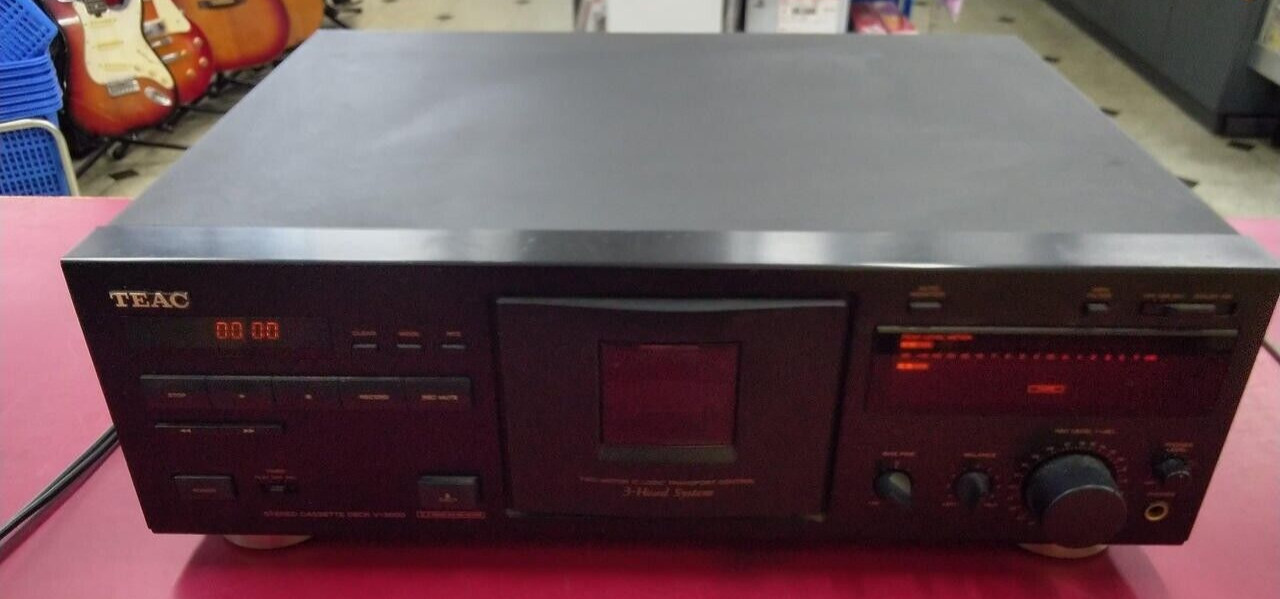
The front panel was cleanly laid out with large, tactile knobs and clear metering. The VU meters, flanking the central tape window, offered accurate level monitoring during recording, while the illuminated tape path made threading easier in low-light environments.
Common Issues and Maintenance
Like all high-precision reel-to-reel decks, the V-5000 requires regular maintenance to perform at its best. Over time, rubber components such as idler tires, pinch rollers, and drive belts can degrade, leading to speed instability or transport failure. These should be inspected and replaced every 10–15 years, depending on usage.
The tape heads and guides also require periodic cleaning with isopropyl alcohol and non-abrasive swabs to prevent oxide buildup, which can dull high frequencies and increase noise. Demagnetizing the heads and tape path every 10–20 hours of use is strongly recommended to maintain clarity and dynamic range.
One known issue with older Teac decks is the potential for dried-up lubrication in the capstan shafts and transport mechanism. If the deck feels stiff or produces uneven tape tension, a full mechanical servicing by a qualified technician is advised. Additionally, the internal wiring and capacitors may need inspection in units that have been stored for decades, as electrolytic capacitors can dry out and fail over time.
Despite these aging concerns, the V-5000 is known for its robust build quality. Its heavy-duty chassis, metal gears, and precision-machined components have allowed many units to remain functional decades after production.
Current Market Value and Collectibility
The Teac V-5000 is not as widely known as some of its contemporaries — such as the Revox B77 or Studer A80 — but it has developed a loyal following among reel-to-reel enthusiasts. In excellent working condition, with clean heads and a serviced transport, the V-5000 typically sells for $800 to $1,400 on the vintage audio market, depending on region and included accessories.
Fully restored units with documented service history command premium prices, especially when paired with original boxes, manuals, or calibration tapes. Its relative rarity compared to more mass-market decks adds to its appeal among collectors.
While reel-to-reel decks are inherently niche today, the resurgence of interest in analog audio has brought renewed attention to machines like the V-5000. Audiophiles seeking the warm, organic sound of tape — particularly for archiving vinyl or recording live instruments — find the V-5000 to be a compelling alternative to more expensive studio gear.
Conclusion and Legacy
The Teac V-5000 stands as a testament to the craftsmanship and engineering ambition of late-1970s Japanese audio design. Though overshadowed by the cassette revolution and later digital formats, it remains a high-water mark in Teac’s reel-to-reel history — a machine built for those who refused to compromise on sound quality.
It may not have the brand cachet of a Studer or the retro charm of a vintage Tandberg, but in performance and build, the V-5000 belongs in the same conversation. For the discerning collector or analog enthusiast, it offers a rare combination: studio-level engineering, meticulous adjustability, and the soulful warmth of real tape.
In an age of digital perfection, the Teac V-5000 reminds us that sometimes, the most accurate sound isn’t the most sterile — it’s the one with texture, depth, and a little bit of tape hiss.
eBay Listings



As an eBay Partner, we earn from qualifying purchases. This helps support our independent vintage technology research.
Related Models
- Teac A-6700DX (1980)
- Teac A-105 (1975)
- Teac A-106 (1975)
- Teac A-170 (1976)
- Teac A-2300 (1978)
- Sony TC-2050SD (1978)
- Aiwa AD-F990 (1993)
- Kenwood KX-3060 (1982)
- Sony TC-2130A (1974)
- Sony TC-2220 (1972)