Teac V-455-X: The Unsung Workhorse of Vintage Reel-to-Reel Recording
In the late 1970s, when cassette tapes were gaining popularity for portability and convenience, a different breed of audio enthusiast was still devoted to the rich, warm fidelity of analog tape. For those serious about recording and playback quality, the Teac V-455-X stood as a compelling option in the world of reel-to-reel tape recorders. Though not as widely recognized as some of its contemporaries from Studer or Revox, the V-455-X carved out a loyal following among home recordists, musicians, and audiophiles who valued professional-grade features in a compact, user-friendly package.
Manufactured under the TASCAM (Teac Audio Systems Corporation) brand umbrella—Teac’s professional audio division—the V-455-X was part of a wave of semi-professional reel-to-reel machines aimed at bridging the gap between consumer gear and full studio equipment. Released around 1978, it arrived during a golden era of analog recording, when multi-track home studios were beginning to emerge and independent artists sought affordable yet reliable tools for capturing high-fidelity sound.
Technical Specifications
The Teac V-455-X was designed as a 1/4-inch, 2-track stereo recorder, capable of operating at multiple tape speeds to accommodate different recording needs. It supported standard tape formats and was engineered for durability, with a robust mechanical transport system and precision tape heads.
| Specification | Detail |
| Format | 1/4-inch, 2-track stereo |
| Tape Speeds | 7.5, 15, and 30 inches per second (ips) |
| Tracks | 2-track stereo (full-track playback) |
| Head Configuration | Separate record, playback, and erase heads |
| Motor System | Dual capstan, direct-drive |
| Frequency Response | 30Hz – 20kHz (at 15 ips, +3/-6dB) |
| Wow and Flutter | < 0.25% (WRMS) |
| Signal-to-Noise Ratio | > 60dB (Dolby B optional) |
| Input/Output | Line in/out (RCA), mic in (XLR and 1/4") |
| Equalization | 120µs and 180µs (switchable) |
| Power Requirement | 120V AC, 60Hz (North American models) |
| Dimensions | 440mm (W) × 145mm (H) × 350mm (D) |
| Weight | Approx. 11.5 kg (25.3 lbs) |
The inclusion of three tape speeds—especially the high-speed 30 ips option—was a notable feature, allowing users to maximize frequency response and dynamic range for critical listening or master recording. The machine’s separate record and playback heads enabled precise monitoring during recording sessions, a feature typically found in more expensive professional decks.
Sound Characteristics and Performance
The V-455-X delivered the lush, natural sound that reel-to-reel enthusiasts cherish. At 15 and 30 ips, the frequency response was impressively flat, with smooth highs and tight, well-defined bass. The analog warmth of tape saturation could be subtly introduced by driving levels slightly into the red, giving recordings a pleasing harmonic character that remains difficult to replicate digitally.
Thanks to its high-quality record and playback heads—likely made from permalloy or similar magnetic alloys—the V-455-X offered excellent headroom and low distortion. The dual capstan drive system contributed to stable tape tension and consistent speed, minimizing wow and flutter and ensuring reliable performance over long recording sessions.
When paired with a good preamp and high-quality microphones, the V-455-X was capable of producing near-broadcast-grade recordings. Its ability to handle both line-level and microphone inputs (with balanced XLR connectivity) made it a versatile tool for capturing vocals, acoustic instruments, or direct feeds from mixers.
Notable Features and Innovations
While not packed with flashy extras, the V-455-X was thoughtfully engineered for practicality and performance:
- Switchable EQ (120µs/180µs): Allowed compatibility with different tape formulations (e.g., normal bias vs. high bias tapes), giving users flexibility in tape choice.
- Dolby B Noise Reduction (optional): Helped reduce tape hiss, especially at lower speeds, improving the signal-to-noise ratio for cleaner playback.
- Front-panel level meters: Large VU meters provided real-time visual feedback for input and output levels, essential for proper gain staging.
- Tape counter with reset function: Useful for locating specific passages during editing or overdubbing.
- Direct-drive motors: Enhanced speed stability and reduced mechanical wear compared to belt-driven systems.
One of the more subtle but important design choices was the modular head stack, which simplified alignment and maintenance. This was particularly valuable for users who wanted to keep their machine calibrated for optimal performance.
Common Issues and Maintenance
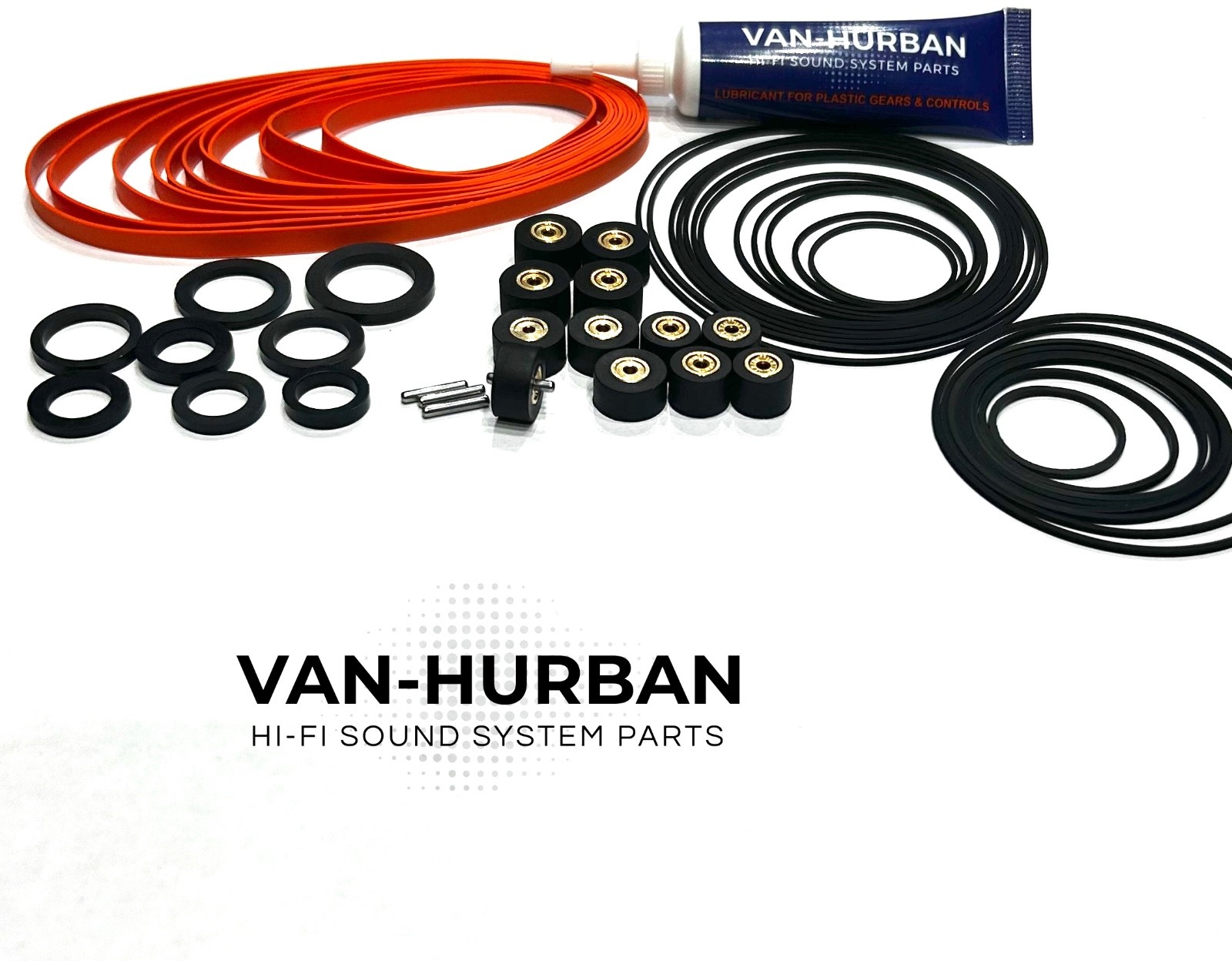
Like all vintage reel-to-reel machines, the Teac V-455-X requires regular maintenance to perform at its best. Over time, rubber parts such as pinch rollers and idler tires can harden or crack, leading to speed inconsistencies or tape slippage. These components should be inspected and replaced if necessary.
The tape heads and capstans also accumulate oxide buildup and require periodic cleaning with isopropyl alcohol and lint-free swabs. For best results, a demagnetizing tool should be used every few months to prevent signal degradation.
Another potential issue is head misalignment, which can occur due to physical shock or wear. Misaligned heads result in poor stereo imaging, reduced high-frequency response, and level imbalances between channels. Proper alignment requires a test tape and alignment tool, best handled by a technician experienced with analog tape decks.
Lubrication of moving parts—especially the transport mechanism—should be done sparingly and with the correct type of grease to avoid attracting dust or gumming up over time.
Current Market Value and Collectibility
The Teac V-455-X is not a high-profile collector’s item like some of the Swiss or Japanese flagship decks, but it holds steady appeal among reel-to-reel enthusiasts and DIY recording artists. In working condition, units typically sell for $300 to $600, depending on cosmetic condition, included accessories, and whether a recent servicing has been performed.
Fully restored models with new belts, cleaned heads, and calibrated electronics may command higher prices, especially if bundled with original boxes or documentation. While not as rare as some boutique brands, the V-455-X is becoming increasingly scarce, and well-maintained examples are prized for their reliability and sound quality.
Its value is further enhanced by its TASCAM heritage, a brand that would go on to dominate the home recording market in the 1980s with products like the Portastudio. The V-455-X represents an early step in that legacy—a machine built for real-world use, not just audiophile indulgence.
Conclusion and Legacy
The Teac V-455-X may not have the celebrity status of a Revox A77 or a Studer B67, but it stands as a testament to Teac’s commitment to quality engineering and accessible professional audio. For its time, it offered an exceptional balance of performance, durability, and usability—qualities that continue to resonate with analog lovers today.
In an age of digital perfection, the V-455-X reminds us of the tactile joy of threading tape, watching VU meters dance, and capturing sound with the warmth and character only magnetic tape can provide. Whether used for archival transfers, music recording, or simply enjoying vintage master tapes, the V-455-X remains a capable and rewarding machine.
For those exploring the world of reel-to-reel, the Teac V-455-X is a smart and satisfying entry point—unassuming in appearance, but rich in sonic reward.
eBay Listings



As an eBay Partner, we earn from qualifying purchases. This helps support our independent vintage technology research.
Related Models
- Teac A-6700DX (1980)
- Teac A-105 (1975)
- Teac A-106 (1975)
- Teac A-170 (1976)
- Teac A-2300 (1978)
- Sony TC-2050SD (1978)
- Aiwa AD-F990 (1993)
- Kenwood KX-3060 (1982)
- Sony TC-2130A (1974)
- Sony TC-2220 (1972)