Teac V-383-C: A Vintage Reel-to-Reel Workhorse with Studio-Grade Finesse
In the late 1970s, when cassette tapes were becoming the norm for home audio, Teac stood apart by continuing to champion the fidelity and craftsmanship of open-reel tape technology. Among their respected lineup of reel-to-reel recorders, the Teac V-383-C emerged as a compelling model for semi-professional users, audiophiles, and home recording enthusiasts who demanded more than what compact cassettes could offer. Though not as widely documented as some of its siblings like the A-3340 or the legendary X-1000 series, the V-383-C occupies a quiet but important place in Teac’s legacy—a machine built for precision, durability, and musical transparency.
Historical Context: Teac’s Golden Era of Tape
Teac (Tokyo Electro-Acoustic Company) earned its reputation in the 1960s and 1970s by producing high-quality, accessible reel-to-reel recorders that bridged the gap between consumer and professional use. By the late '70s, the market was shifting toward convenience, but Teac remained committed to analog tape excellence. The V-383-C, introduced around 1978, was part of a generation of machines designed for serious home studios, radio stations, and mastering engineers on a budget. It reflected Teac’s philosophy: deliver studio-grade performance with thoughtful engineering and reliable mechanics, all in a compact, user-friendly package.
Unlike the massive multi-track recorders of the era, the V-383-C was a 2-track stereo recorder, ideal for high-fidelity music duplication, live recording, and archival mastering. It catered to audiophiles who wanted to create their own high-resolution tapes or transfer vinyl collections with minimal generational loss—a practice that’s seeing a nostalgic revival today.
Technical Specifications
The V-383-C was engineered for accuracy and ease of use, featuring a dual-capstan transport system, quartz-locked speed control, and high-quality tape heads. While full schematics are scarce, surviving units and service manuals confirm the following specifications:
| Specification | Detail |
| Format | 1/4" 2-track stereo, full-track or stereo |
| Tape Speeds | 7.5 ips, 15 ips (standard) |
| Transport System | Dual capstan, direct-drive reel motors |
| Head Configuration | Separate record, playback, and erase heads |
| Recording Modes | Full-track mono, stereo (15 ips), half-track mono (7.5 ips) |
| Frequency Response | 30Hz – 20kHz (15 ips, ±3dB) |
| Wow and Flutter | < 0.15% (WRMS, 15 ips) |
| Signal-to-Noise Ratio | > 60 dB (Dolby B optional) |
| Input/Output | Line In/Out (RCA), Mic In (1/4") |
| Equalization | 120µs (15 ips), 180µs (7.5 ips) |
| Power Supply | 110–120V AC, 60Hz (North American model) |
| Dimensions | 430 × 145 × 330 mm (W×H×D) |
| Weight | Approx. 12.5 kg (27.5 lbs) |
The V-383-C used a quartz-locked servo system to maintain precise tape speed, minimizing pitch instability and ensuring consistent playback—critical for music recording and mastering. Its three-motor design (one for capstan, two for reels) allowed for smooth, independent reel control, reducing tape tension and wear.
Sound Characteristics and Performance
The sonic signature of the Teac V-383-C is best described as clean, open, and dynamically rich—hallmarks of well-engineered analog tape. At 15 inches per second (ips), the machine delivers a frequency response that rivals early digital recordings, with a smooth high end and solid bass foundation. The separate playback and record heads allow for optimal alignment, ensuring minimal phase distortion and excellent stereo imaging.
Tape saturation on the V-383-C is subtle and musical, adding a gentle warmth without muddying transients. When used with high-quality tape stock like Ampex 456 or Sony UX, it captures acoustic instruments and vocals with startling realism. Many users report that recordings made on the V-383-C have a “3D” quality—depth and spatial presence that modern digital systems often struggle to replicate.
Its ability to handle both full-track mono (ideal for voice or archival) and stereo recording made it versatile. The inclusion of Dolby B noise reduction (on later revisions) helped reduce tape hiss, especially at 7.5 ips, making it practical for longer recordings without sacrificing too much fidelity.
Notable Features and Innovations
While not as flashy as some of Teac’s higher-end models, the V-383-C packed several thoughtful features:
- Dual Capstan Transport: Reduced tape flutter and ensured consistent head-to-tape contact, improving high-frequency response.
- Quartz-Locked Speed Control: Used a crystal oscillator to maintain exact tape speed, critical for pitch stability in music recording.
- Front-Panel Metering: Large VU meters with peak hold function allowed for precise level setting—essential for avoiding distortion.
- Head Selector Switch: Enabled users to switch between playback and calibration heads, simplifying alignment procedures.
- Direct Drive Reel Motors: Provided smooth winding and back-tilting to prevent tape spillage.
- RCA and 1/4" Connectivity: Made it easy to integrate with preamps, mixers, and turntables.
The front panel was clean and functional, with tactile knobs and switches that inspired confidence. The aluminum chassis and steel subframe contributed to low resonance and excellent mechanical stability.
Common Issues and Maintenance
Like all vintage tape machines, the Teac V-383-C requires regular maintenance to perform at its best. Common issues include:
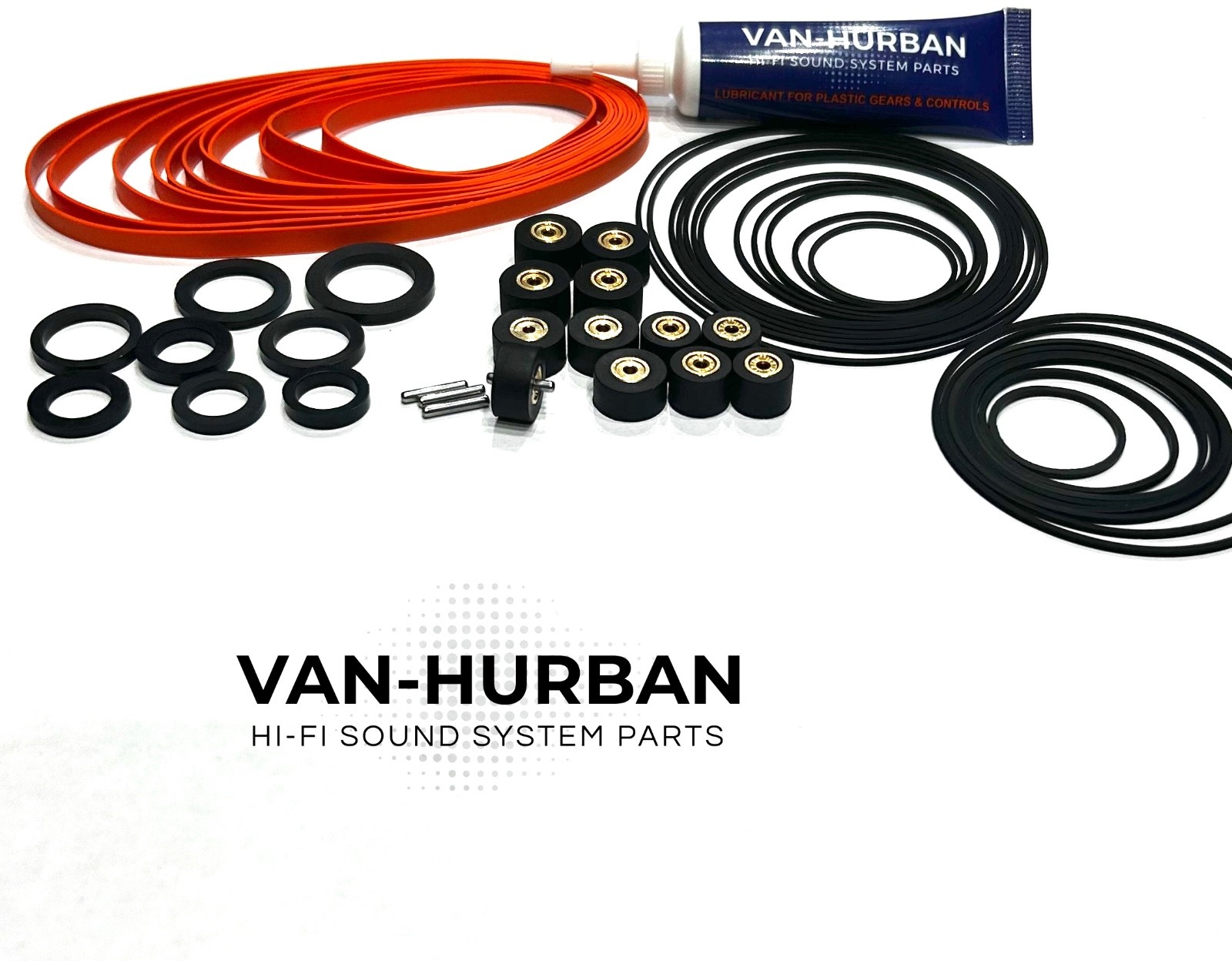
- Deteriorated Rubber Components: Pinch rollers, drive belts (if present), and idler tires can harden or crack over time. Replacement with modern equivalents is recommended.
- Dirty or Worn Tape Heads: Heads should be cleaned with isopropyl alcohol and demagnetized regularly. Worn heads may need resurfacing or replacement.
- Capstan Shaft Oxidation: Can cause speed fluctuations. Light polishing with metal polish restores smooth operation.
- Capacitor Aging: Electrolytic capacitors in the power supply and audio circuits may dry out, leading to noise or failure. A full recap is advisable for long-term reliability.
- Lubrication Needs: Gears and transport mechanisms require periodic lubrication with synthetic grease designed for audio equipment.
Finding service manuals can be challenging, but enthusiast forums and vintage audio communities often share schematics and alignment procedures. Alignment should be performed with a calibration tape and oscillator for optimal results.
Current Market Value and Collectibility
The Teac V-383-C is not as sought-after as the X-1000 or A-3300 series, but it’s gaining attention among reel-to-reel collectors and analog recording enthusiasts. Well-maintained units typically sell for $400–$700, depending on condition, included accessories, and provenance.
Its value lies in its reliability, sonic quality, and relative rarity. Unlike mass-market cassette decks, the V-383-C was built in smaller numbers and targeted a niche market. Finding one in working order with clean heads and healthy electronics is a win.
It’s particularly appealing to those building a vintage analog chain—pairing it with a tube preamp, turntable, or microphone preamp creates a stunningly musical recording setup. With the resurgence of interest in analog tape, the V-383-C is poised to become a cult favorite.
Conclusion: A Hidden Gem of Analog Fidelity
The Teac V-383-C may not have the fame of its siblings, but it embodies everything that made Teac a trusted name in analog recording: precision engineering, musical transparency, and rugged build quality. It’s a machine that rewards care and attention, delivering a listening experience that digital formats often fail to match.
For the vintage audio enthusiast, the V-383-C is more than a recorder—it’s a portal to a time when sound was captured with care, one reel at a time. Whether you're archiving vinyl, recording live music, or simply indulging in the tactile joy of analog, the Teac V-383-C remains a worthy companion in the pursuit of sonic truth.
In a world of instant digital perfection, the V-383-C reminds us that sometimes, the most beautiful sound comes on tape.
eBay Listings


As an eBay Partner, we earn from qualifying purchases. This helps support our independent vintage technology research.
Related Models
- Teac A-6700DX (1980)
- Teac A-105 (1975)
- Teac A-106 (1975)
- Teac A-170 (1976)
- Teac A-2300 (1978)
- Sony TC-2050SD (1978)
- Aiwa AD-F990 (1993)
- Kenwood KX-3060 (1982)
- Sony TC-2130A (1974)
- Sony TC-2220 (1972)