Teac V-2020-S: The Analog Audiophile’s Time Machine
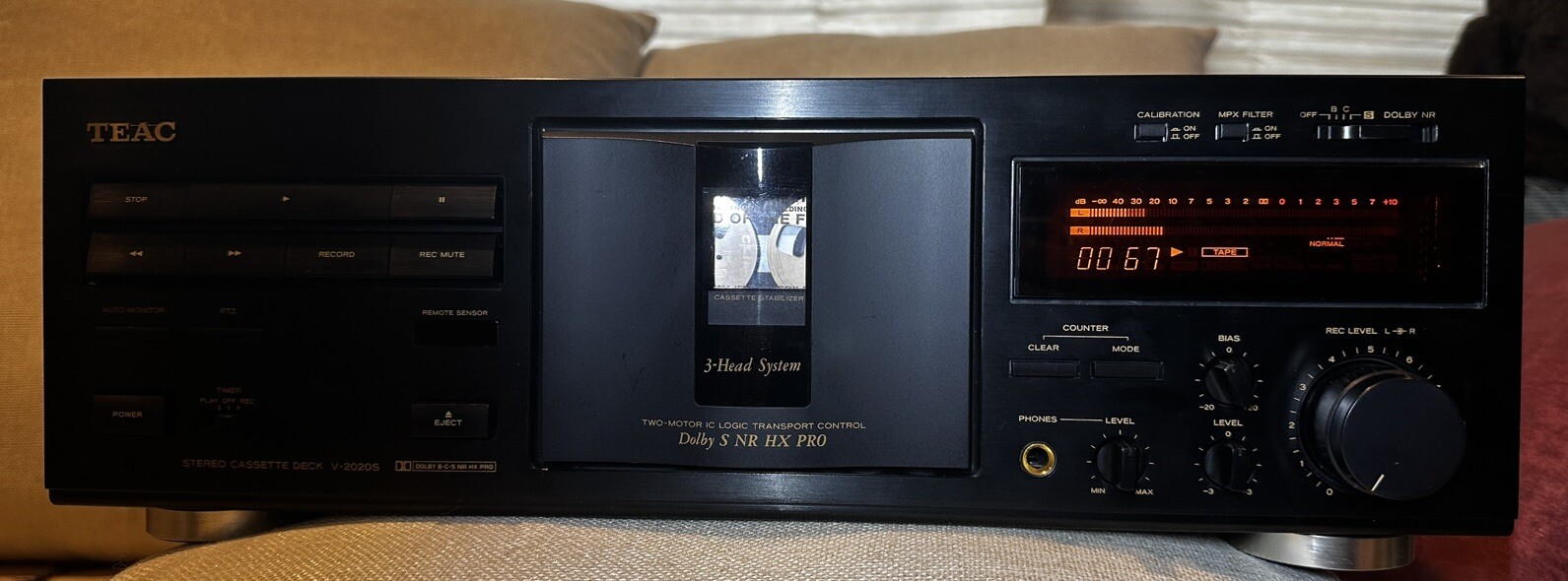
In the golden age of analog audio, few names carried the weight of Teac—a Japanese manufacturer renowned for blending precision engineering with accessible design. Among their impressive lineup of open-reel tape recorders from the 1970s, the Teac V-2020-S stands as a quiet legend: not the flashiest, not the most powerful, but undeniably one of the most refined and reliable reel-to-reel machines of its time. Though it may not command the same headlines as the TEAC A-3340 or the TASCAM 38, the V-2020-S carved out a loyal following among home recordists, audiophiles, and broadcast engineers who valued consistency, clarity, and craftsmanship.
Released in 1975, the V-2020-S arrived during a peak period for consumer reel-to-reel technology. High-fidelity home audio was booming, and open-reel recorders offered unmatched sound quality compared to cassette decks or even early quadraphonic systems. Teac, already respected for its professional-grade gear under the TASCAM brand, brought that same ethos to its consumer models—engineering robust machines that could deliver studio-like performance in domestic environments. The V-2020-S was no exception.
Technical Specifications
The V-2020-S was designed as a ½-inch 2-track stereo recorder, capable of handling standard reel sizes up to 7 inches. It supported two tape speeds: 7.5 ips and 15 ips, allowing users to choose between extended recording time and maximum fidelity. While not a multi-track machine, its focus on stereo performance made it ideal for music archiving, live recording, and high-end playback.
| Specification | Detail |
| Format | ½-inch 2-track stereo open-reel |
| Tape Speeds | 7.5 ips, 15 ips |
| Tracks | 2-track stereo (full-track playback capable) |
| Heads | 3-head design (record, playback, erase) |
| Motor System | Dual capstan, direct-drive with servo control |
| Frequency Response | 20Hz – 20kHz @ 15 ips (±2dB) |
| Signal-to-Noise Ratio | >60 dB (Dolby B capable) |
| Input/Output | RCA line in/out, ¼" mic in (x2), headphone out |
| Equalization | 120µs (15 ips), 180µs (7.5 ips) |
| Power Requirements | 120V AC, 60Hz (NTSC regions) |
| Dimensions | 440 mm × 145 mm × 335 mm (W×H×D) |
| Weight | 11.5 kg (approx. 25.3 lbs) |
Built with a 3-head configuration, the V-2020-S allowed for true post-recording monitoring—a hallmark of professional decks. The separate playback head ensured that users could verify recordings immediately without switching modes or sacrificing tape alignment. Combined with dual capstan transport, the machine delivered exceptional tape stability, minimizing wow and flutter to levels below 0.25% (WRMS)—a remarkable achievement for a consumer-grade unit.
Sound Characteristics and Performance
The sonic signature of the Teac V-2020-S is best described as warm, detailed, and effortlessly natural. At 15 ips, the machine captures a wide frequency range with smooth highs, rich mids, and tight, well-defined bass. Its ability to reproduce acoustic instruments—particularly piano, strings, and voice—is where it truly shines. The 3-head design and precision tape guidance system contribute to a spacious soundstage and excellent stereo imaging, making it a favorite for live concert taping and vinyl ripping.
One of the V-2020-S’s most appreciated traits is its low distortion and excellent dynamic range. When paired with high-quality tape stock like Ampex 456 or BASF SM468, it delivers results that rival professional studio recorders costing twice as much. The inclusion of Dolby B noise reduction (switchable) further enhances its playback performance, taming tape hiss without introducing the “breathing” artifacts common in lesser systems.
Notable Features and Innovations
While not packed with flashy extras, the V-2020-S excelled in thoughtful, user-centric design:
- Direct-drive servo-controlled motors: Unlike belt-driven systems prone to slippage, the V-2020-S used precision motors regulated by feedback circuits to maintain exact tape speed, ensuring pitch stability.
- Front-panel tape type selector: Allowed users to optimize bias and equalization for different tape formulations (normal, high-bias), maximizing fidelity.
- Full logic transport controls: Motorized start, stop, rewind, and fast-forward with mechanical interlocks prevented conflicting operations and extended component life.
- Calibration mode access: A hidden service mode (accessible via internal switch) enabled technicians to align heads and adjust levels—evidence of its semi-professional aspirations.
- Solid construction: A rigid steel chassis, rubber-isolated feet, and a die-cast aluminum front panel reduced vibration and resonance.
The layout is clean and intuitive, with large VU meters, tactile buttons, and clearly labeled inputs. It lacks the glamour of wood cabinets found on some competitors, but its minimalist black-and-silver aesthetic speaks to its functional elegance.
Common Issues and Maintenance
Like all vintage reel-to-reel machines, the V-2020-S requires regular maintenance to perform at its best. Over four decades, rubber parts degrade, tape heads wear, and lubricants dry out. Common issues include:
- Perished pinch rollers and idler tires: These must be replaced to restore proper tape tension and speed accuracy.
- Dirty or oxidized tape heads: Regular cleaning with isopropyl alcohol and demagnetizing are essential for optimal sound.
- Sticky mode switches or potentiometers: Caused by dust or oxidation; can often be resolved with contact cleaner.
- Capstan bearing dryness: Leads to speed instability; requires disassembly and re-lubrication.
Fortunately, the V-2020-S is relatively serviceable compared to other models of its era. Its modular design allows for straightforward head replacement, and service manuals are available through vintage audio archives. Due to Teac’s widespread use of standard components, many parts are cross-compatible with other Teac and TASCAM decks.
Current Market Value and Collectibility
The Teac V-2020-S is not as widely collected as some of its siblings, but it has a dedicated niche following. Well-maintained, fully serviced units typically sell between $400 and $700, depending on condition, accessories, and provenance. Machines with original boxes, manuals, and unopened tape stock can command higher prices, especially in Europe and Japan where reel-to-reel culture remains strong.
Its value lies not in rarity, but in reliability and sonic excellence. For analog enthusiasts building a high-fidelity tape chain, the V-2020-S offers a compelling balance of performance and usability. It’s also a favorite among vinyl archivists who appreciate its line-level precision and low noise floor.
Conclusion and Legacy
The Teac V-2020-S may not be the most famous reel-to-reel recorder of the 1970s, but it embodies everything that made that era special: a commitment to quality, a respect for the listening experience, and a belief that great sound should be accessible. It wasn’t designed for rock studios or film scoring—it was built for the discerning listener who wanted to capture music as it was meant to be heard.
Today, as the analog revival continues to grow, the V-2020-S stands as a testament to Teac’s engineering prowess. It’s a machine that rewards care and attention, delivering warmth, clarity, and a tangible connection to the music. For those willing to invest in its upkeep, the V-2020-S isn’t just a vintage recorder—it’s a portal to the golden age of sound.
eBay Listings



As an eBay Partner, we earn from qualifying purchases. This helps support our independent vintage technology research.
Related Models
- Teac A-2340R (1975)
- Teac V-30 (1975)
- Teac W-416 (1975)
- Teac A-108-SYNC (1978)
- Teac A-110 (1978)
- Akai AM-2850 (1975)
- Akai AP-206 (1975)
- Nakamichi BX-1 (1985)
- Acoustic Research research-ar-17 (1978)
- Acoustic Research AR-19 (1994)