Teac C-1-MK-II: The Quiet Masterpiece of Passive Preamplification
In the late 1970s, Japanese audio manufacturer TEAC (Tokyo Electro-Acoustic Company) was riding the crest of a golden wave in high-fidelity engineering. Known primarily for their precision tape decks and integrated receivers, TEAC also quietly released a series of high-end components under their Esoteric and Reference lines—products aimed squarely at the discerning audiophile. Among these rarities stands the Teac C-1-MK-II, a dual-mono passive preamplifier that defies conventional design wisdom and remains a cult favorite among vintage audio enthusiasts.
Released in 1979, the C-1-MK-II was not a product designed for mass appeal. With no amplification circuitry, no power supply, and no tone controls, it represented a radical departure from the active preamps dominating the market. Instead, it embraced purity—offering nothing but meticulously engineered signal routing and attenuation. For those who value transparency and signal integrity above all else, the C-1-MK-II remains one of the most compelling passive preamplifiers ever made.
Technical Specifications
| Specification | Detail |
| Model | C-1-MK-II |
| Manufacturer | TEAC Corporation, Japan |
| Year of Release | 1979 |
| Type | Dual-mono passive preamplifier |
| Gain | Unity (0 dB) – no amplification |
| Input Impedance | 47 kΩ (switchable to 100 kΩ on some units) |
| Output Impedance | <1 kΩ (varies with volume setting) |
| Inputs | 4 line-level (RCA) |
| Outputs | 1 main (RCA) |
| Attenuation Control | 24-step precision resistor ladder |
| Volume Adjustment | Dual-gang stepped attenuator (L/R independent) |
| Tone Controls | None |
| Power Requirement | None (passive design) |
| Dimensions (W×H×D) | 430 × 125 × 330 mm |
| Weight | Approx. 9.5 kg |
| Chassis Construction | Solid steel and aluminum, dual-mono layout |
| Finish Options | Black or silver faceplate |
Sound Characteristics and Performance
The sonic signature of the Teac C-1-MK-II is best described as transparent, neutral, and dynamically alive. Without active circuitry or feedback loops, the signal passes through with minimal coloration. What you hear is not the preamp’s interpretation of the music, but rather a near-direct conduit from source to power amplifier.
Because it uses a precision resistor ladder network for volume control—rather than a potentiometer—the C-1-MK-II maintains exceptional channel balance across its 24-step range. Each step is a discrete resistor pair, ensuring consistent impedance and phase characteristics. This design avoids the channel drift and scratchiness common in worn-out potentiometers, a frequent issue in vintage gear.
Critically, the dual-mono construction means left and right channels are physically and electrically isolated, minimizing crosstalk and preserving stereo imaging. The result is a soundstage of remarkable depth and focus, with pinpoint instrument placement and excellent low-level detail retrieval.
However, being a passive preamp, the C-1-MK-II is not for every system. It provides no gain, so it relies on strong source components and sensitive power amplifiers. Pairing it with low-output phono stages or inefficient speakers can result in insufficient volume. But when matched correctly—especially with high-gain sources like modern DACs or high-output tape decks—the C-1-MK-II reveals microdynamics and harmonic richness that many active preamps struggle to match.
Notable Features and Innovations
The Teac C-1-MK-II was ahead of its time in several key areas:
- Dual-Mono Passive Architecture: At a time when most preamps were active and centrally grounded, the C-1-MK-II’s complete channel separation was revolutionary. Each channel has its own dedicated resistor bank and signal path, housed in a rigid, shielded enclosure to prevent interference.
- Stepped Attenuator Design: The 24-position rotary switch offers precise, repeatable volume settings. Unlike potentiometers, which degrade over time, these resistor ladders (typically metal film or wire-wound) are highly stable and maintain accuracy for decades.
- No Power Supply Required: As a truly passive device, the C-1-MK-II eliminates power-related noise, ground loops, and electromagnetic interference. This contributes significantly to its black background and low noise floor.
- High-Quality Internal Wiring: TEAC used oxygen-free copper internal cabling and gold-plated RCA jacks, ensuring low resistance and excellent signal transfer—uncommon in even high-end gear of the era.
- Minimalist Signal Path: With only resistors and switches in the signal chain, there are no capacitors, transistors, or op-amps to color the sound. This purity appeals to purists who believe less is more.
Common Issues and Maintenance
While the C-1-MK-II is mechanically robust, a few issues can arise after 40+ years:
- Oxidation on Switch Contacts: The stepped attenuator switches can develop oxidation, leading to crackling or channel imbalance. This is usually resolved with careful contact cleaning using high-quality deoxidizer (e.g., CAIG DeoxIT), though disassembly requires technical skill.
- Loose Input Selector Knob: The selector knob can become loose over time due to wear on the plastic set screw. Replacement or tightening with a small amount of thread locker often fixes this.
- Wear on RCA Jacks: Frequent cable changes may loosen the RCA jacks. Solder joints should be inspected, and jacks replaced if wobbly.
- Dust Accumulation: Due to its passive nature, the unit has no cooling fan or vents, but dust can settle inside. Periodic inspection and gentle cleaning are recommended.
Because there are no active components, the C-1-MK-II is remarkably reliable. Many units still function perfectly today, a testament to TEAC’s build quality.
Current Market Value and Collectibility
The Teac C-1-MK-II is a rare and sought-after piece. While never mass-produced, it has gained a strong reputation in audiophile circles, particularly among fans of minimalist, high-traceability signal chains. Units in good working condition typically sell for $600–$1,200, depending on finish, provenance, and included accessories (original remote, manual, or packaging).
Silver-faced models are slightly rarer and often command a premium. Fully serviced units with cleaned switches and tested resistors are especially desirable.
Its collectibility is bolstered by its historical significance—representing a bold experiment in passive design during the analog golden age. It also appeals to the growing community of audiophiles embracing "low-feedback" or "zero-feedback" signal paths, where transparency is paramount.
Conclusion and Legacy
The Teac C-1-MK-II is not just a preamplifier—it’s a statement. A statement that simplicity, precision, and integrity can yield extraordinary results. In an era obsessed with features, the C-1-MK-II stripped everything back to the essentials, delivering a listening experience defined by clarity, neutrality, and emotional immediacy.
While it won’t suit every system, for those with the right sources and amplification, the C-1-MK-II remains a benchmark in passive preamplification. Its influence can be seen in modern high-end passives from brands like Audience, SPL, and even DIY communities building resistor-ladder preamps inspired by its design.
Today, the Teac C-1-MK-II stands as a quiet masterpiece—an unsung hero of vintage audio that continues to surprise and delight those who discover it. If you're lucky enough to find one in good condition, consider it not just a component, but a piece of audio philosophy carved in steel and wire.
eBay Listings


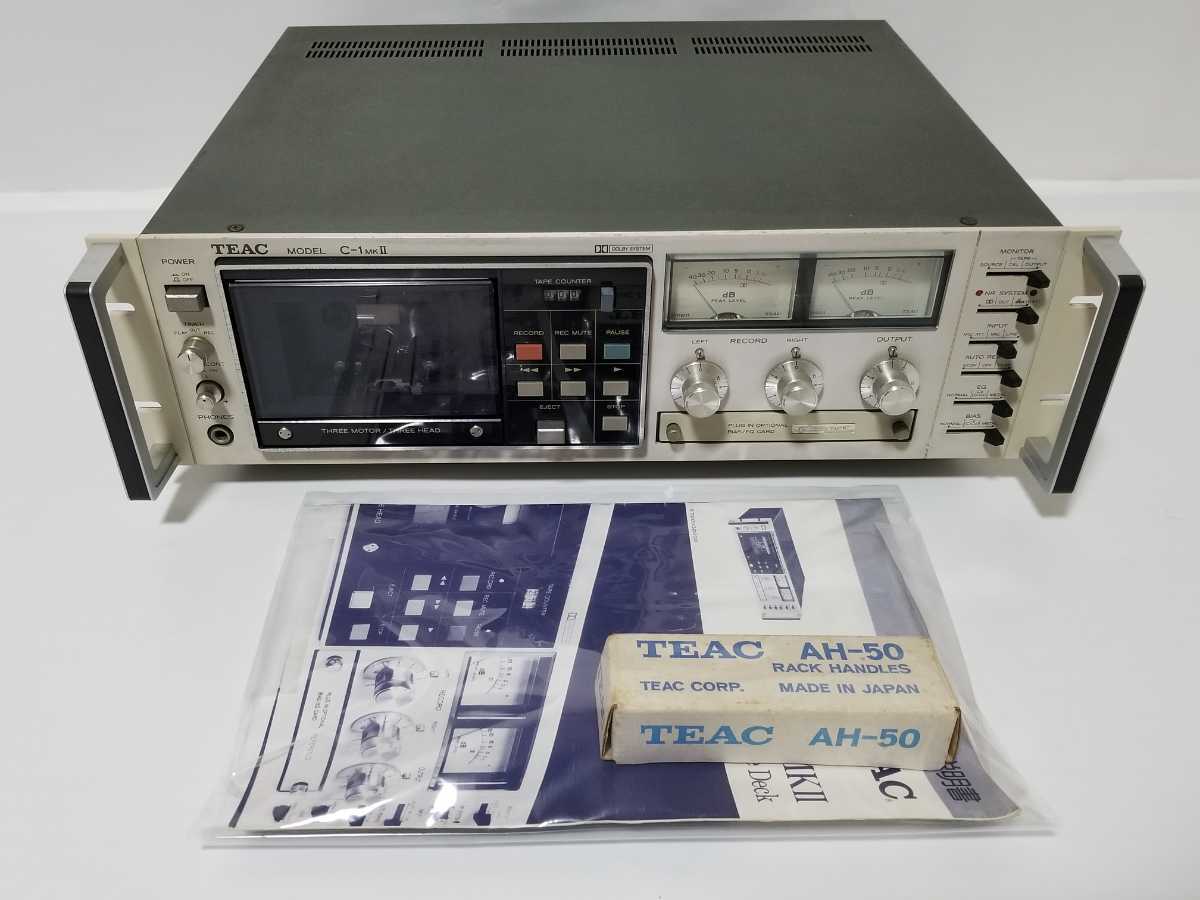

As an eBay Partner, we earn from qualifying purchases. This helps support our independent vintage technology research.
Related Models
- Teac A-103 (1975)
- Teac A-150 (1975)
- Teac A-210 (1975)
- Teac A-2300S (Early) (1978)
- Teac A-250 (1975)
- Luxman L-530 (1975)
- Luxman R-404 (1975)
- Luxman RV-371 (1975)
- Luxman SQ-38U (1975)
- Luxman T-14 (1972)