Teac AS-100 (1972)
A compact integrated amplifier that Teac pitched as the natural companion to its tape decks — and that a lab bench once pushed past its own published ratings.
Overview
The AS-100 was one half of a matched component pair Teac advertised in 1972, the other being the AT-100 stereo FM tuner. The pitch, as it ran in the pages of Audio (April 1972, p.3), was straightforward: Teac built "definitive Dolby equipment" and "professional-quality tape decks," so the separates that carried the name ought to be voiced to match them — components that did more than "merely frequency-demodulate and amplify," and that were "sensibly priced" so a buyer didn't end up "ear-rich and pocket-poor." That same advertisement ran essentially unchanged in High Fidelity (June 1972, p.115) and HiFi-Stereo (January 1972, p.119), which tells you how hard Teac was pushing the pairing. Marketing copy is not a verdict, but it does establish the intent: this was a system amplifier for someone who already owned a Teac deck.
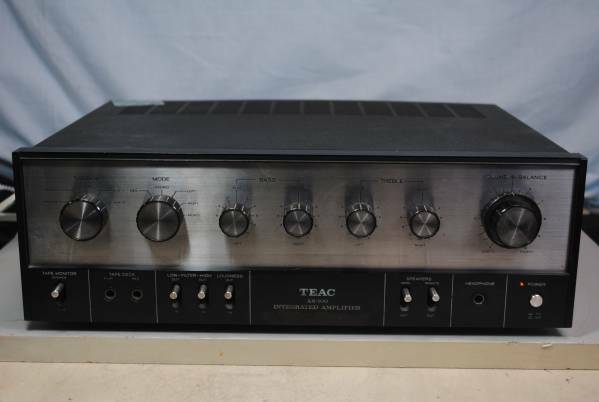
The interesting part is what a test bench found. Writing in Audio (January 1973, p.56), the reviewer noted that the tone-control circuits were of the preferred feedback type, and that beyond the externally accessible speaker fuses, each power amplifier channel carried its own electronic output protection. Those fuses and that protection matter for anyone buying one today — they're the difference between a blown output stage and a blown fuse when something goes wrong downstream.
That same bench run produced the number worth remembering. Teac's published rating was 40 watts per channel at 0.2% THD, but the lab measured mid-band power output of 45 watts per channel with both channels driven before the rated 0.2% THD was reached. Rated IM distortion of 0.2% wasn't hit until just over 40 watts per channel. In other words, the amp had a few watts of genuine headroom above its own spec sheet — not a dramatic margin, but real, and the kind of conservative rating that owners have long reported as a sign of honest engineering rather than marketing arithmetic. The Audio (September 1972, p.41) amplifier directory lumped the AS-100 in with the basic and integrated amplifiers of the day, listing it alongside the Sony 1130 and Superscope A-240 — useful context for where it sat in the market, though the directory entry itself carries no performance data.
Feature-wise, the contemporary new-products notice in HiFi-Stereo (March 1972, p.24) describes the AS-100 as having a loudness control that boosts both low and high frequencies at low volume settings, and it mentions fixed and variable outputs — the variable output being the practical hook for tape users, since it lets the amp feed a recorder at a level the deck can actually use. The same notice references hiss-cancellation circuitry in the context of the matching tuner; treat the amplifier's own noise performance as undocumented rather than assume it.
What the AS-100 is not, at least on the available record, is a heavyweight. It's a modest integrated amp from the early Seventies, built to sit next to a tape deck and drive reasonably efficient speakers, with protection circuitry that has kept at least some of them alive for fifty years. That scarcity cuts both ways: there's no bidding war, but there's also no parts ecosystem. The external speaker fuses are a blessing; the internal electronics are not something to poke at without a schematic. Buy on condition, verify the protection circuits haven't been bypassed by a previous owner, and expect to recap if it hasn't been touched. The AT-100 tuner is the natural partner if one surfaces, but the amplifier stands on its own as a period piece — honest ratings, feedback tone controls, and a lab sheet that says it did a little more than it promised.
eBay Listings
As an eBay Partner, we earn from qualifying purchases. This helps support our independent vintage technology research.