Teac AN-180: The Quiet Master of Passive Preamplification
In the golden era of late 1970s high-fidelity audio, Japanese manufacturers like Teac were rapidly gaining respect among audiophiles for their meticulous engineering, refined build quality, and value-oriented yet performance-driven designs. While Teac is often celebrated for its cassette decks and integrated receivers, the company also produced a line of high-end components under its premium branding—many of which flew under the radar but delivered exceptional performance. Among these hidden gems is the Teac AN-180, a passive preamplifier that stands out for its minimalist philosophy, elegant execution, and enduring appeal to purists.
Released in 1978, the AN-180 was part of Teac’s advanced AN-series, which included companion components like the AN-505 power amplifier and AN-100 tuner. Unlike most preamplifiers of its time—which typically employed active circuitry with voltage gain stages—the AN-180 took a different path: it was a fully passive design, relying solely on precision attenuators and high-quality passive components to manage volume and source selection. This approach eliminated active stages (and their associated noise and coloration), offering a transparent, uncolored signal path prized by discerning listeners.
Technical Specifications
The Teac AN-180 was engineered with simplicity and signal integrity in mind. As a passive preamp, it does not require power and contains no amplification circuitry. Instead, it uses high-grade resistive ladders and robust switching mechanisms to deliver clean, low-distortion signal routing.
| Specification | Detail |
| Model | Teac AN-180 |
| Year of Release | 1978 |
| Type | Passive Preamplifier |
| Power Requirement | None (passive design) |
| Inputs | 4 x RCA (Tuner, Phono, Aux, Tape) |
| Outputs | 1 x RCA (to power amplifier) |
| Volume Control | Dual-gang precision attenuator, 24-step |
| Tone Controls | None |
| Impedance | Not applicable |
| Gain | 0 dB (attenuation only) |
| Construction | Steel chassis, aluminum front panel |
| Dimensions (W×H×D) | 420 × 115 × 305 mm |
| Weight | 4.2 kg (9.3 lbs) |
| Finish | Brushed aluminum, black or silver variants |
The AN-180 features a clean, symmetrical layout with large, knurled aluminum knobs for input selection and volume. The stepped attenuator ensures precise, repeatable volume settings and avoids the inconsistencies common in potentiometer-based designs. Gold-plated RCA jacks were used throughout to minimize oxidation and signal loss, and internal wiring was kept short and direct to preserve signal integrity.
Sound Characteristics and Performance
The sonic signature of the Teac AN-180 is best described as neutral, transparent, and immediate. Without active circuitry, there’s no added noise floor, no phase shift, and no coloration from op-amps or transistors. What you hear is essentially the source—be it turntable, tuner, or tape deck—passed through with minimal interference.
This makes the AN-180 particularly well-suited for high-output sources like modern CD players (or well-gain-matched phono stages) and line-level components. It excels in systems where clarity, speed, and dynamic realism are prioritized over warmth or euphonic coloration. Imaging is precise, soundstage depth is excellent, and low-level detail retrieval is impressive for a component of its era.
However, because it is passive, the AN-180 does not provide gain. This means it must be paired with a power amplifier that has sufficient sensitivity, or with a high-output preamp stage (such as a dedicated phono preamp). It also means that impedance matching between source components and the amplifier becomes more critical—poor matching can lead to high-frequency roll-off or volume limitations.
Notable Features and Innovations
While seemingly simple, the AN-180 embodies several thoughtful design choices that set it apart:
- Stepped Attenuator: Unlike most passive preamps of the time that used potentiometers, the AN-180 employed a precision 24-step rotary switch with discrete resistors. This ensured consistent left/right balance and long-term reliability.
- High-Quality Switching: The input selector used a heavy-duty rotary switch with gold-plated contacts, minimizing signal degradation across sources.
- Minimalist Signal Path: With no tone controls, power supply, or active stages, the signal travels from input to output with only necessary components in its path—ideal for purist audiophiles.
- Build Quality: Housed in a rigid steel chassis with a thick aluminum faceplate, the AN-180 feels substantial and well-damped. It resists microphonics and vibration, contributing to its clean sound.
Teac’s engineering philosophy with the AN-180 was clear: remove everything that doesn’t contribute to the music. In an era when many manufacturers were adding features like loudness controls, graphic equalizers, and multi-band tone stacks, the AN-180 stood as a quiet rebuttal—a return to fundamentals.
Common Issues and Maintenance
Given its passive nature, the Teac AN-180 is remarkably reliable. With no tubes, transistors, or power supply to fail, it has fewer points of failure than most vintage electronics. However, a few issues may arise with age:
- Oxidation on Switches: The input selector and volume switches may develop crackling or channel imbalance due to oxidation. This can usually be resolved with careful contact cleaning using high-quality deoxidizer (e.g., DeoxIT), though disassembly is required.
- Wear on Attenuator Contacts: Over decades of use, the stepped attenuator’s contact points may wear slightly, leading to inconsistent volume steps. Re-lubrication or professional cleaning can restore smooth operation.
- Cable and Connector Degradation: While the RCA jacks are gold-plated, cables and interconnects used with the unit may degrade over time. Using fresh, high-quality cables is recommended for optimal performance.
- Mechanical Wear: The knobs and switches, while robust, may become loose or gritty. Replacing worn bushings or switches (if available) can restore like-new feel.
Because the AN-180 has no circuit board or complex electronics, repairs are typically mechanical rather than electrical—making it a relatively straightforward restoration project for DIY enthusiasts.
Current Market Value and Collectibility
The Teac AN-180 remains a niche but respected piece among vintage audio collectors, particularly those who appreciate minimalist, high-tranparency designs. It is not as widely known as contemporaries from Marantz, Sansui, or Accuphase, but it has developed a loyal following in passive preamp circles.
In today’s market (2024), a fully functional Teac AN-180 in good cosmetic condition typically sells for $150–$250, depending on finish, included accessories, and region. Units with original packaging or documentation may command slightly higher prices. Given its solid build and timeless design philosophy, the AN-180 is unlikely to depreciate further and may even appreciate among purist audiophiles.
It’s particularly sought after in Japan and Europe, where passive preamps have a stronger following. In North America, it’s more of a cult favorite—often discovered by accident by someone restoring a Teac AN-series system.
Conclusion and Legacy
The Teac AN-180 is a quiet masterpiece of minimalist audio engineering. In an age of increasing complexity, it represents a bold commitment to simplicity, transparency, and fidelity. While it won’t suit every system—especially those with low-output sources or amplifiers requiring high input sensitivity—it remains a compelling choice for audiophiles who value signal purity above all.
Its legacy lies not in flashy features or high power output, but in its unwavering focus on the essence of high-fidelity: getting out of the way of the music. For those building a vintage system with a focus on clarity and neutrality, the AN-180 is not just a functional component—it’s a philosophical statement.
Today, as modern audiophiles rediscover the virtues of passive preamplification, the Teac AN-180 stands as an early pioneer—a forgotten gem from a company better known for tape decks, but one that quietly proved Teac could compete at the highest levels of analog design.
eBay Listings


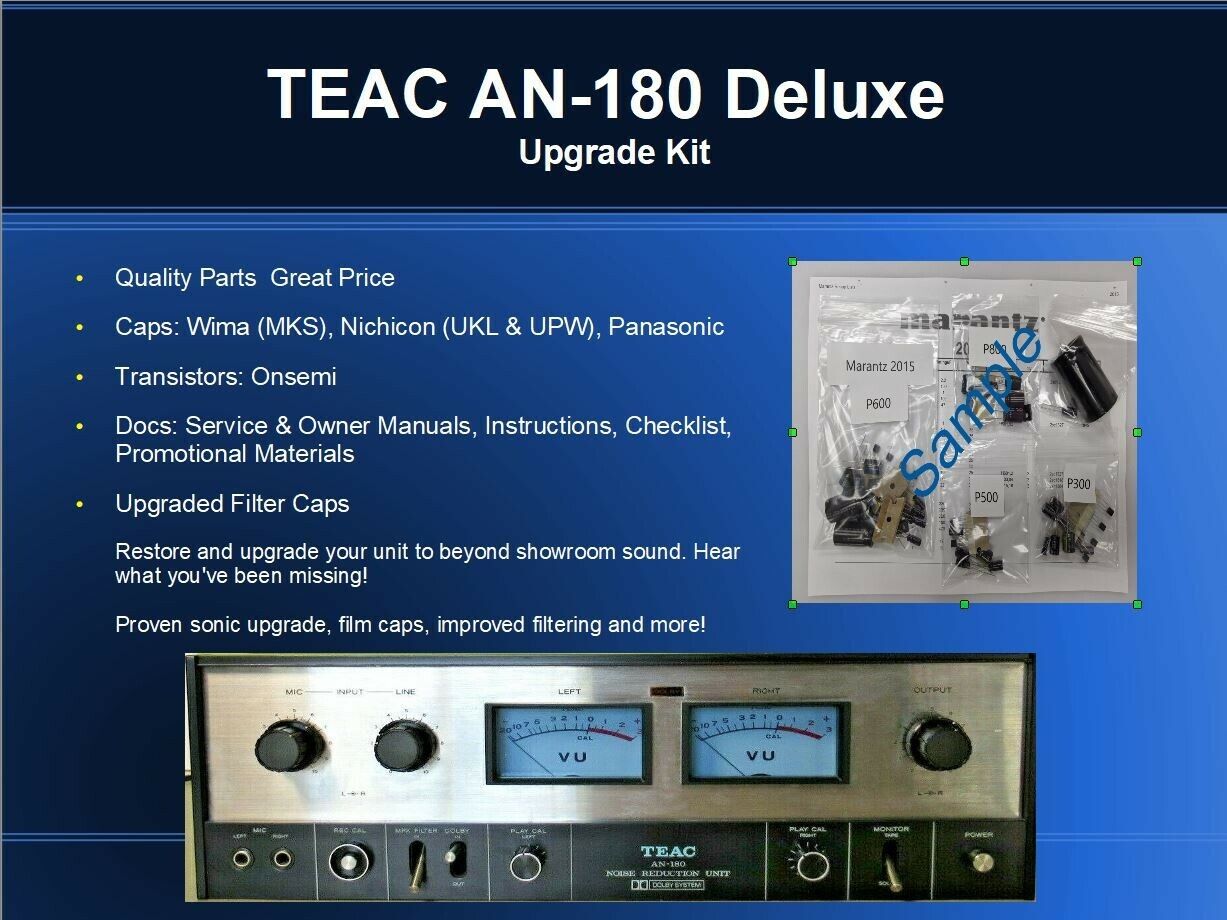

As an eBay Partner, we earn from qualifying purchases. This helps support our independent vintage technology research.
Related Models
- Teac A-103 (1975)
- Teac A-150 (1975)
- Teac A-210 (1975)
- Teac A-2300S (Early) (1978)
- Teac A-250 (1975)
- Luxman L-530 (1975)
- Luxman R-404 (1975)
- Luxman RV-371 (1975)
- Luxman SQ-38U (1975)
- Luxman T-14 (1972)