Teac A-1300
A single-motor Teac deck whose service manual survives better than its reputation. The manual tells you almost everything the marketing never did.
Overview
Not much was ever written about the Teac A-1300, so it's surprising how much of it you can pin down. There's no advertising campaign, no independent test report and no original price. The paper trail that usually anchors a vintage deck page is missing here. What survives is the service manual, and for a machine like this that document is worth more than a brochure. It tells you what the deck is made of, how it was aligned at the factory, and what a technician in 2026 is going to be looking at when the transport comes apart on the bench.
The headline architecture is a single motor. It's a two-speed hysteresis synchronous motor coupled to a belt-drive system, an arrangement that trades brute-force torque for speed stability and simplicity. The motor runs at both 3-3/4 and 7-1/2 ips, and the manual rates speed accuracy at ±0.5%. That's a working figure, not a spec-sheet flourish. It tells you the A-1300 was built for the person who wanted a competent Teac transport without stepping up to the three-motor direct-drive machines further up the line.
Wow and flutter is where the single-motor design shows. The manual gives 0.20% at 7-1/2 ips and 0.25% at 3-3/4 ips, measured to the weighted NAB standard using Teac's own flutter-free test tape. Those numbers won't embarrass anyone recording acoustic guitar and piano, but they're a full order of magnitude away from what a well-sorted three-motor deck delivers. Owners report the A-1300 is a pleasant machine to listen to rather than a forensic one.
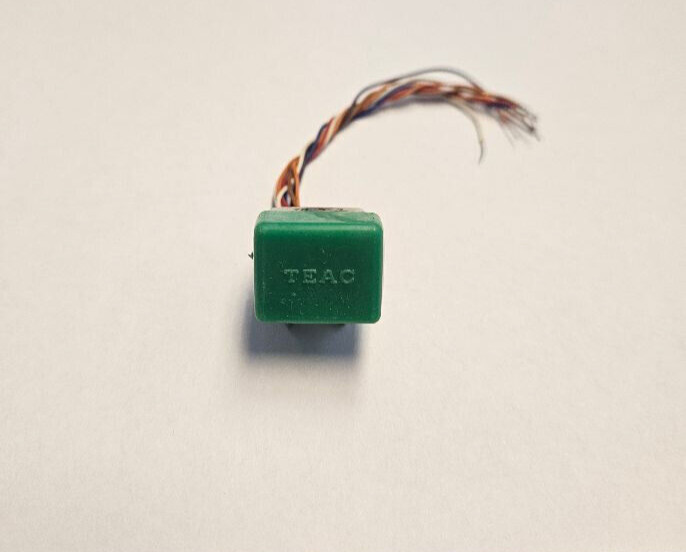
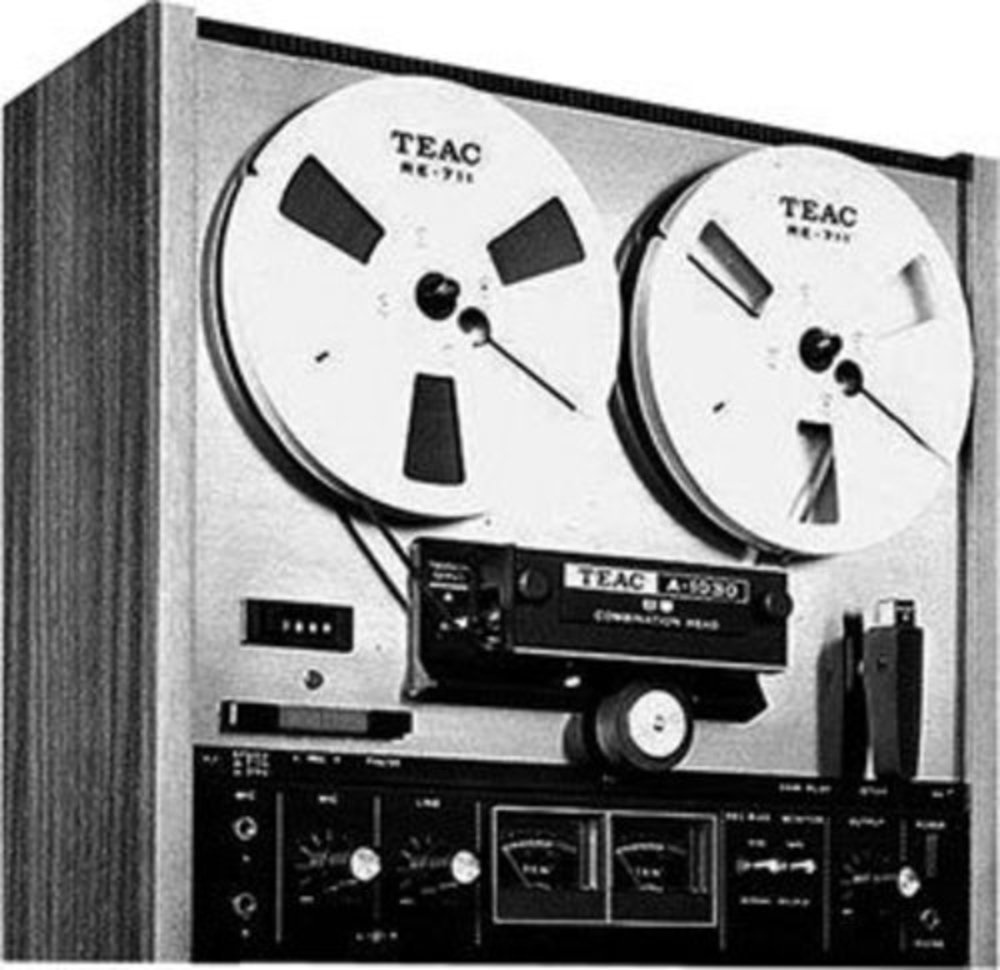
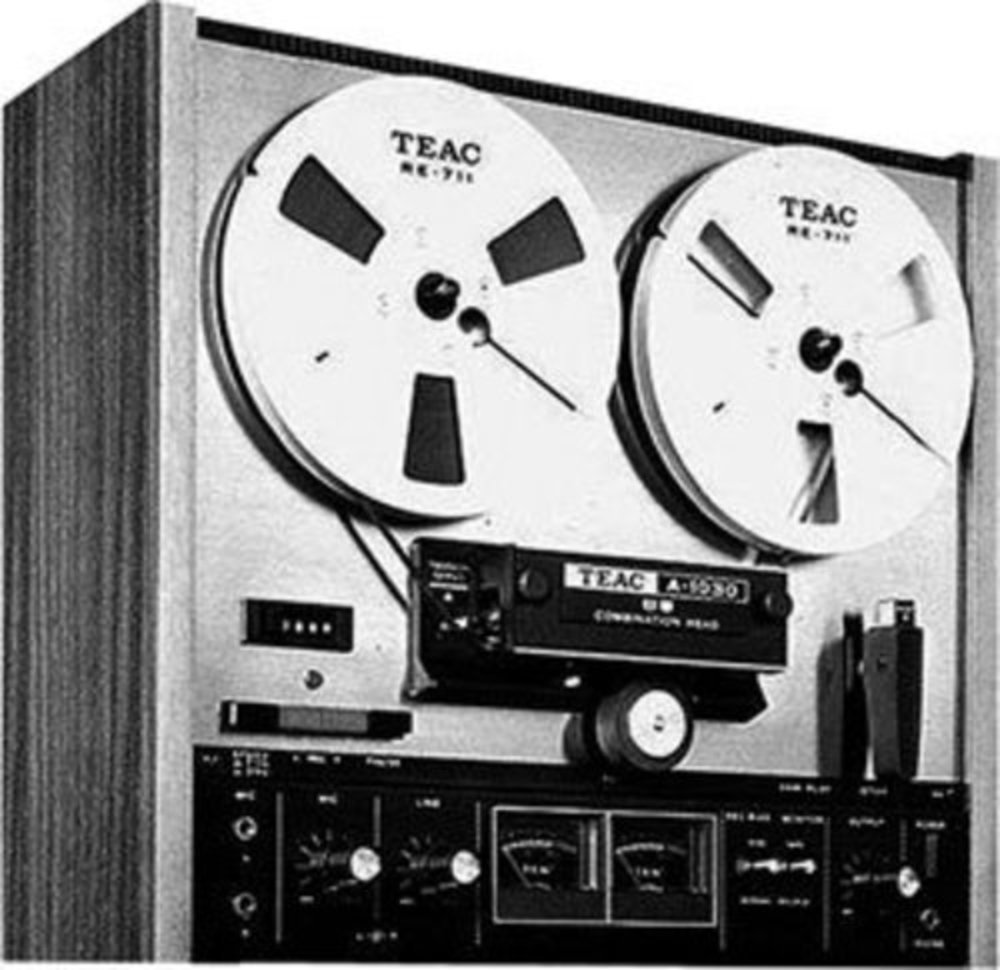
The head complement is the interesting compromise. Teac describes it as a "combination Erase/Record head plus an independent playback head," which the company was careful to frame as providing "all the operating functions of a three head machine." You get separate record and playback amplifiers and the ability to monitor off the playback head while recording, which is the functionally important part. What you don't get is an erase head on its own. That job is folded into the record head assembly. For most users this is invisible. For anyone planning heavy editing or repeated re-recording on the same tape, the erase section is sharing space with the record head.
The electrical specs are period-typical and match the machine's place in the lineup. Signal-to-noise is 48 dB or better at 7-1/2 ips and 45 dB or better at 3-3/4 ips, measured as peak record level to unweighted noise. A separate noise check in the manual puts the figure at -56 dB or less at 7-1/2 and -53 dB or less at 3-3/4 once you factor in bias, erase, and playback amplifier noise together. The two sets of numbers don't contradict each other. They measure different things, and the manual is unusually explicit about that. Crosstalk rejection is rated at 45 dB or better channel-to-channel at 1 kHz, and 35 dB or better for adjacent tracks at 100 Hz. Erase efficiency is 70 dB or better at 7-1/2 ips, with a separate bench procedure that should show -62 dB or more through a 1 kHz band-pass filter.
Inputs and outputs are aimed squarely at a home system. The mic input wants 0.25 mV into 600 ohms, or -72 dB, and the line input takes 0.1 V into 50k ohms at -18 dB. Maximum output is 0.3 V into 10k ohms or better, and the headphone jack is rated 0.3 mW into 8 ohms at -24 dB. Bias comes from a 100 kHz push-pull oscillator, a high bias frequency for the era and well above the audible band. Equalization is 50 µs at 7-1/2 ips and 90 µs at 3-3/4 ips.
Mechanically, the A-1300 takes standard quarter-inch tape on reels up to 7 inches, and Teac rated it for horizontal or vertical operation, which helps if you're stacking a system in a rack or on a shelf. Fast winding is quoted at approximately 210 seconds or less for a 1,200-foot reel. That's leisurely by later standards but normal for a belt-drive single-motor transport. Net weight is 28-3/8 lbs, and the power supply is multi-voltage: 100/117/200/220/240 V AC at 50/60 Hz, drawing 75 W. The multi-tap transformer helps anyone buying a unit from overseas, since no step-down converter is strictly required if the internal taps can be moved.
Internally the deck is a discrete-transistor design, not an op-amp-and-IC affair. The manual lists twenty-two transistors: eight 2SC644(T), eight 2SC828(T), two 2SC828(R), two 2SA666I(S), and two 2SC971(YBL), plus a SIB02-01 silicon stack and an FR2-06 silicon diode. For a repair tech, that's a parts list you can actually work from. Most of these are long-obsolete but substitutable, and there's no proprietary custom IC to source.
The service documentation is unusually thorough for a consumer deck. The manual walks through head assembly removal (loosen the thumb screws on the cover plate, lift it, pull two Phillips screws, slide the assembly off), pinch roller removal, control lever removal, and face plate removal. It warns explicitly to visually check head alignment after reinstalling the head assembly, which suggests the factory knew exactly where the alignment would drift. Azimuth adjustment gets its own procedure with a warning that the effect of turning the screw won't register immediately on the level meter, so the tech has to nudge and wait. Level variation limits are spelled out: 0.5 dB at 400 Hz and 1.0 dB at 10 kHz at 7-1/2 ips, 1.0 dB at 5 kHz at 3-3/4 ips, measured against a Scotch 203 test tape. Overall frequency response checks are run at 15 dB below specified input level to avoid tape saturation, swept 50 Hz to 15 kHz at 7-1/2 ips and 50 Hz to 7.5 kHz at 3-3/4 ips.
The manual also carries an odd quirk for anyone hunting documentation. The general description section refers to the machine as the A-1030 in several places, describing a "precision built combination Erase/Record head plus an independent playback head" and a "single motor tape deck utilizing a two speed hysteresis synchronous motor." That's almost certainly a copy-paste carryover from a sibling model's manual, and it suggests Teac's documentation from this period was assembled from shared boilerplate. Buyers chasing a manual for the A-1300 specifically should expect to see the A-1030 name appear.
As far as the surviving record shows, the A-1300 has no documented independent review, original retail price, or production run. That matters for anyone thinking about buying one. There's no period magazine verdict to lean on, no published list price to anchor a fair offer, and no confirmed production years. The deck exists in the documentation as a serviceable, competent, single-motor Teac. It is not a sleeper classic with a cult following, and it should not be priced like one.
Collectors should treat the A-1300 as a working machine rather than an investment. The value case rests entirely on condition: a clean head assembly, a transport that hasn't eaten its belts, and a motor that still holds speed at both settings. Given the belt-drive design, capstan and drive belts are the obvious wear items. The manual's own emphasis on head alignment after reassembly suggests that any unit which has been apart is worth checking against a test tape before money changes hands. The multi-voltage transformer makes it more attractive to international buyers, and the discrete transistor design makes it more attractive to anyone who repairs their own gear.
eBay Listings
As an eBay Partner, we earn from qualifying purchases. This helps support our independent vintage technology research.
Related Models
- Teac V-2030-S (1975)
- Teac V-480 (1978)
- Teac V-50 (1978)
- Teac V-707-RX (1979)
- Teac 122
- Akai CS-M40R (1983)
- Akai GX-7 (1970)
- Akai GX-8 (1975)
- Akai GX-F44R (1979)
- Akai GX-F71 (1982)