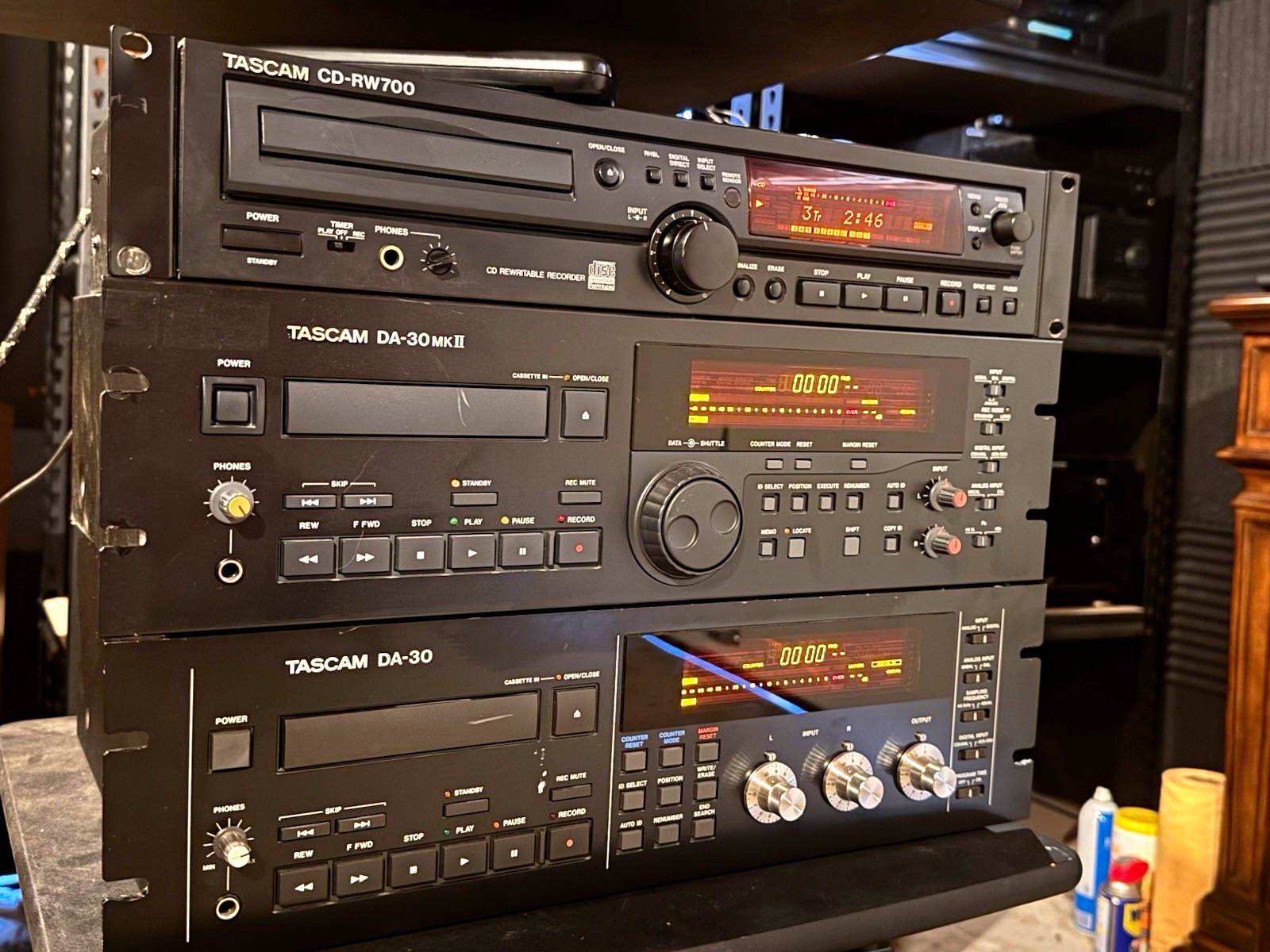
Tascam DA-30
A professional DAT deck that recorded brilliantly and then made enemies of every other machine in the rack.
Overview
The DA-30 was Tascam's first-generation professional DAT recorder. It arrived while the format was still a minefield of copy-protection politics. The deck had 64× oversampling delta-sigma A/D converters and 8× oversampling 18-bit D/A converters. Together they gave a signal-to-noise ratio of more than 94dB. In 1990 the gap between a DAT master and a CD was still narrow enough to argue about. Sampling frequencies of 48kHz, 44.1kHz and 32kHz were all available, with 32kHz recording possible through the digital inputs.
Connectivity is where the DA-30 earned its "professional" label, and where it started causing trouble. The deck offered AES/EBU digital I/O alongside IEC-format coaxial connections. Balanced +4dBm inputs and outputs were on XLR-3 connectors, and unbalanced -10dBv ins and outs were on RCAs. A 15-pin parallel I/O port was onboard for remote control, and the DA-30 shipped with a full-function programmable remote. The front panel had start ID positioning and a headroom margin display that read available headroom in decibels. The main display switched between hours/minutes/seconds, track time, time remaining on the tape, or a numerical tape counter.
The DA-30 is best known for its SCMS behavior. The deck recorded an "11" status code on any recording it made, whether via digital or analog inputs. Unlike the Panasonic SV-3700, it could not be changed. A letter to Recording Engineer described one engineer's problem: mixes made on a DA-30 would not play back on a Sony TCD-D10 Pro, and the Sony would monitor but not record an S/PDIF input carrying the "11" code. The same correspondence noted that the DA-30 would not copy "10" status tracks via its IEC interface. "00" tracks stayed "00" and "11" tracks were upgraded to "10". In IEC mode, then, the DA-30 behaved exactly like an ordinary consumer DAT deck, SCMS and all. Via the AES/EBU interface the deck copied program material on all tracks without difficulty. No start IDs or program numbers were recorded unless Auto ID was engaged, and indexes were not transferred during a digital dub.
The clocking was another known trouble spot. Tapes recorded on almost any other machine would not have their start IDs read correctly by the DA-30. That made it a poor fit for a multi-machine facility. If a tape carried any type of copy flag, the consumer ports refused to make copies at all. The AES/EBU ports sidestepped that restriction entirely. The deck did read and write absolute time code, and it could renumber program IDs and write start and skip IDs manually. But it would not copy program IDs during a digital dub, and it added an SCMS copycode to digital copies.
Mix (September 1990, p.78) covered the DA-30 shortly after its unveiling at the winter NAMM show in Anaheim that January, noting that the deck was greeted with considerable anticipation by dealers and press alike, and highlighting its margin display as a departure from the standard peak-hold metering of the day. A manufacturer document excerpt also listed a retail price of $1,899. A separate Recording Engineer product announcement confirmed the same figure and the same conversion specs — 64× oversampling delta-sigma A/Ds, 18-bit D/As with 8× oversampling, S/N greater than 94dB — along with the AES/EBU I/O, programmable remote, start ID positioning, headroom margin display, and the +4dBm balanced / -10dBv unbalanced connector set.
Even with the status-code problem, the DA-30 was a workhorse. Dealer listings from the period show it sitting alongside the Panasonic SV-3700 as in-stock professional DAT options. Its reputation for reliable transport and clean conversion kept it in service long after its copy-protection quirks became a running joke among engineers. The margin display was a useful feature. It showed working engineers how much headroom remained before clipping, rather than making them interpret a peak-hold bar graph.
The DA-30 recorded well, converted cleanly, and offered the connectivity a professional facility needed. But its fixed "11" status code and its inability to read start IDs from other machines' tapes made it hard to mix with other decks. Collectors today run into varying degrees of SCMS-related frustration with them.
eBay Listings

As an eBay Partner, we earn from qualifying purchases. This helps support our independent vintage technology research.