Tascam CD-RW750
A standalone CD recorder built to pull clean 44.1 kHz masters off anything you can plug into it.
Overview
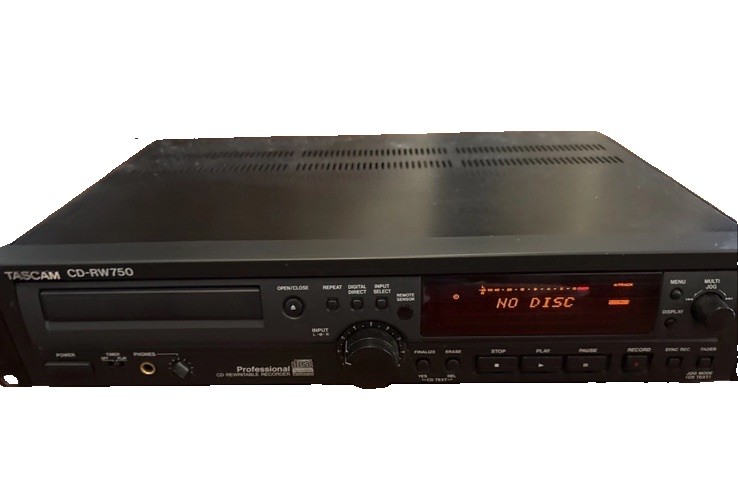
The Tascam CD-RW750 is a CD rewritable recorder. Tascam's own manual lists what it was meant to record from: other CDs, MiniDisc recordings, analog cassettes, and records. That tells you who the machine was for. It is not a computer peripheral and it does not pretend to be one. It is a rack-mount deck that takes whatever analog or digital source you feed it and writes it to a recordable CD, one track at a time or all at once, until the disc is finalized and can go in any ordinary CD player.
The signal path is where the money went. The CD-RW750 has 24-bit digital-to-analog and analog-to-digital converters, which is a serious conversion stage for a device in this class. Tascam provided analog unbalanced inputs and outputs intended for −10 dBV equipment, plus both coaxial and optical digital inputs and outputs for gear that speaks S/PDIF. A lot of consumer CD recorders of the period gave you one flavor of digital input and made you live with it. The CD-RW750 gives you the coax and the optical, so the DAT deck, the CD transport, and the sound card interface can all stay connected at once.
The recording behavior is where the deck earns its keep in a working studio. Track divisions can be entered by hand or generated automatically from input signal level. A recording buffer makes sure the first milliseconds of a track are captured instead of clipped off while the machine reacts. "One-touch" fade-ins and fade-outs over a specified time let you shape the ends of a program without leaving the deck. A multi-function "multi jog" dial handles parameter entry, confirmation, and CD TEXT title entry. A wireless remote control unit is included.
Tascam states one caveat plainly: some models of CD player may be unable to play certain discs produced using the CD-RW750. That comes from consumer CD-R media and player tolerances, not from a defect unique to this deck. It tends to show up when you hand someone a reference disc.
Key Features
Sampling Frequency Converter for Non-44.1 kHz Sources
CDs are locked to a 44.1 kHz sampling frequency, and the CD-RW750 always records and plays back at that rate. Not every digital source arrives at 44.1 kHz, though. Some arrives at 44.1 kHz but played back at a non-standard speed, such as a varispeed unit running more than 1% off standard. The CD-RW750's internal frequency converter handles both cases automatically, resampling the incoming digital stream to 44.1 kHz on the fly. For dubbing from a varispeed-capable deck or a digital source recorded at another rate, that means no stack of error messages.
Digital Direct Mode and Its Deliberate Limitation
Digital direct mode is the purist's option. It bypasses part of the input circuitry - the frequency converter and the digital level control - and writes the incoming digital data straight to disc. The DIGITAL indicator in the display flashes slowly when the mode is engaged. Tascam is explicit about the trade: because the converter is out of the circuit, recording in digital direct is only possible from sources recorded at 44.1 kHz. Try it with a source at any other frequency and the deck throws a "Not Fs44.1k!" error rather than silently resampling. If you want an unaltered digital copy, you get one. If you want convenience, turn the mode off.
Adjustable Trigger Level for Synchronized Recording
Synchronized recording (sync rec) starts the deck automatically when it hears signal. The trigger sensitivity is user-adjustable: −24, −30, −36, −42, −48, −54, −60, −66, and −72 dB. Low numerical values toward −24 mean a louder signal is required to start recording. High numerical values toward −72 mean a relatively quiet signal will do it. The first trap is a slow fade-in: set the threshold too high and the deck will not start until the piece is already underway. The second trap is the analog noise floor. Recording from vinyl, the threshold needs to sit above the base level of hiss, pops, and crackles, or the surface noise triggers a false start.
Tascam also warns about a delay between starting the source and the CD-RW750 responding in sync mode. This comes from the design: the unit stores data in a memory buffer before writing it to disc. The company says it is not a cause for concern, because all audio data received between the start and end points will be recorded.
CD TEXT Titling
The deck writes CD TEXT titles to discs and tracks, and reads them back on suitably-equipped players, itself included. Up to 23 alphanumeric characters, spaces included, fit in a title. The limit is one title per disc and one title per track. The disc title and artist cannot be entered as separate fields, which is a real constraint if you wanted a proper metadata scheme. Titling is a menu operation done through the MULTI JOG control, with the FADER (JOG MODE) key toggling between character entry and cursor movement. Two rules apply: titling can only be done on an unfinalized recordable disc, and the titles only become readable by a player after the disc has been finalized.
Erase, Finalize, and Disc Refresh
The front panel carries dedicated FINALIZE and ERASE keys. Finalize does what it says and doubles as a confirm key when entering CD TEXT data. Erase works on CD-RW discs only. It erases tracks, erases a whole disc, refreshes a "bad" disc, and unfinalizes a finalized disc. That last function is the one that matters most in practice, since a finalized CD-RW can be returned to a recordable state without being thrown away. Erase also serves as the delete key during CD TEXT entry.
Recording Buffer and Sync Behavior
Tascam's documentation mentions the buffer twice. It preserves the opening milliseconds of a track, and it introduces a small, harmless lag in synchronized recording. Both behaviors come from the same design: data is staged in memory before being committed to the disc.
Historical Context
The available documentation for the CD-RW750 is Tascam's own manual material, which describes the deck's capabilities and operating conditions in detail but does not establish a production timeline. No production years have been confirmed for this model, and none should be assumed. The documentation does establish the design brief: a standalone CD rewritable recorder that accepts analog and digital sources from a broad range of consumer and semi-pro equipment, converts them at 24 bits, and commits them to CD-R or CD-RW media at the CD-standard 44.1 kHz rate. The feature set is frequency conversion, digital direct bypass, sync recording with adjustable trigger, CD TEXT, and unfinalize.
The manual also carries a copyright notice. Tascam states that the product is designed to help record and reproduce sound works to which the user owns the copyright or has obtained permission from the copyright holder or rightful licensor. It also states that unauthorized recording, reproduction, or distribution may result in severe criminal penalties under copyright laws and international copyright treaties. The company directs users uncertain about their rights to consult a legal advisor and disclaims responsibility for illegal copying performed with the CD-RW750. That is standard language for the category.
Collectibility & Value
No pricing, market data, or documented failure patterns for the CD-RW750 appear in the available documentation. The manual does document the operating conditions the deck expects. The nominal temperature range is 5°C to 35°C (41°F to 95°F), and Tascam notes the CD-RW750 is more sensitive to extremes of temperature than ordinary CD players. Relative humidity should be 30 to 90 percent, non-condensing. The unit may become hot during operation, so it needs clearance above for ventilation, and it should not be installed in a confined space such as a bookcase. It must sit level. Mount it in a rack tilted 5° or more from vertical and the tray will not open or close.
Tascam gives two maintenance warnings. First, condensation is a hazard if the unit or a disc moves from a cold to a warm place or is used after a sudden temperature change. Vapor can condense on the internal mechanism and make correct operation impossible. The remedy Tascam gives is to leave the player for one or two hours with the power on, then turn the power off and on again. Second, never use commercially available CD stabilizers or printable recordable discs. Tascam states these will damage the mechanism and cause malfunction. It specifically warns against discs that have had a stabilizer mounted, because residual adhesive can cause the disc to stick to the turntable, and then a technician is required to extract it.
For transport, Tascam recommends keeping the original packing materials and always using them, and taping the disc tray closed with an adhesive that will not spoil the finish. The voltage supplied to the unit should match the voltage printed on the rear panel.
eBay Listings



As an eBay Partner, we earn from qualifying purchases. This helps support our independent vintage technology research.