Tannoy 2528 (1975)
That moment when a single driver delivers the whole picture—coherent, centered, and startlingly real.
Overview
The Tannoy 2528 isn’t a speaker you just plug in and forget. It’s a 10-inch Dual Concentric driver—the beating heart of a generation of monitors that refused to compromise. Built in 1975, it was engineered for broadcast and studio environments where clarity and accuracy weren’t just preferred, they were mandatory. And it delivered. So much so that it became a benchmark in audio monitoring, a term not tossed around lightly in those circles. This wasn’t gear for the casual listener; it was for engineers who needed to hear every breath, every string scrape, every subtle phase shift. And they did—through the 2528.
What makes it special isn’t just its pedigree, but its design philosophy. Tannoy didn’t just slap a tweeter on a woofer and call it coaxial. The 2528 uses true Dual Concentric architecture, where the high-frequency section sits physically and acoustically at the center of the low-frequency cone. That alignment means sound arrives at your ears in perfect time and phase, eliminating the off-axis smearing you get with conventional two-way designs. It’s why owners report such a focused soundstage—because the source is literally a single point. You’re not hearing two drivers working in tandem; you’re hearing one unified voice.
And that voice? It’s carried by a 2-inch pepperpot tweeter nested right in the middle, fed by integrated high-frequency horns. The whole assembly rides on a cast aluminum frame with a rubber surround, built to last but not immune to age. It’s an 8-ohm driver, making it relatively easy to pair with vintage or modern amplifiers, and it’s built around a ferrite single magnet—less exotic than alnico, sure, but more stable and cost-effective for its time. The result is a driver that’s both robust and refined, designed to be the centerpiece of serious systems.
It found its way into several iconic Tannoy enclosures: the Ascot T145, Chester T165, Dorset T185, and Mayfair T225—all produced between 1978 and 1982. In those cabinets, the 2528 wasn’t just a component; it was the star. One user described their Ascot speakers with 2528 drivers as “superb to my ears—especially for jazz and vocals.” Another, chasing more bass depth than the factory spec claimed (around 45Hz, though skepticism remains), still valued the “point-source” purity enough to keep pushing the design. Even when bi-amping or adding a ribbon super-tweeter, the core appeal remained: a single driver doing the work of two, cleanly and cohesively.
Specifications
| Driver size | 10 inch |
| Impedance | 8 Ohm |
| Driver type | Dual Concentric |
| Tweeter type | pepperpot tweeter |
| Magnet type | ferrite single magnet |
| High Frequency type | post 1979 |
| High Frequency Size | 2" |
| Outside diameter | approx. 25.5 cm |
| Installation diameter | approx. 22.5 cm |
| Installation depth | approx. 13.5 cm |
| Diagonal hole spacing | approx. 27 cm |
| Frame material | cast aluminum |
| Surround material | rubber |
| Sensitivity | high sensitivity |
Key Features
Dual Concentric Design
The 2528’s defining trait is its Dual Concentric layout—a coaxial design where the high-frequency horn is integrated directly at the center of the low-frequency cone. This isn’t a gimmick; it’s physics in service of fidelity. By aligning the acoustic centers of both drivers, Tannoy ensured that highs and mids arrive at the listener’s ears simultaneously, preserving time alignment and phase coherence. The result? A soundstage that doesn’t collapse when you step off-axis. It’s why engineers favored these in control rooms—what you heard in the sweet spot was reliable, and what you heard outside it didn’t lie.
Pepperpot Tweeter & Integrated Horns
At the core of the high-frequency section is the pepperpot tweeter—a small, dome-like compression driver with a perforated faceplate that gives it its name. It’s fed by integrated high-frequency horns, which help control dispersion and boost efficiency. This design was characteristic of Tannoy’s post-1979 HF units, and in the 2528, it’s paired with a 2-inch throat. The horn loading allows the tweeter to play loud and clean, contributing to the driver’s high sensitivity. It’s not a silky-smooth silk dome; it’s dynamic, immediate, and unapologetically present.
Build & Materials
The 2528 is built like a studio workhorse. The cast aluminum frame provides rigidity and heat dissipation, while the rubber surround offers long-term flexibility without drying out as quickly as older foam types. The ferrite single magnet keeps things stable and avoids the corrosion issues sometimes seen in older alnico designs. It’s a no-nonsense approach: durable materials, precise engineering, and a focus on serviceability. And that matters, because these drivers do age—especially at the edges.
Historical Context
The Tannoy 2528 was born in 1975, a time when broadcast studios and mastering houses demanded accuracy above all. It was designed explicitly for those environments, where a flawed monitor could mean a flawed mix. Its reputation grew quickly—so much so that it became a benchmark in audio monitoring, a standard against which others were measured. It wasn’t just heard in studios; it shaped them.
It’s part of Tannoy’s “Monitor Gold” series, a line that also included 15-inch and 12-inch versions, each tailored for different room sizes and applications. The 2528 brought that same philosophy down to a 10-inch format—compact enough for smaller rooms, but still powerful enough to deliver full-range performance. It wasn’t a downsized compromise; it was a focused evolution of Tannoy’s point-source ideal.
Collectibility & Value
The 2528 is collectible less as a standalone driver and more as a key component in vintage Tannoy systems. Its value today is tied to the condition of the drivers and the availability of service parts. One known failure point is the dustcap: if it’s badly glued, it can allow the bass voice coil to contact the magnet assembly, leading to distorted or “not ok” sound. Another issue is voice coil damage—burning or discoloration from over-powering or DC offset due to a faulty amplifier. These aren’t death sentences, but they’re common enough that repair is part of ownership.
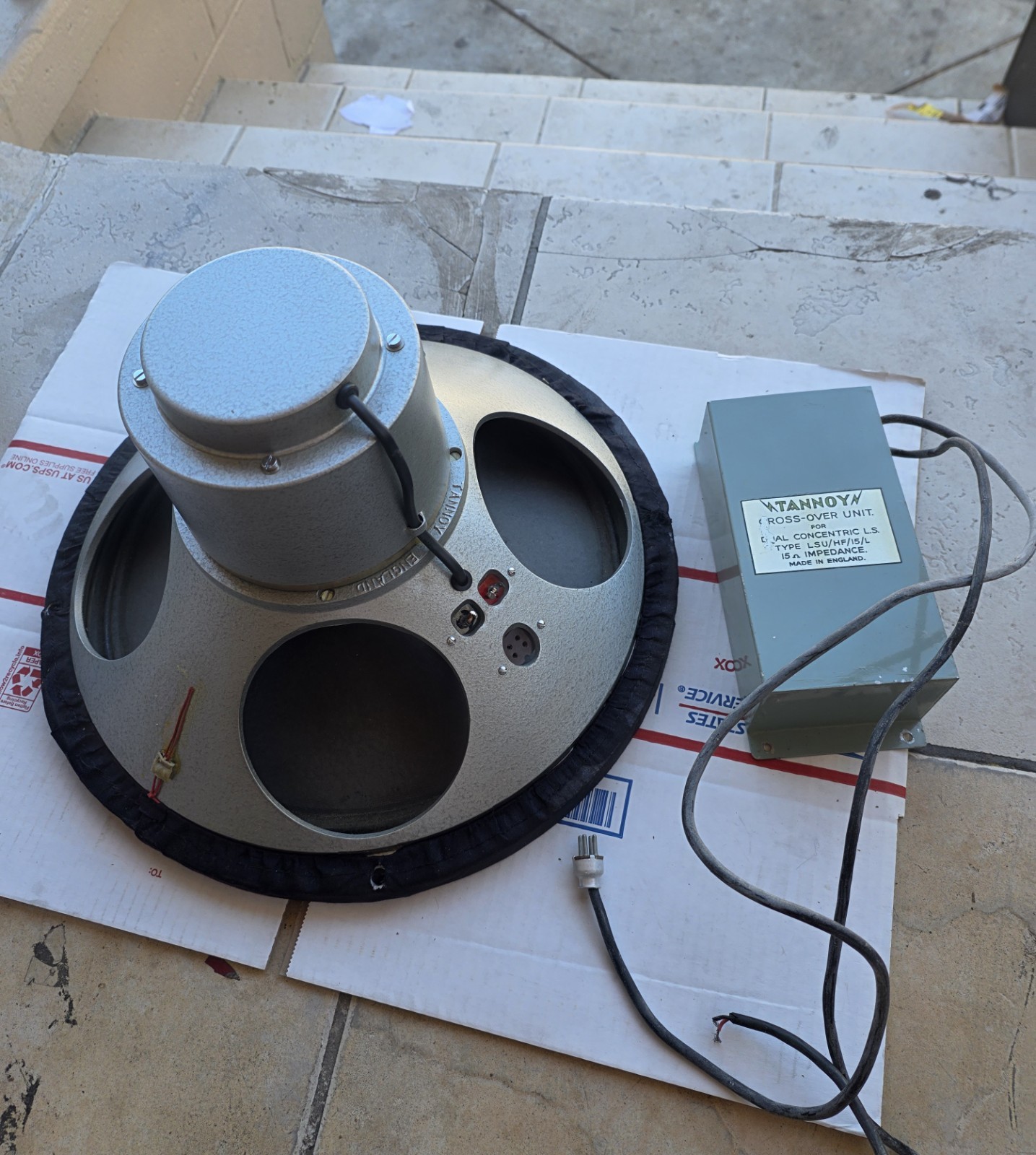
Reconing is a known maintenance path. The bass cone can be replaced and recentered, the coil cleaned and sealed, and the dustcap reattached or swapped. A recone kit exists for the 2528, and a New Old Stock (NOS) genuine Tannoy recone kit was listed for CA$220 on September 24, 2025. That’s not cheap, but it’s a lifeline for drivers that would otherwise be museum pieces. Also available on the market are NOS Tannoy #1004 crossovers—the correct units for systems using the 2528—sometimes sold in pairs, confirming that there’s still active interest in restoring these to spec.
Original pricing and current resale values for the driver itself remain unconfirmed. What’s clear is that functional, well-maintained 2528s in working cabinets—especially Chester or Ascot models—are the real prize. The driver is the soul, but the system is what people pay for.
eBay Listings


As an eBay Partner, we earn from qualifying purchases. This helps support our independent vintage technology research.