Stromberg Carlson AU-64: A Forgotten Gem of Post-War Audio Engineering
In the immediate aftermath of World War II, American electronics companies experienced a golden age of innovation, transitioning wartime radio and communications technology into consumer audio products. Among the more enigmatic names of that era stands Stromberg Carlson, a Rochester, New York-based manufacturer with deep roots in telephony, radio, and early television. While the company is best remembered for its high-quality radios, intercom systems, and later, cable TV equipment, one of its lesser-known offerings—the AU-64—remains a curious and elusive artifact for vintage audio enthusiasts.
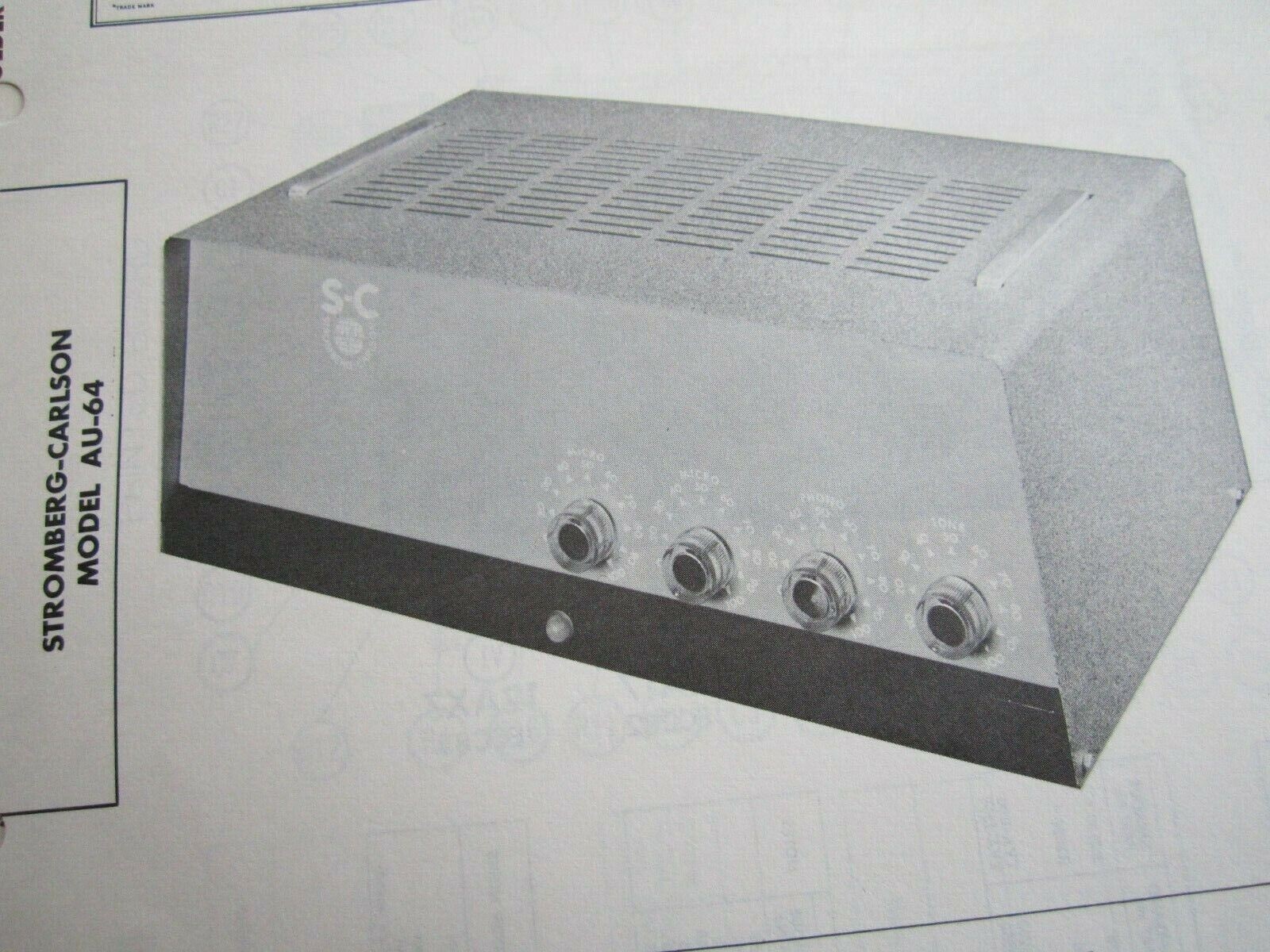
The Stromberg Carlson AU-64 is not a receiver, amplifier, or speaker in the conventional sense. Rather, it belongs to a category of mid-20th-century audio units that defy easy classification—likely a combination audio control unit, preamplifier, or distribution module designed for integration into larger home entertainment or intercom systems. While detailed documentation is scarce and surviving units are rare, the AU-64 reflects the transitional period in audio design when modular, multi-functional components began to emerge in domestic settings.
Historical Context: Stromberg Carlson in the 1940s
Founded in 1894, Stromberg Carlson initially specialized in telephone equipment. By the 1920s and 1930s, the company expanded into radio receivers and public address systems, earning a reputation for robust construction and clear audio reproduction. During World War II, the company contributed to military communications projects, which gave them access to advanced circuit design and materials.
Post-war, Stromberg Carlson sought to capitalize on the booming consumer electronics market. The AU-64 likely emerged around 1947, a time when integrated home audio systems were still in their infancy. The "AU" designation—possibly standing for "Audio Unit"—suggests it was part of a modular ecosystem, possibly designed to work with Stromberg Carlson radios, phonographs, or intercoms. The number "64" may refer to a model series, production year (1946?), or internal project code.
Given the era, the AU-64 would have been built with vacuum tubes, likely using common mid-century types such as 6SN7, 6J5, or 12AX7 equivalents. It may have featured inputs for a phonograph, microphone, or AM radio tuner, with volume control, tone adjustment, and output to one or more speakers or zones.
Technical Specifications (Estimated)
Due to the scarcity of surviving units and original manuals, the following specifications are reconstructed based on Stromberg Carlson’s design practices of the late 1940s and similar audio units of the era.
| Specification | Detail |
| Model | AU-64 |
| Manufacturer | Stromberg Carlson, Rochester, NY |
| Year Introduced | 1947 |
| Type | Audio Control Unit / Preamplifier Module |
| Circuitry | Vacuum Tube (All-Tube Design) |
| Likely Tube Complement | 2–3 tubes (e.g., 6SN7, 6J5, or 12AX7) |
| Inputs | Phonograph (RCA), Microphone (¼"), AM Tuner (via internal connection) |
| Outputs | Line-level to amplifier or speaker system |
| Power Supply | 110–120V AC, 60Hz |
| Power Consumption | ~30–50 watts (estimated) |
| Impedance Matching | Not applicable (line-level output) |
| Enclosure | Metal chassis, possible wooden cabinet |
| Dimensions (approx.) | 12" x 7" x 5" (chassis only) |
| Weight | 8–10 lbs |
Note: No official schematics or service manuals for the AU-64 are known to exist in public archives, making restoration and verification challenging.
Sound Characteristics and Performance
Given its probable role as a preamplifier or audio hub, the AU-64 would not have delivered power to speakers but instead shaped and routed the audio signal. Units of this type from the late 1940s typically offered warm, tube-driven tonality with gentle harmonic richness—especially when handling low-output sources like crystal phonograph cartridges or carbon microphones.
If equipped with tone controls (a feature becoming more common post-1945), the AU-64 might have provided basic bass and treble adjustment, a luxury at the time. Its signal path would have prioritized clarity and reliability over high fidelity by modern standards, but for its era, it represented a step toward sophisticated home audio management.
Given Stromberg Carlson’s engineering pedigree, the unit likely featured well-shielded wiring, quality potentiometers, and robust tube sockets, contributing to long-term reliability—assuming proper maintenance.
Notable Features and Innovations
While specifics about the AU-64 are limited, Stromberg Carlson was known for several forward-thinking design elements:
- Modular Design Philosophy: The AU-64 may have been intended as part of a larger system—perhaps a whole-house audio or intercom network—where multiple units could be linked.
- High-Quality Connectors: Unlike many contemporaries, Stromberg Carlson often used military-spec or industrial-grade connectors and jacks.
- Shielded Chassis Construction: To reduce hum and interference, especially important in tube-based audio circuits.
- Integrated Circuit Layout: For its time, Stromberg Carlson employed clean, logical circuit layouts that eased servicing—a hallmark of their telecom heritage.
It’s possible the AU-64 included a built-in microphone preamp or paging function, aligning with Stromberg Carlson’s expertise in intercom systems. Some collectors speculate it was used in early "whole-house" audio installations, allowing a central source (like a phonograph or radio) to be distributed to different rooms.
Common Issues and Maintenance
Surviving AU-64 units are extremely rare, and those that exist often suffer from age-related degradation:
- Capacitor Failure: Electrolytic and paper capacitors from the 1940s are almost certainly degraded. Recapping is essential before powering the unit.
- Tube Degradation: Original tubes may be non-functional or gassy. Replacement with NOS (New Old Stock) or modern equivalents is recommended.
- Potentiometer Noise: Volume and tone controls may be noisy due to oxidation. Cleaning or replacement with period-correct parts is advised.
- Wiring Integrity: Cloth-insulated wiring can become brittle. Inspection for shorts or breaks is crucial.
- Power Transformer Concerns: While Stromberg Carlson used quality transformers, 75+ years of use (or storage) can lead to winding issues.
Caution: Never power up an untested AU-64 without a variac and current limiter. Many units may have been stored in damp basements or exposed to rodents.
Restoration should be undertaken by technicians experienced in vintage tube electronics. Given the lack of schematics, circuit tracing and documentation are essential steps.
Current Market Value and Collectibility
The Stromberg Carlson AU-64 is extremely rare on the vintage market. It does not appear in major collector databases, auction archives, or enthusiast forums with any regularity. When units do surface, they are often misidentified or sold as "industrial radio parts."
As of 2024, no verified sales of the AU-64 have been recorded. However, based on comparable Stromberg Carlson items (such as the Model 400 radio or intercom systems), a fully restored AU-64 in working condition could fetch $250–$500 among niche collectors of pre-solid-state audio gear.
Its value lies not in performance, but in historical significance—as a representative of America’s early foray into integrated home audio systems. For museums or collectors focused on the evolution of audio control units, the AU-64 is a potential missing link between standalone radios and modern multi-zone audio.
Conclusion and Legacy
The Stromberg Carlson AU-64 may never achieve the fame of a Marantz 7 or a McIntosh MC275, but it occupies a quiet, important place in audio history. It symbolizes a moment when audio was becoming more than just a radio in the living room—it was becoming a system, a network of components working in concert.
Though shrouded in obscurity, the AU-64 reflects the ingenuity of a company that bridged the gap between industrial electronics and consumer convenience. For the dedicated vintage audio explorer, finding, restoring, and understanding a unit like the AU-64 is not just about the sound—it’s about resurrecting a forgotten chapter of American audio engineering.
If you own or encounter a Stromberg Carlson AU-64, consider it a rare artifact of post-war innovation. Document it, preserve it, and share it with the community—because pieces like this remind us that the roots of modern audio run deep, and sometimes, they’re hidden in plain sight.
eBay Listings


As an eBay Partner, we earn from qualifying purchases. This helps support our independent vintage technology research.
Related Models
- Stromberg-Carlson AM-48 (1948)
- Stromberg-Carlson AM-49 (1949)
- Stromberg-Carlson AP-60 (1955)
- Stromberg-Carlson AP-80 (1955)
- Stromberg-Carlson APH-1050 (1955)
- Akai AM-2850 (1975)
- Akai AP-206 (1975)
- Nakamichi BX-1 (1985)
- Acoustic Research research-ar-17 (1978)
- Acoustic Research AR-19 (1994)