Stromberg Carlson AU-63: A Mid-Century American Audio Classic
In the golden age of American radio and the dawn of the home hi-fi era, few names resonated with the public quite like Stromberg Carlson. Known for their innovative radio designs and commitment to quality craftsmanship, the company carved out a niche in the 1940s and 1950s as a trusted manufacturer of consumer electronics and audio equipment. Among their diverse product lineup, the Stromberg Carlson AU-63 stands as a charming example of mid-century audio design—a combination console unit that brought both music and news into the living rooms of postwar America.
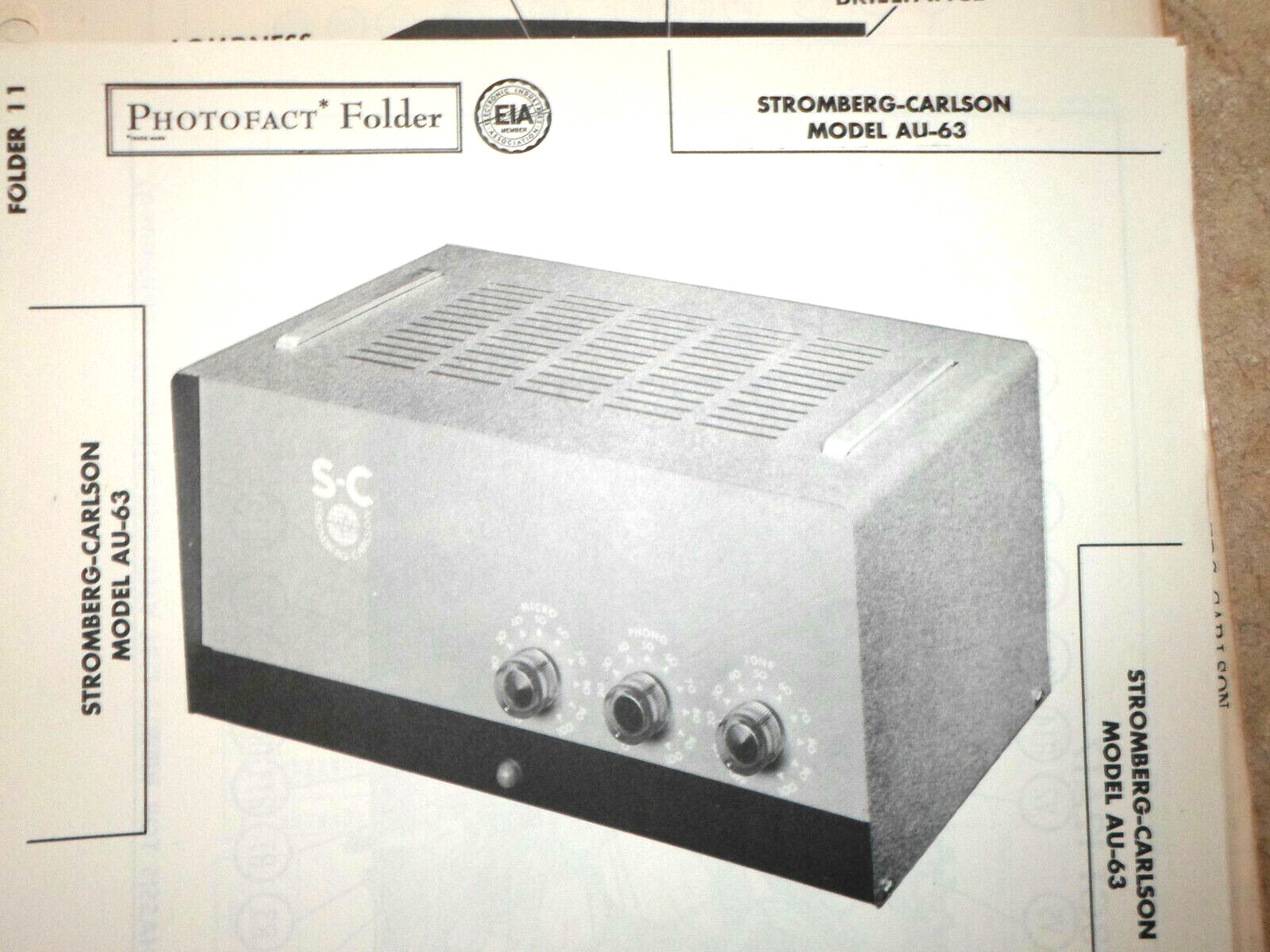
Though detailed technical documentation on the AU-63 is scarce today, its existence fits neatly within Stromberg Carlson’s broader catalog of console radios and phonograph combinations from the early 1950s. The AU-63 was not a standalone amplifier or receiver in the modern sense, but rather a furniture-style console housing an AM radio tuner and a built-in record player—typically a 78 RPM turntable, possibly with provisions for 33⅓ and 45 RPM records as the format transitioned during that era.
Historical Context
The early 1950s marked a pivotal moment in American home entertainment. Television was beginning to rise in popularity, but radio remained a dominant medium for music, news, and serialized dramas. Record players, once luxury items, were becoming more accessible to the middle class. Companies like Stromberg Carlson, Philco, Zenith, and RCA capitalized on this demand by producing elegant console units that doubled as furniture and entertainment centers.
The AU-63, introduced around 1950, was part of this wave. It likely featured a richly finished wooden cabinet—possibly walnut or mahogany—with a cathedral-style or streamlined modern design, typical of the period. These consoles were often placed prominently in living rooms, reflecting both technological pride and domestic taste.
Stromberg Carlson, founded in 1927 in Rochester, New York, began as a manufacturer of telephone equipment before transitioning into radio production. By the 1940s and 1950s, the company was well-regarded for its radio sensitivity and build quality. While not as widely documented as some of its larger competitors, Stromberg Carlson maintained a loyal customer base and a reputation for dependable performance.
Technical Specifications
As a combination radio-phonograph console, the AU-63 integrated several components into one unit. While exact schematics are rare, we can infer its specifications based on typical Stromberg Carlson models of the era.
| Feature | Specification |
| Model | AU-63 |
| Year Introduced | 1950 |
| Manufacturer | Stromberg Carlson |
| Type | Console radio-phonograph combination |
| Radio Bands | AM only (550–1600 kHz) |
| Tuner Type | Analog dial with pointer |
| Speaker Configuration | Single dynamic speaker (6–8 inch) |
| Phonograph Speeds | 78 RPM (likely also 33⅓ and 45 RPM) |
| Turntable Type | Belt or idler drive (common for era) |
| Amplifier Type | Vacuum tube (AC/DC or full AC) |
| Tubes (Typical) | 12SA7, 12SK7, 12SQ7, 50L6, 35W4 (estimated) |
| Power Supply | 110–120V AC, 60 Hz |
| Output Power | ~2–4 watts (estimated) |
| Cabinet Material | Solid wood (walnut or mahogany finish) |
| Dimensions (approx.) | 20" H × 18" W × 10" D |
| Weight | ~25–30 lbs |
The AU-63 likely used an AC/DC tube circuit, common in postwar radios to reduce cost and eliminate the need for a heavy power transformer. This design, while efficient, posed safety risks if not properly maintained—especially in units with "hot chassis" configurations, where the metal frame could become electrically live.
Sound Characteristics and Performance
By modern standards, the audio output of the AU-63 would be considered modest. With a single mid-sized speaker and low power output, bass response was limited, and volume levels were suited to small to medium-sized rooms. However, within its context, the AU-63 delivered clear midrange and articulate AM reception, which was critical for speech and music of the time.
The phonograph, while not high-fidelity by today’s standards, would have provided a warm, analog reproduction of 78 RPM shellac records—often featuring big band, jazz, or classical performances. The tonearm was likely lightweight with a crystal or ceramic cartridge, requiring careful tracking adjustment to avoid record wear.
Despite its technical limitations, the AU-63 offered a cohesive and immersive listening experience for its era. The warm glow of vacuum tubes, the tactile feel of tuning the dial, and the ritual of placing a record all contributed to a sense of engagement that modern digital systems often lack.
Notable Features and Design
The AU-63’s most striking feature was its elegant cabinet design. Stromberg Carlson paid close attention to aesthetics, and the AU-63 likely featured:
- A gracefully curved front panel
- A large analog tuning dial with illuminated frequency scale
- A flip-down or front-loading record storage compartment
- Decorative grille cloth, possibly with embroidered branding
- Built-in record changer mechanism (for stacking 78s)
Some models may have included push-button station presets or automatic turn-off features, though these were more common in higher-end units. The integration of radio and phonograph into a single chassis was itself an innovation at the time, offering convenience and space-saving design.
Common Issues and Maintenance
Today, the Stromberg Carlson AU-63 is a sought-after piece for collectors of mid-century audio and retro furniture. However, restoring one requires caution and expertise:
- Capacitor Deterioration: Paper and wax capacitors degrade over time and can cause hum, distortion, or even damage to tubes. A full recap is essential before powering up.
- Resistor Drift: Carbon composition resistors often increase in value, affecting bias and performance.
- Tube Failure: Tubes should be tested or replaced; NOS (New Old Stock) tubes are often preferred for authenticity.
- Phonograph Wear: The turntable motor, belts (if applicable), and stylus need inspection. Replacement styli for 78 RPM records are rare but available.
- Safety Concerns: Units with hot chassis designs should be restored with isolation transformers or modern safety modifications.
Due to the age of these units, original parts can be difficult to source. However, the Stromberg Carlson community—though small—is active among vintage radio enthusiasts, and cross-compatibility with other brands (like Zenith or RCA) can aid in repairs.
Current Market Value and Collectibility
The AU-63 is not a high-profile model like some Zenith or Philco consoles, but it holds moderate collectible value, especially in fully restored condition. Prices typically range from $150 to $400, depending on:
- Cabinet condition (original finish, no veneer lifting)
- Completeness (original knobs, grille, turntable)
- Working order
- Rarity of the specific model
Units with unique finishes, rare tube configurations, or provenance may command higher prices. As interest in mid-century modern design grows, so does demand for functional vintage audio furniture like the AU-63.
Conclusion and Legacy
The Stromberg Carlson AU-63 may not have been a technological revolution, but it was a faithful companion to American households in the early 1950s. It represents a time when electronics were becoming part of daily life, yet still carried the warmth of craftsmanship and design.
Today, the AU-63 is more than just a relic—it’s a portal to the past, a conversation piece, and a testament to an era when listening to music was a deliberate, cherished act. For collectors, restorers, and lovers of mid-century style, the Stromberg Carlson AU-63 remains a quiet icon of American audio heritage.
eBay Listings
As an eBay Partner, we earn from qualifying purchases. This helps support our independent vintage technology research.
Related Models
- Stromberg-Carlson AU-35 (1955)
- Stromberg-Carlson AU-42 (1947)
- Stromberg-Carlson Stereo Console 200 (1965)
- Luxman PD-272 (1983)
- Garrard 2025tc (1968)
- Onkyo CP-1010 (1976)
- Pioneer PL-15R (1975)
- Pioneer PL-250 (1979)
- Pioneer PL-40 (1977)
- Pioneer PL-514 (1978)