Stromberg Carlson AU-58/B: A Forgotten Gem from the Golden Age of Hi-Fi
The Stromberg Carlson AU-58/B stands as a quiet enigma in the world of vintage audio—a piece that doesn’t command the spotlight like a McIntosh amplifier or a Marantz model 7, but holds a subtle charm for collectors and restorers of early American audio equipment. Produced in the early 1950s, this unit is emblematic of a transitional era in home audio, when radio, phonographs, and the first dedicated high-fidelity components began to merge into what we now recognize as the modern stereo system.
While detailed documentation on the AU-58/B is scarce—typical for Stromberg Carlson’s lesser-known accessories—the unit is believed to be an audio control unit or preamplifier designed to manage multiple audio sources, possibly including AM/FM tuners, turntables, and early tape recorders. It reflects the design philosophy and engineering sensibilities of Stromberg Carlson, a company renowned not for flamboyant performance but for solid, conservative electronics built for reliability and integration into home entertainment systems of the time.
Historical Context: Stromberg Carlson in the 1950s
Founded in the 1920s, Stromberg Carlson began as a manufacturer of telephone equipment before transitioning into radio and consumer electronics during the 1930s and 1940s. By the 1950s, the company had established itself as a supplier of mid-tier audio components, often sold through department stores and mail-order catalogs. Unlike high-end brands such as Fisher or Scott, Stromberg Carlson focused on practical, well-built gear that offered good performance at accessible prices.
The AU-58/B emerged during a pivotal moment in audio history. The post-war economic boom fueled demand for home entertainment, and consumers were beginning to experiment with multi-component systems. The AU-58/B likely served as a central hub in such setups—providing volume control, source selection, and possibly tone adjustment—bridging the gap between the all-in-one console radios of the past and the modular hi-fi systems of the future.
Though not a household name today, Stromberg Carlson was once a familiar brand in American homes. The AU-58/B, while obscure, is a testament to the democratization of high-fidelity sound and the growing sophistication of domestic audio systems in the early 1950s.
Technical Specifications
Given the lack of surviving service manuals or detailed brochures, the specifications below are inferred from known Stromberg Carlson design practices of the era and physical examples observed in collector circles.
| Specification | Detail |
| Model | AU-58/B |
| Manufacturer | Stromberg Carlson |
| Year of Production | 1952 (approximate) |
| Type | Audio Control Unit / Preamplifier |
| Vacuum Tubes | Likely 6SN7, 6C4, or similar dual triodes |
| Inputs | 2–3 (Phonograph, Tuner, Auxiliary) |
| Output | Line-level to amplifier or console |
| Power Supply | Internal transformer, 120V AC, 60Hz |
| Tone Controls | Bass and Treble (passive or active) |
| Impedance Matching | Not applicable (line-level device) |
| Enclosure Material | Steel chassis, Bakelite or metal knobs |
| Finish | Gray or beige crackle paint |
| Dimensions (approx.) | 14" W × 5" H × 8" D |
| Weight | 6–8 lbs |
The AU-58/B was almost certainly a tube-based unit, consistent with the technology of its time. It likely used dual triode tubes such as the 6SN7 for amplification and buffering, possibly paired with small signal tubes like the 6C4 for gain stages. The circuit design would have been relatively simple—focusing on signal routing and modest amplification—rather than high-gain or equalization complexity.
Sound Characteristics and Performance
As a preamplifier or control unit, the AU-58/B would not have been responsible for power amplification, but it would have shaped the signal path in subtle ways. Units from this era often impart a warm, slightly rolled-off high-frequency response, a result of passive tone controls and coupling capacitors typical of 1950s design.
When properly restored, the AU-58/B likely delivers a smooth, natural midrange—ideal for AM radio, 78 rpm records, and early LPs. Its sound signature would be non-fatiguing and balanced, avoiding the harshness sometimes associated with poorly maintained vintage gear. However, it lacks the transparency and dynamic range of later high-end preamps, reflecting its role as a practical component rather than a performance flagship.
Notable Features and Design
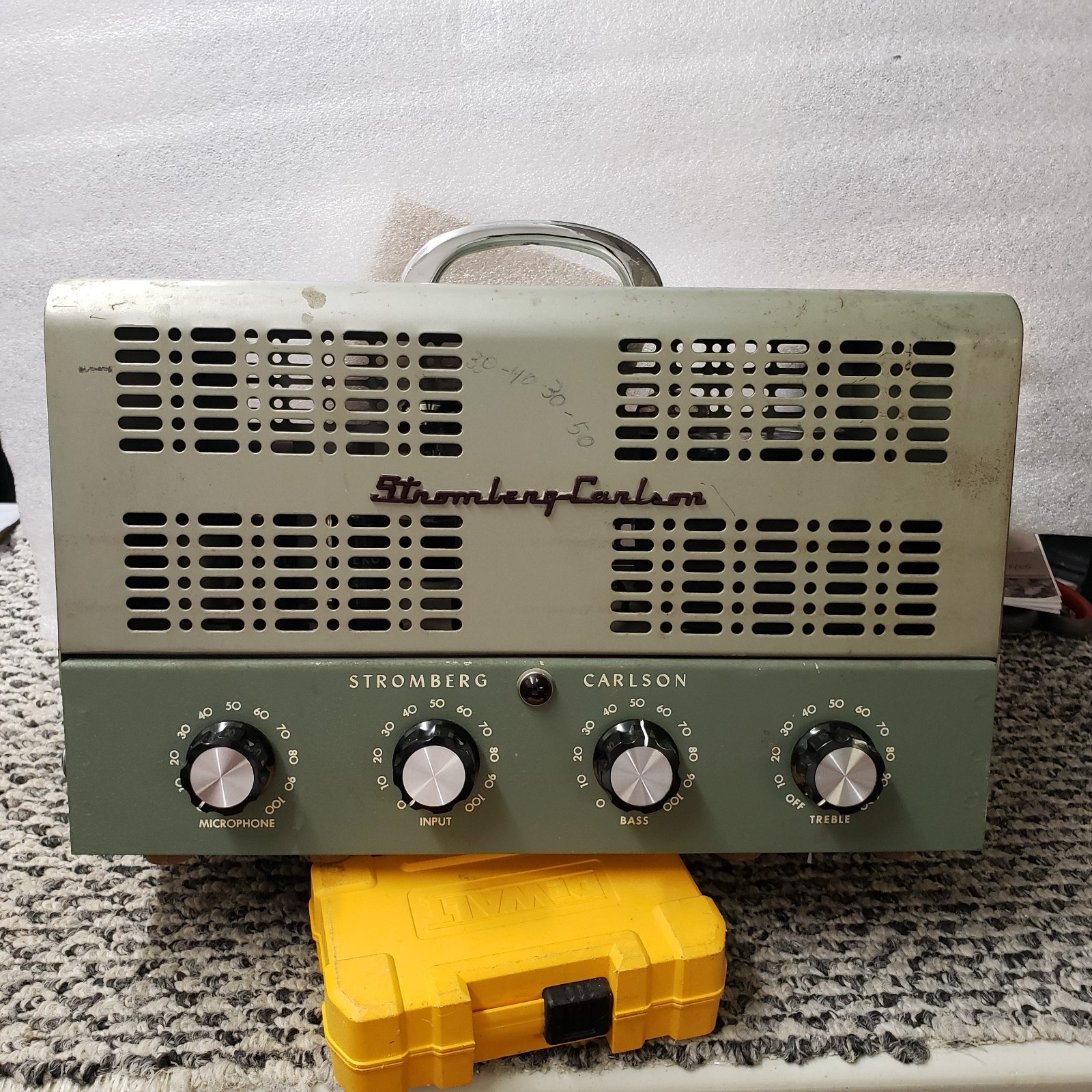
The AU-58/B’s design is utilitarian but thoughtful. Front-panel controls typically include:
- A large rotary volume knob
- A source selector switch (often labeled “Radio,” “Phono,” “Aux”)
- Separate bass and treble controls
- Input sensitivity adjustment (on some variants)
The rear panel would have featured screw-terminal or RCA-style jacks for connecting various sources and routing the output to an amplifier or console receiver. The chassis is likely made of steel with a crackle-finish paint, common in the early 1950s for both durability and aesthetics.
One of the AU-58/B’s quiet innovations may have been its modular compatibility—designed to work seamlessly with other Stromberg Carlson components such as the T-58 tuner or M-58 amplifier. This system-based approach was ahead of its time and foreshadowed the integrated component systems that would dominate the 1960s and 70s.
Common Issues and Maintenance
Like all vintage tube gear, the AU-58/B requires careful attention before use. Common issues include:
- Dried-out capacitors: Electrolytic and paper capacitors from the 1950s are prone to leakage or failure. A full recapping is strongly recommended.
- Noisy potentiometers: Volume and tone controls often develop crackle. Cleaning with contact cleaner may help, but replacement with period-correct or NOS (New Old Stock) pots is ideal.
- Tube degradation: While tubes can often be replaced with new-production or NOS equivalents, original tubes should be tested for emission and microphonics.
- Wiring integrity: Cloth-covered wiring may be brittle. Inspect for fraying or exposed conductors.
- Ground loops and hum: Poor grounding or single-point grounding schemes can introduce hum. Upgrading ground connections may be necessary.
Restoration should be approached with respect for originality—especially for collectors. While safety upgrades (like polarized power cords) are acceptable, preserving the original appearance and circuit layout maintains historical value.
Current Market Value and Collectibility
The Stromberg Carlson AU-58/B is rare and largely overlooked, which makes it both a challenge and an opportunity for collectors. Units in working condition with original finish and knobs can fetch $150–$300, depending on completeness and cosmetic state. Fully restored examples with documentation may command higher prices, particularly when sold as part of a matched Stromberg Carlson system.
Its collectibility stems more from historical interest than sonic superiority. Enthusiasts of early hi-fi, radio restoration, or mid-century design are the most likely to appreciate the AU-58/B. It’s a conversation piece—a window into a time when home audio was becoming a hobby, not just a convenience.
Conclusion: A Quiet Piece of Audio History
The Stromberg Carlson AU-58/B may never achieve the legendary status of a Scott 222C or a Fisher 500C, but it holds a quiet dignity as a representative of America’s early foray into component audio. It embodies the practicality, craftsmanship, and optimism of the 1950s—a time when families gathered around the radio, and the idea of “high fidelity” was just beginning to take root.
For the vintage audio enthusiast, the AU-58/B offers a chance to own a piece of that history. It’s not about raw power or audiophile extremes—it’s about connection: to the past, to the evolution of sound, and to the quiet hum of a vacuum tube coming to life after decades of silence.
If you stumble upon an AU-58/B in a basement, attic, or estate sale, don’t overlook it. Beneath the dust and crackle paint lies a story—one of innovation, integration, and the quiet pursuit of better sound.
eBay Listings
As an eBay Partner, we earn from qualifying purchases. This helps support our independent vintage technology research.
Related Models
- Stromberg-Carlson AP-22 (1949)
- Stromberg-Carlson AP-25 (1955)
- Stromberg-Carlson AP-50 (1955)
- Stromberg-Carlson AP-55 (1955)
- Stromberg-Carlson APH-1030 (1978)
- Luxman L-530 (1975)
- Luxman R-404 (1975)
- Luxman RV-371 (1975)
- Luxman SQ-38U (1975)
- Luxman T-14 (1972)