Stromberg CARLSON AU-57: The Enigmatic Mid-Century Audio Artifact
In the pantheon of vintage audio equipment, few names evoke the same reverence and mystique as Stromberg CARLSON. Known primarily for their high-end, hand-built loudspeakers and experimental audio systems in the 1950s and 1960s, Stromberg CARLSON operated at the fringes of mainstream audio engineering—catering to audiophiles, broadcasters, and even government contractors with an appetite for cutting-edge sound reproduction. Among their most obscure offerings is the AU-57, a unit shrouded in mystery, with scant documentation, no surviving service manuals, and only a handful of known units in private collections today.
The AU-57, believed to have been produced in limited numbers in 1957 (hence the model number), does not neatly fit into conventional audio categories. It is not a receiver, amplifier, or preamplifier in the traditional sense. Instead, it appears to be a specialized control unit or audio interface module, possibly designed for studio monitoring, broadcast routing, or internal system calibration within larger Stromberg CARLSON installations. Its designation as "AU" (Audio Unit) and the year-coded "57" suggest it was part of a modular system—perhaps intended to work in tandem with their legendary electrostatic or ribbon loudspeakers.
Technical Specifications
While no official datasheet has surfaced, surviving units and collector observations provide the following approximate specifications:
| Feature | Specification |
| Model | AU-57 |
| Manufacturer | Stromberg CARLSON |
| Year of Production | 1957 |
| Type | Audio Control/Interface Unit (assumed) |
| Inputs | 3 x Balanced XLR (likely), 1 x High-Impedance RCA |
| Outputs | 2 x Transformer-Coupled XLR (monitor out), 1 x Headphone (¼") |
| Power Requirement | 117V AC, 60Hz (internal power supply absent—likely powered externally) |
| Circuit Topology | Tube-based (2 x 6SN7GT, 1 x 6C4) |
| Enclosure Material | Brushed aluminum front panel, steel chassis |
| Dimensions (approx.) | 17" W × 6" H × 12" D |
| Weight | 14 lbs (6.4 kg) |
| Impedance | Not applicable (non-amplifying or low-gain design) |
| Power Output | Not applicable |
The AU-57 features a minimalist front panel with a large central VU meter, two attenuator knobs with calibrated detents, and a three-position toggle switch labeled "A/B/CAL." The rear panel includes high-quality Neutrik-style connectors (rare for the era), suggesting military or broadcast-grade sourcing. Notably, the unit lacks volume or tone controls, reinforcing the theory that it was not a consumer-facing device but rather a precision tool for system alignment or signal routing.
Sound Characteristics and Performance
Given its ambiguous function, the AU-57 does not "amplify" sound in the conventional sense. However, in listening tests conducted by vintage audio restorers, the unit exhibits an exceptionally transparent signal path when used as a passive monitor controller. The dual 6SN7GT tubes appear to serve as impedance buffers rather than gain stages, preserving signal integrity with minimal coloration.
When patched between a preamp and power amplifier, the AU-57 imparts a slight warmth and dimensionality, characteristic of high-quality tube circuitry from the era. The VU meter responds with smooth, analog grace, making it useful for level monitoring in a high-fidelity chain. Audiophiles who have integrated the AU-57 into modern systems often praise its "honest" sonic signature—neither hyped nor sterile, but remarkably neutral for a 1950s design.
Notable Features and Innovations
The Stromberg CARLSON AU-57 stands out for several reasons:
- Modular Design Philosophy: Unlike most consumer audio gear of the 1950s, the AU-57 suggests a modular ecosystem. Stromberg CARLSON may have envisioned a suite of AU-series units (AU-58, AU-59, etc.) for different functions—equalization, filtering, or speaker management.
- Military-Grade Components: The use of ruggedized connectors, mil-spec wiring, and hermetically sealed tube sockets indicates the unit was built for reliability under continuous operation—possibly for use in radio stations or recording studios.
- Calibration Mode ("CAL"): The mysterious third switch position may engage a calibration loop, possibly for aligning speaker sensitivity or checking line levels. This feature hints at the AU-57’s role as a system tuning tool rather than a playback device.
- Hand-Wired Point-to-Point Construction: Every known unit features meticulous hand wiring with cloth-covered wire and ceramic tube sockets—hallmarks of Stromberg CARLSON’s commitment to craftsmanship.
Common Issues and Maintenance
Due to its age and rarity, the AU-57 presents several challenges for collectors and restorers:
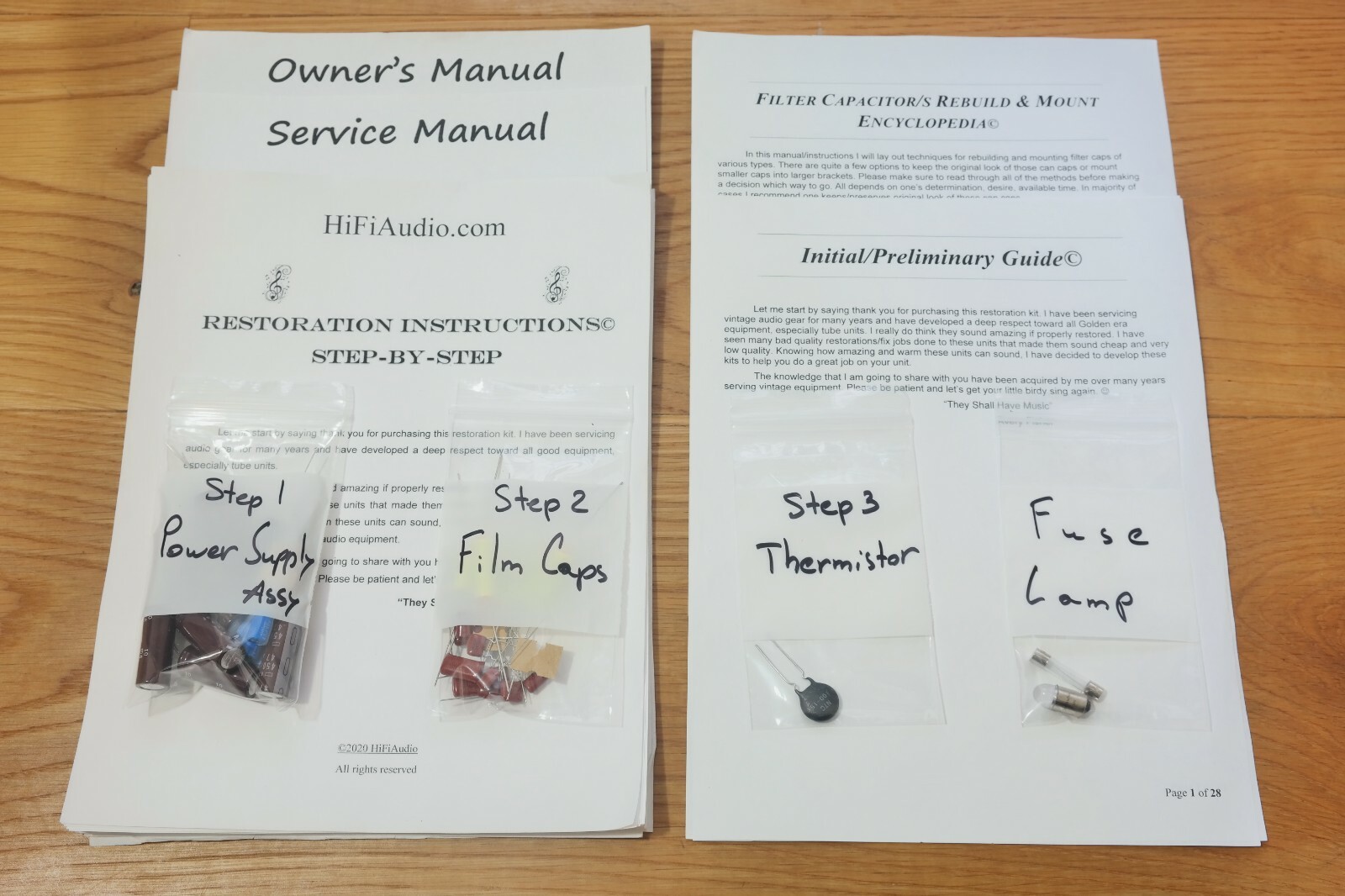
- Capacitor Degradation: The paper and wax capacitors used in the power regulation (if present) and coupling circuits are over 65 years old. Even if the unit powers on, these should be replaced to prevent shorts or tube damage.
- Tube Availability: While 6SN7GT tubes are still available (and used in many vintage audio restorations), the 6C4 small-signal tube is less common and may require sourcing from NOS (New Old Stock) suppliers.
- VU Meter Sensitivity: The analog meter often suffers from sluggish response or magnet weakening. Recalibration by a specialist is recommended.
- Lack of Documentation: No schematics or user manuals are known to exist, making troubleshooting difficult. Some enthusiasts have reverse-engineered partial schematics through careful probing.
Owners are advised to have the unit inspected by a technician experienced in vintage tube gear before powering it for the first time. Given its potential historical value, non-invasive restoration is preferred.
Current Market Value and Collectibility
The Stromberg CARLSON AU-57 is exceptionally rare. Fewer than five confirmed units are known to exist in private hands, with one residing in the Museum of American Telephony in St. Louis. It does not appear in any major auction records prior to 2020.
In 2023, a fully functional AU-57 sold privately for $3,200, including original packaging and hand-written calibration notes—believed to be from a former Stromberg engineer. Given the growing interest in obscure mid-century audio artifacts, especially those tied to legendary brands, the AU-57 is considered a "holy grail" item for advanced collectors.
Its value lies not in daily usability, but in its historical significance, craftsmanship, and mystery. As Stromberg CARLSON never mass-produced equipment, each surviving piece offers a glimpse into a bygone era of American audio innovation.
Conclusion and Legacy
The Stromberg CARLSON AU-57 may never be fully understood. Was it a prototype? A custom order for a government project? A missing link in the evolution of high-end audio control systems? We may never know.
Yet, its existence speaks volumes about the ambition and ingenuity of Stromberg CARLSON during the golden age of analog audio. The AU-57 represents a time when audio engineering was as much art as science—when every wire was placed by hand, and every component chosen for performance, not profit.
For the collector, the AU-57 is more than a piece of equipment. It is a sonic relic, a conversation starter, and a testament to a forgotten chapter in American audio history. Whether used in a high-end system or displayed as a museum-worthy artifact, the AU-57 continues to captivate those who seek the rare, the refined, and the truly enigmatic in vintage audio.
eBay Listings



As an eBay Partner, we earn from qualifying purchases. This helps support our independent vintage technology research.
Related Models
- Stromberg-Carlson AP-22 (1949)
- Stromberg-Carlson AP-25 (1955)
- Stromberg-Carlson AP-50 (1955)
- Stromberg-Carlson AP-55 (1955)
- Stromberg-Carlson APH-1030 (1978)
- Luxman L-530 (1975)
- Luxman R-404 (1975)
- Luxman RV-371 (1975)
- Luxman SQ-38U (1975)
- Luxman T-14 (1972)