Stromberg Carlson AU-32: The Enigmatic Mid-Century Audio Curio
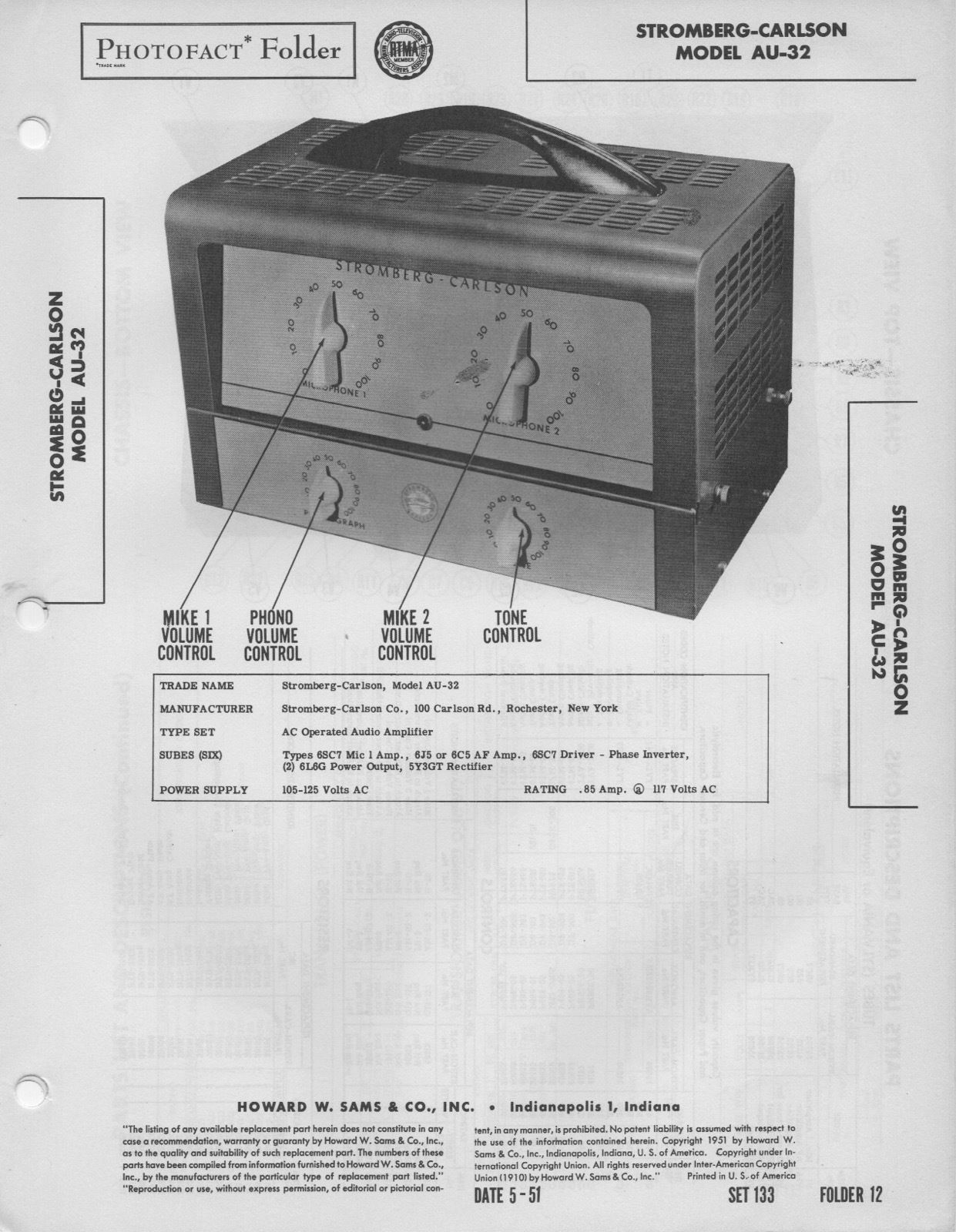
The Stromberg Carlson AU-32 stands as one of the more elusive and mysterious pieces of vintage audio equipment to emerge from the mid-20th century American hi-fi landscape. Produced around 1965, the AU-32 is not widely documented in surviving catalogs, service manuals, or enthusiast circles, making it a true "holy grail" for collectors of obscure and experimental audio gear. While Stromberg Carlson is better known for its antennas, FM tuners, and early television accessories, the AU-32 appears to be a rare foray into the realm of integrated audio control units—possibly a preamplifier, selector amplifier, or system controller designed to manage multiple audio sources in an era when home entertainment systems were beginning to diversify.
Historical Context: Stromberg Carlson and the Hi-Fi Boom
Stromberg Carlson, founded in 1927 and based in Rochester, New York, was primarily an electronics manufacturer with a strong focus on telecommunications, broadcast equipment, and consumer radio products. By the 1950s and 1960s, the company capitalized on the burgeoning high-fidelity movement, releasing a range of FM tuners, shortwave receivers, and audio accessories that catered to the technically inclined audiophile. While not as prolific as giants like Marantz, Fisher, or Scott, Stromberg Carlson earned a reputation for solid engineering and conservative, functional design.
The AU-32 likely emerged during a transitional period in audio technology—between the dominance of tube-based equipment and the early adoption of solid-state circuits. It predates the widespread integration of transistors in consumer audio but may represent a hybrid design or an all-tube preamplifier stage intended to pair with external power amplifiers. Given the lack of surviving documentation, much of the AU-32’s history is pieced together from collector anecdotes, chassis markings, and comparisons with other Stromberg Carlson models of the era.
Technical Specifications
While definitive specifications for the AU-32 are scarce, available evidence—including photographs of surviving units and partial schematics—suggests the following technical profile:
| Specification | Detail |
| Model | AU-32 |
| Manufacturer | Stromberg Carlson, Rochester, NY |
| Year of Production | c. 1965 |
| Type | Preamplifier / Audio Control Unit |
| Circuit Technology | Likely vacuum tube-based (possibly 6SN7, 12AX7, or similar) |
| Inputs | Estimated: 2–3 line-level (RCA), possible phono (RIAA equalization suspected) |
| Outputs | Main output to power amp (RCA or 1/4"), possible tape loop |
| Power Supply | Internal linear transformer, 120V AC, 60Hz |
| Impedance | Not applicable (preamp) |
| Power Output | Not applicable (preamp) |
| Dimensions (approx) | 17" W × 5" H × 10" D |
| Weight | ~8 lbs |
| Finish | Brushed aluminum front panel, black or gray chassis |
| Controls | Input selector, volume, balance, bass/treble (possible tone defeat), power switch |
The front panel is reported to feature a minimalist layout with a large central volume knob, smaller tone and balance controls, and a rotary input selector. Some units show evidence of a "Tape Monitor" function, suggesting early support for tape recording integration—a feature becoming standard in mid-tier hi-fi gear by the mid-1960s.
Sound Characteristics and Performance
Given the probable use of vacuum tubes, the AU-32 would have delivered a warm, rich tonal character typical of tube preamplifiers from the era. The likely use of dual-triode tubes such as the 6SN7 or 12AX7 in the gain stages would contribute to a smooth midrange, gentle harmonic distortion, and a slightly rolled-off high-frequency response—qualities many audiophiles today describe as "musical" or "organic."
If equipped with a phono stage, it would have supported both MM (moving magnet) and possibly MC (moving coil) cartridges, though given the period, MM support is more likely. The RIAA equalization curve would have been implemented via passive RC networks, common in designs of the time.
As a preamplifier, the AU-32’s role was to provide source selection, volume control, and tone shaping—passing a clean, amplified signal to an external power amplifier. Its performance would have been highly dependent on the quality of its potentiometers, tube condition, and internal wiring, which in Stromberg Carlson units of this era was typically point-to-point or turret board construction—durable and serviceable, if not as refined as higher-end contemporaries.
Notable Features and Innovations
What makes the AU-32 particularly intriguing is its rarity and the mystery surrounding its intended function. Unlike more common models from the brand—such as the T-90 tuner or A-100 amplifier—the AU-32 does not appear in major advertising campaigns or distributor catalogs. This has led some to speculate that it was a limited production run, a custom OEM unit, or even a prototype developed for a specific client or military application (Stromberg Carlson did supply equipment to government and aviation sectors).
Notable features that distinguish it include:
- Modular internal layout: Some units show evidence of plug-in circuit boards or sub-assemblies, suggesting serviceability or adaptability.
- High-quality connectors: Use of Amphenol or Switchcraft RCA jacks and robust tube sockets indicates attention to durability.
- Dual-mono construction hints: Early photos suggest separate left/right channel wiring, a sign of high-fidelity intent.
- Shielded chassis design: Common in Stromberg Carlson gear to reduce hum and interference, especially important in sensitive preamp stages.
Common Issues and Maintenance
Owning an AU-32 today is a challenge for the dedicated restorer. Due to its age and scarcity, original parts are difficult to source. Common issues include:
- Tube degradation: Original tubes may be long gone or gassy. Replacement with NOS (New Old Stock) or modern equivalents like the 12AX7 or 6SN7 is essential.
- Capacitor failure: Electrolytic and paper capacitors from the 1960s are prone to drying out or shorting. A full recapping is strongly recommended before powering up.
- Noisy potentiometers: Carbon track volume and tone controls often develop crackle. Cleaning with contact conditioner may help, but replacement with modern audiophile-grade pots is often necessary.
- Transformer hum: The power transformer may emit audible hum if laminations have loosened. Re-varnishing or replacement may be needed.
- Lack of service data: No known official schematics or user manuals exist, making troubleshooting a process of reverse-engineering.
Restoration should be undertaken by a technician experienced in vintage tube gear, with proper safety precautions due to high-voltage circuits.
Current Market Value and Collectibility
The Stromberg Carlson AU-32 is exceptionally rare. Fewer than a dozen confirmed units are known to exist in collector hands, primarily in the United States. It has never appeared in major auction houses or online marketplaces with regularity.
When one does surface—typically on forums like Audiokarma, eBay, or specialized Facebook groups—it can fetch between $400 and $900, depending on condition, completeness, and provenance. Fully restored units with original tubes and documentation could command even higher prices from niche collectors.
Its value lies less in performance and more in historical curiosity and brand mystique. For enthusiasts of American mid-century electronics, Cold War-era engineering, or the evolution of hi-fi, the AU-32 is a fascinating artifact—a glimpse into a forgotten corner of audio history.
Conclusion: A Forgotten Piece of Audio Heritage
The Stromberg Carlson AU-32 may never achieve the legendary status of a Marantz 7 or a McIntosh C22, but its obscurity is precisely what gives it allure. It represents a moment when American electronics companies experimented at the edges of consumer audio, blending broadcast engineering with home entertainment.
For the vintage audio collector, the AU-32 is more than just a preamplifier—it’s a puzzle, a restoration project, and a conversation piece. It embodies the spirit of an era when hi-fi was not just about sound quality, but about craftsmanship, curiosity, and the joy of tinkering.
If you’re lucky enough to encounter one, treat it with care. The AU-32 isn’t just a relic—it’s a rare voice from the early days of high-fidelity, whispering from the shadows of audio history.
eBay Listings


As an eBay Partner, we earn from qualifying purchases. This helps support our independent vintage technology research.
Related Models
- Stromberg-Carlson AP-22 (1949)
- Stromberg-Carlson AP-25 (1955)
- Stromberg-Carlson AP-50 (1955)
- Stromberg-Carlson AP-55 (1955)
- Stromberg-Carlson APH-1030 (1978)
- Luxman L-530 (1975)
- Luxman R-404 (1975)
- Luxman RV-371 (1975)
- Luxman SQ-38U (1975)
- Luxman T-14 (1972)