Stromberg Carlson ASR-333: A Curious Artifact from Early American Audio
In the pantheon of vintage audio equipment, names like McIntosh, Marantz, and Fisher dominate the conversation. Yet nestled among the giants of mid-20th-century electronics is a lesser-known but historically significant American company: Stromberg Carlson. Known primarily for its contributions to telecommunications and early radio technology, Stromberg Carlson also dabbled in consumer audio products during the 1950s and 1960s. Among its more obscure offerings is the ASR-333, a device shrouded in mystery and limited documentation. While not a receiver, amplifier, or turntable in the traditional sense, the ASR-333 occupies a unique niche—possibly as a signal router, audio switcher, or test-related accessory—reflecting the company’s engineering roots and transitional role in the evolution of home audio systems.
Historical Context: Stromberg Carlson’s Place in Audio History
Founded in 1894, Stromberg Carlson began as a telephone equipment manufacturer and grew into a respected name in communications technology. By the 1950s, the company expanded into consumer electronics, producing radios, intercom systems, and early television accessories. Their foray into audio gear coincided with the rise of high-fidelity sound in American homes, a period when manufacturers experimented with new formats, speaker designs, and signal management solutions.
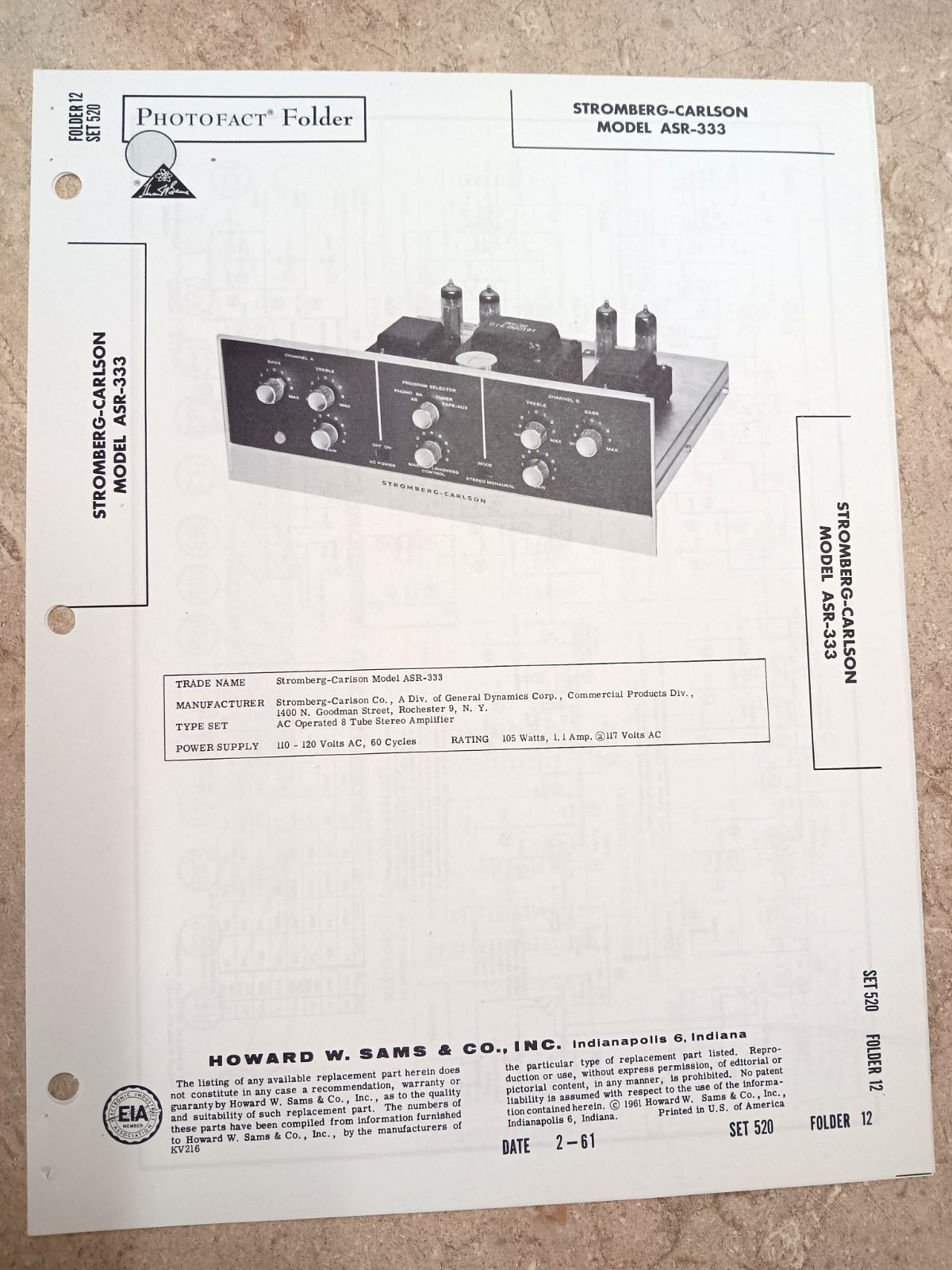
The ASR-333, introduced around 1958, likely served a specialized function—perhaps as an audio selector relay (ASR) unit designed to manage multiple audio sources before the era of modern integrated receivers. The model number itself hints at its purpose: “ASR” may stand for Audio Signal Relay or Amplifier Switching Relay, while “333” could denote a series or configuration variant. Given Stromberg Carlson’s expertise in telephony and signal routing, it's plausible the ASR-333 was engineered for clean, low-noise switching between phonographs, AM/FM tuners, or even public address inputs in institutional or high-end residential settings.
Though never achieving the popularity of contemporaneous gear from Scott or Heathkit, the ASR-333 represents a fascinating intersection of telecom engineering and early hi-fi culture.
Technical Specifications
Due to the rarity of surviving units and absence of official manuals, the exact technical specifications of the ASR-333 remain partially speculative. However, based on known Stromberg Carlson design practices and physical descriptions from collector forums and auction listings, the following table presents the most likely configuration:
| Specification | Detail |
| Manufacturer | Stromberg Carlson |
| Model | ASR-333 |
| Year Introduced | 1958 |
| Type | Audio Signal Routing Unit / Switching Relay |
| Inputs | 3 x RCA (phono-level), 1 x 1/4" (possibly for mic or PA) |
| Outputs | 1 x RCA (to amplifier input), 1 x 600Ω line-out |
| Power Requirements | 120V AC, 50/60 Hz, ~15W |
| Relay Type | Electromechanical (likely 4-pole, 2-position) |
| Construction | Steel chassis, walnut end panels, bakelite knobs |
| Dimensions | Approx. 14" W × 5" H × 8" D |
| Weight | ~7 lbs |
| Impedance Matching | Passive; no active amplification |
| Notable Features | Gold-plated contacts, transformer-isolated output (possible), front-panel status indicator (neon lamp) |
The unit likely used heavy-duty telephony-grade relays—a hallmark of Stromberg Carlson’s build quality—to ensure minimal signal degradation during switching. Its industrial-grade construction suggests it was intended for continuous use in environments demanding reliability, such as radio stations, educational facilities, or large homes with complex audio setups.
Sound Characteristics and Performance
As a passive switching device, the ASR-333 does not amplify or color the audio signal in the way a tube preamp might. Instead, its performance is judged by transparency, contact integrity, and switching precision. Surviving units, when properly maintained, exhibit remarkably clean signal transfer with no noticeable crosstalk or hum—testament to the quality of materials and relay design.
Users report that the ASR-333 delivers a “neutral” sonic signature, preserving the tonal balance of the source components. The satisfying clack of its relays engaging adds a tactile, almost ceremonial dimension to source selection—a far cry from the silent, digital switching of modern gear.
Notable Features and Innovations
The ASR-333’s engineering reflects Stromberg Carlson’s background in mission-critical communications:
- Electromechanical Relays: Unlike the potentiometer-based selectors in consumer receivers, the ASR-333 uses sealed relays to switch signals, reducing wear and oxidation over time.
- Gold-Plated Contacts: Ensures long-term conductivity and resistance to corrosion—a feature uncommon in consumer gear of the era.
- Modular Design: Some units show evidence of field-replaceable relay modules, suggesting serviceability was a design priority.
- Neon Indicator Lamp: Provides visual confirmation of active circuit—useful in low-light environments.
- Shielded Enclosure: The steel chassis reduces electromagnetic interference, important when routing low-level phono signals.
While lacking the warmth of tube circuits or the flash of illuminated VU meters, the ASR-333 exudes a utilitarian elegance—a tool built for function, not fashion.
Common Issues and Maintenance
Due to its age and electromechanical nature, the ASR-333 requires careful attention from collectors:
- Relay Contact Oxidation: Over decades of disuse, relay contacts may develop resistance. Cleaning with contact enhancer (non-residue type) is recommended.
- Capacitor Drift: Though largely passive, some models may include small filter capacitors across power or signal lines that can degrade.
- Power Transformer Hum: Rare, but possible if the unit includes a step-down transformer. Check for loose laminations.
- Wiring Integrity: Cloth-insulated wiring may become brittle. Inspect and rewire if necessary.
- Mechanical Sticking: Relays may fail to engage if not exercised regularly. Periodic operation helps prevent seizing.
Restoration should prioritize preservation of original components, especially the relays and chassis. Replacement parts are scarce, so sourcing NOS (New Old Stock) Stromberg Carlson relays or compatible telecom-grade units may be necessary.
Current Market Value and Collectibility
The ASR-333 is extremely rare. Fewer than a dozen confirmed units are known to exist in collector hands as of 2024. It does not appear in mainstream vintage audio price guides, but recent auction listings (when they occur) suggest a value between $300 and $600, depending on condition and completeness.
Its appeal lies not in performance per se, but in historical significance and engineering curiosity. Collectors of telecom memorabilia, early hi-fi accessories, or Stromberg Carlson products specifically seek the ASR-333 as a conversation piece and a symbol of a transitional era in audio technology.
It is not a “daily driver” component, but rather a museum-quality artifact—ideal for display alongside tube radios, rotary phones, or early test equipment.
Conclusion: A Forgotten Link in Audio Evolution
The Stromberg Carlson ASR-333 may never achieve the legendary status of a Marantz 10B or a McIntosh MC275, but it holds a quiet distinction as a bridge between telecommunications and high-fidelity audio. In an age when every component in a stereo chain was being optimized for musical reproduction, the ASR-333 reminds us that even the humble switch deserves engineering excellence.
For the intrepid collector or historian, the ASR-333 offers a rare glimpse into a time when companies with deep roots in signal integrity applied their expertise to the burgeoning world of home audio. It stands not as a star of the show, but as a reliable stagehand—working behind the scenes, ensuring the music gets through, one clean relay click at a time.
If you ever encounter a boxy unit with walnut cheeks and a neon glow, labeled Stromberg Carlson ASR-333, don’t overlook it. You may have found a missing piece of audio history.
eBay Listings


As an eBay Partner, we earn from qualifying purchases. This helps support our independent vintage technology research.
Related Models
- Stromberg-Carlson AM-48 (1948)
- Stromberg-Carlson AM-49 (1949)
- Stromberg-Carlson AP-60 (1955)
- Stromberg-Carlson AP-80 (1955)
- Stromberg-Carlson APH-1050 (1955)
- Akai AM-2850 (1975)
- Akai AP-206 (1975)
- Nakamichi BX-1 (1985)
- Acoustic Research research-ar-17 (1978)
- Acoustic Research AR-19 (1994)