Stromberg-Carlson AR-425: A Mid-Century Audio Console Classic
In the golden era of American hi-fi, when home entertainment meant craftsmanship, wood veneers, and vacuum tubes, Stromberg-Carlson stood as a respected name in communications and consumer electronics. While not as widely remembered today as RCA or Philco, the Rochester-based company produced a range of high-quality audio consoles during the 1950s, and the Stromberg-Carlson AR-425 is a standout example of their integrated design philosophy. More than just a radio or record player, the AR-425 was a complete living room audio solution—an elegant console that combined AM/FM radio, a built-in phonograph, vacuum tube amplifier, and dynamic loudspeakers, all housed in a beautifully crafted wooden cabinet.
Though detailed factory documentation on the AR-425 is scarce today, surviving units and collector knowledge place it firmly in the mid-1950s, around 1955. It was marketed during a time when families gathered around console radios as their primary source of music and news. The AR-425 reflects Stromberg-Carlson’s engineering heritage—originally a telephone and telegraph equipment manufacturer—which lent a precision and reliability to their audio products that set them apart from flashier competitors.
Technical Specifications
| Feature | Specification |
| Manufacturer | Stromberg-Carlson |
| Model | AR-425 |
| Year Introduced | 1955 |
| Type | Console Radio-Phonograph System |
| Tuner Bands | AM, FM |
| Tuning Mechanism | Analog dial with station window |
| Phonograph | Built-in turntable, 78/45/33 1/3 RPM |
| Tonearm | Manual, straight aluminum or steel |
| Cartridge Type | Ceramic (typical for era) |
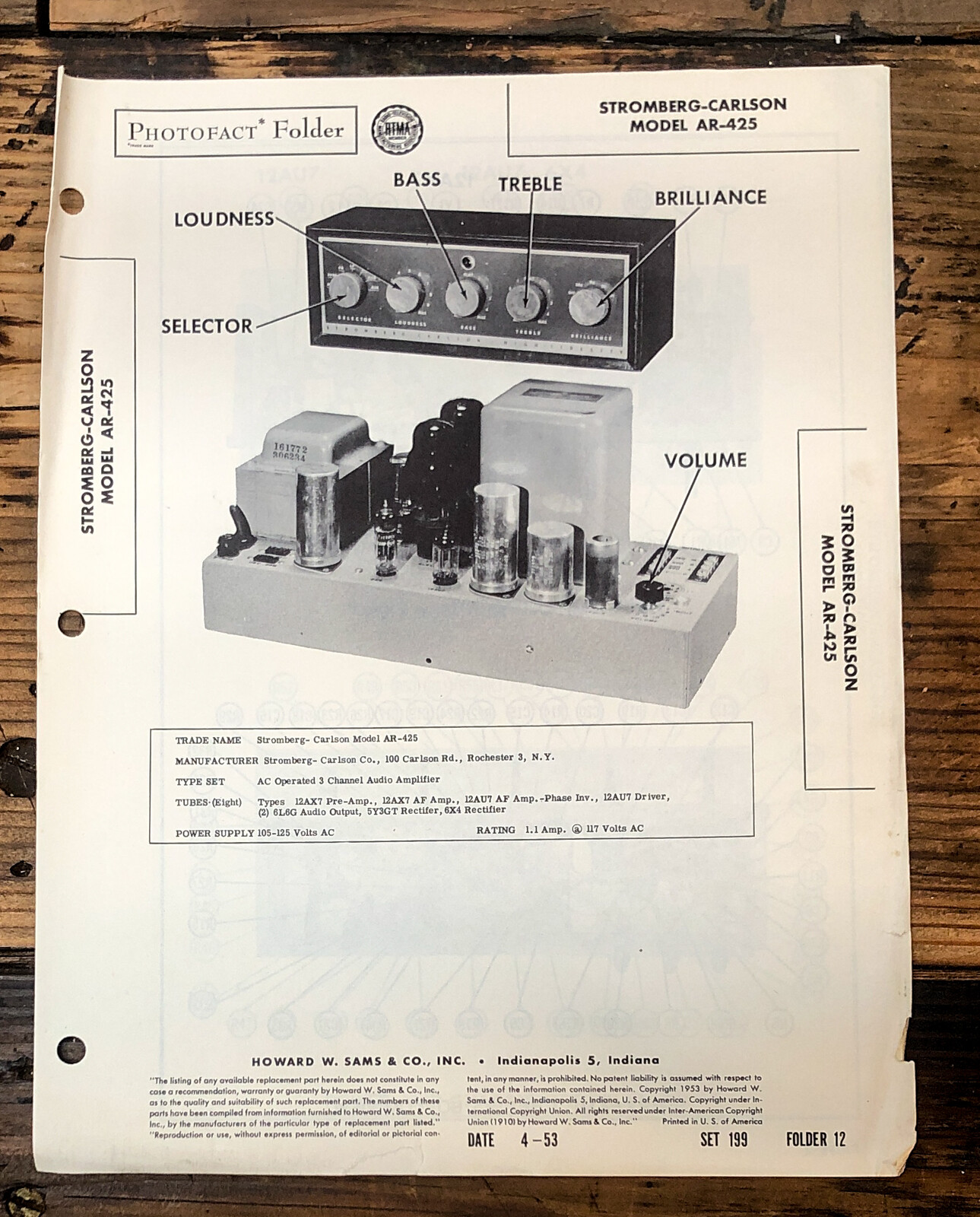
| Amplifier | Vacuum tube-based, push-pull output stage |
| Output Power | Estimated 8–12 watts (RMS, total) |
| Speaker Configuration | Dual dynamic speakers (full-range) |
| Cabinet Material | Solid wood (walnut or mahogany finish) |
| Dimensions (approx.) | 24" H × 20" W × 14" D |
| Weight | ~45 lbs (20.4 kg) |
| Power Requirements | 120V AC, 60 Hz |
| Inputs | None (all-in-one system) |
| Finish Options | Walnut, dark mahogany (varies by unit) |
Sound Characteristics and Performance
The AR-425 delivers the warm, rounded sound signature typical of mid-century vacuum tube electronics. Its AM/FM tuner offers clear reception by the standards of the 1950s, with smooth tracking across the dial—though modern listeners may notice limited stereo separation and frequency extension compared to today’s equipment. The FM band, while a novelty at the time, provides surprisingly decent fidelity, especially for classical and jazz broadcasts of the era.
The built-in phonograph supports all three standard record speeds: 33⅓, 45, and 78 RPM, making it a versatile player for vintage vinyl collections. However, it uses a ceramic cartridge and lacks the precision of modern magnetic cartridges, resulting in higher tracking force and reduced detail retrieval. The sound is full-bodied and forgiving—ideal for shellac 78s and early LPs, but audiophiles should expect noticeable surface noise and limited high-frequency clarity.
The tube amplifier—likely using a combination of 6SJ7, 6SK7, and 6V6GT or similar tubes—drives a pair of medium-sized dynamic speakers mounted within the cabinet. The speakers are typically 8-inch full-range units with felt dust caps, designed more for vocal clarity and midrange presence than deep bass or extended highs. The overall sonic profile is smooth, slightly mid-forward, and highly listenable for background music or vintage radio programs.
Notable Features and Innovations
What made the Stromberg-Carlson AR-425 special was its integration and aesthetic appeal. Unlike component systems that required separate purchases, the AR-425 offered everything in one elegant package. Its large, easy-to-read tuning dial, illuminated station window, and polished wood cabinet made it a centerpiece in any living room.
One of the more refined aspects of Stromberg-Carlson’s design was their attention to circuit layout and shielding. Compared to some contemporaries, the AR-425 exhibits relatively low hum and interference, a testament to the company’s telecom engineering roots. The use of quality potentiometers and switches also contributed to a longer service life than many mass-market consoles.
The AR-425 often featured a dual-level speaker system: a main speaker for music and a secondary “voice” speaker optimized for speech clarity—ideal for news and talk radio. Some units also included a mechanical record changer capable of playing multiple 45s or 78s in sequence, a convenience feature popular before the rise of stereo LPs.
Common Issues and Maintenance
Like all vintage electronics of its age, the Stromberg-Carlson AR-425 requires careful maintenance to operate safely and reliably. The most critical concern is the capacitor plague—paper and electrolytic capacitors from the 1950s are prone to drying out, leaking, or shorting, which can damage transformers or cause overheating. A full recap (replacing all capacitors) is strongly recommended before powering up a long-dormant unit.
Vacuum tubes should be tested or replaced if noisy, microphonic, or weak. Common tubes in these consoles include 6SA7 (converter), 6SK7 (IF amplifier), 6SQ7 (detector), and 6V6GT (audio output). NOS (New Old Stock) tubes are still available, but modern equivalents work well.
The phonograph mechanism, often based on a spring-driven or gear-reduction motor, may suffer from worn belts (if applicable), stiff linkages, or dried lubricants. The tonearm pivot can become sticky, and the stylus (if original) will almost certainly need replacement—modern elliptical ceramic or magnetic cartridges can be retrofitted for better tracking and sound.
Wood cabinets, while beautiful, may show wear, scratches, or finish degradation. Cleaning with a soft cloth and furniture wax suitable for vintage wood is recommended. Avoid harsh polishes that can damage original finishes.
Current Market Value and Collectibility
The Stromberg-Carlson AR-425 is a rare and increasingly collectible piece. While not as widely sought after as a Zenith Trans-Oceanic or a Motorola high-fidelity console, it holds strong appeal among mid-century modern enthusiasts, radio collectors, and vintage audio restorers.
Surviving units in good cosmetic and working condition typically sell between $400 and $800, depending on cabinet quality, functionality, and originality. Fully restored models with upgraded electronics and modern safety modifications can command higher prices, especially if sold as "plug-and-play" vintage furniture with audio functionality.
Its collectibility is enhanced by its relative obscurity—Stromberg-Carlson produced fewer units than giants like RCA, making the AR-425 a hidden gem for those who appreciate understated elegance and solid engineering.
Conclusion and Legacy
The Stromberg-Carlson AR-425 is more than a relic—it’s a time capsule of 1950s American home life. It represents an era when electronics were built to last, designed to complement home decor, and valued for their craftsmanship as much as their performance. While it won’t compete with modern hi-fi systems in terms of fidelity or features, its charm, warmth, and historical significance make it a rewarding addition to any vintage audio collection.
For the restorer, the AR-425 offers a satisfying project with tangible results. For the collector, it’s a conversation piece that blends form and function. And for the nostalgic listener, it delivers the authentic sound of mid-century radio and vinyl—complete with the soft glow of vacuum tubes and the gentle crackle of a well-loved record.
In a world of digital perfection, the Stromberg-Carlson AR-425 reminds us that sometimes, the most beautiful sound is the one that comes with a little warmth, a little hum, and a lot of history.
eBay Listings

As an eBay Partner, we earn from qualifying purchases. This helps support our independent vintage technology research.
Related Models
- Stromberg-Carlson AP-22 (1949)
- Stromberg-Carlson AP-25 (1955)
- Stromberg-Carlson AP-50 (1955)
- Stromberg-Carlson AP-55 (1955)
- Stromberg-Carlson APH-1030 (1978)
- Luxman L-530 (1975)
- Luxman R-404 (1975)
- Luxman RV-371 (1975)
- Luxman SQ-38U (1975)
- Luxman T-14 (1972)