Shure SM-87
A studio-grade condenser that took the road-mic beating and asked for more - and the reason so many engineers stopped reaching for the EQ knob.
Overview
The SM-87 came out of a development process that Shure described as months of testing alongside working sound reinforcement professionals. The frequency response and polar pattern were tuned against the demands of pop, rock, and country performers rather than drawn up in isolation. The result was a supercardioid condenser intended, first and last, for live vocals. In the mid-1980s that market was still overwhelmingly served by dynamic mics. The pitch was straightforward: a condenser's detail and a condenser's output, wrapped in enough shock isolation and RF rejection to survive a touring stage.
The core of it is a supercardioid condenser element with a vocal-contoured response spanning 50 Hz to 15 kHz. Supercardioid pickup buys a high degree of random-incidence rejection. In plain terms, the mic hears the singer and mostly ignores the wedges, the drum kit, and the rest of the band. Shure's marketing leaned hard on this, billing the SM-87 as the "Crowd Pleaser" and claiming an astonishing amount of gain before feedback even in high-gain, multiple-monitor situations. That is advertising copy, not a measurement. But the design goal, maximum isolation with minimum equalization, is consistent across everything Shure published about the mic.
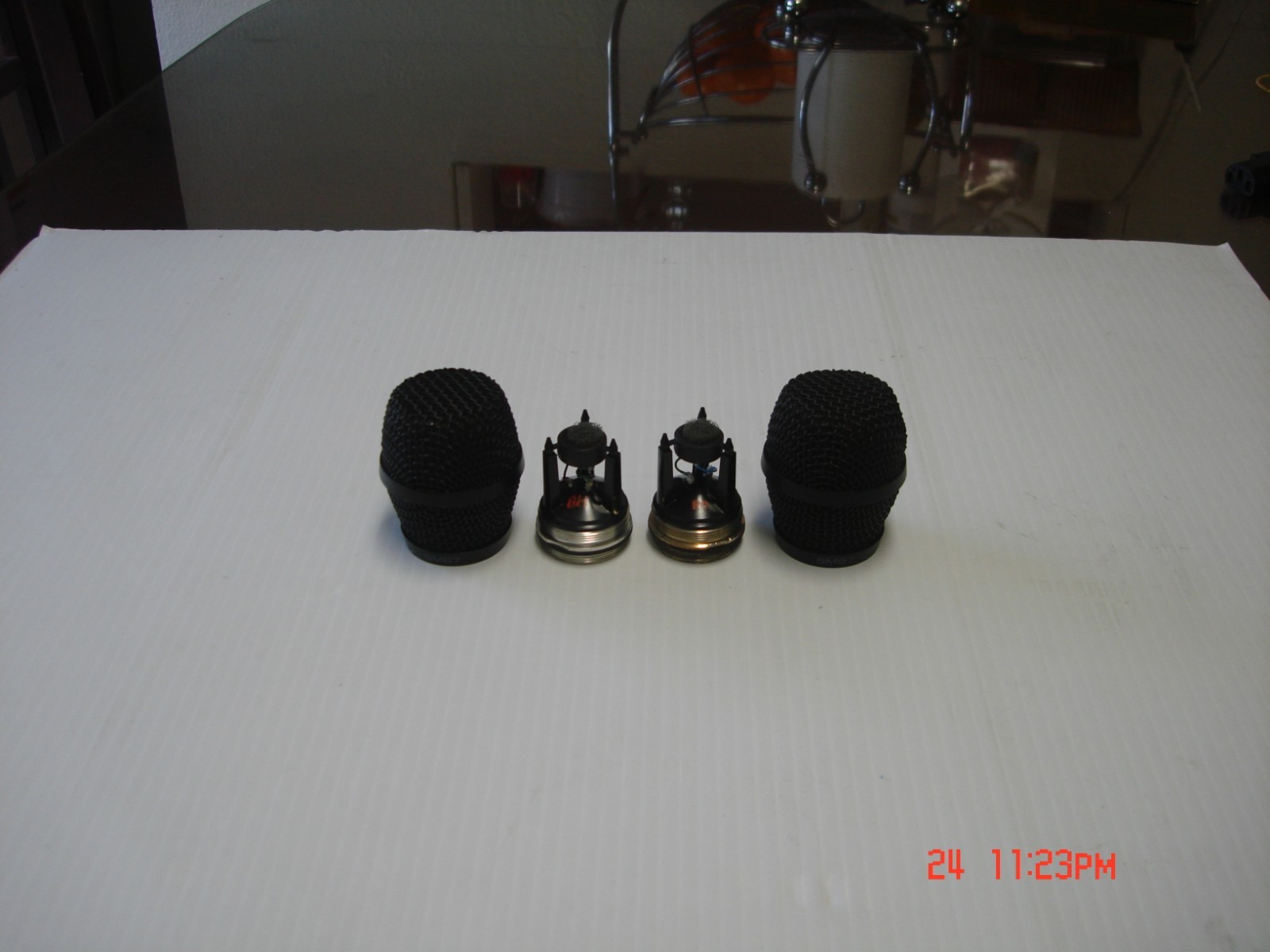
Two mechanical details do a lot of quiet work. The first is an elastomer "space frame" shock mount that decouples the capsule from the body. That is the difference between a handheld condenser that behaves and one that rings every time a finger moves. The second is a built-in multi-stage filter handling wind and plosives, so the mic doesn't need an external pop screen to stay usable up close. Shure also claimed unusually low susceptibility to RF and magnetic hum, plus low distortion. That kind of spec sheet language counts for more in a room full of dimmers and wireless gear than in a quiet studio.
The body is a rugged, lightweight aluminum case in a durable gray finish, and the package includes a swivel adapter. Shure sold it in two versions: the SM87-LC, supplied without cable, and the SM87-CN, which shipped with a 25-foot cable and connectors. User net prices at introduction were $329 for the -LC and $355 for the -CN. Power comes from simplex (phantom) supply, either from an outboard supply or straight off the PA, recording, or broadcast gear already in the rack. No dedicated power box is required.
Recording-Engineer (October 1984, p.210) ran the launch under the "Crowd Pleaser" banner. The mic was also trusted as a head capsule for wireless work, where a capsule that feeds back or picks up handling noise has nowhere to hide. Studio-Sound (December 1984, p.34) covered the introduction as a new product aimed squarely at live vocal use. Mix-Magazine (April 1988, p.27) later described Shure's quality-assurance program for the W15HT/58 and W15HT/87 wireless systems. Each mic cartridge and transmitter was tested individually, then tested again after final assembly through a wireless link to confirm it sounded like the cabled version. The company's own claim was that the wireless SM87 should be acoustically indistinguishable from the wired one.
Working engineers said much the same in plainer language. Jim Sanders, sound engineer for Stevie Wonder, went on the record praising the SM87's warmth and clarity, its supercardioid pattern, and its controlled proximity effect. That last one keeps a singer's tone consistent as they work the mic at different distances. Sanders noted that Wonder used three SM87s in concert, one at each instrument position, and that the consistency between individual mics mattered enormously because the singer moved between them constantly. His point was that polar uniformity across units is what makes that arrangement work without re-EQing at every position. It is an endorsement of manufacturing consistency rather than of any single spec.
The SM-87 is not a museum piece the way a ribbon mic is, and nobody should buy one expecting a collectible. It's a working tool, and the used market treats it as such. Two things are worth knowing before chasing one. First, it is a phantom-powered condenser, so it needs a supply that actually delivers. Plenty of cheap interfaces and older mixers are stingy, and a starved condenser sounds thin and wrong. Second, the elastomer shock mount is the wear item. Rubber that has spent thirty-plus years in a road case, a hot van, or a humid club does not stay rubber forever. A hardened or perished mount is the most common reason a used SM-87 exhibits handling noise its design was supposed to eliminate. Grilles get dented, foam filters inside them turn to dust, and the gray finish shows every scuff. None of that affects the sound, but all of it affects what a seller thinks the mic is worth.
The other thing to understand is what the SM-87 is not. It is not a studio vocal condenser in the large-diaphragm sense, and it was never sold as one. It was built to sit in front of a loud singer in a loud room and survive. Judged on those terms — 50 Hz to 15 kHz, supercardioid, phantom-powered, aluminum-bodied, with a shock mount designed to take abuse — it does exactly what it was built to do, and the people who used it on the road in the 1980s knew it.
eBay Listings
As an eBay Partner, we earn from qualifying purchases. This helps support our independent vintage technology research.