Shure M44-5
A half-mil diamond tracking at three-quarters of a gram, sold as the economical way into Shure's 15-degree world.
Overview
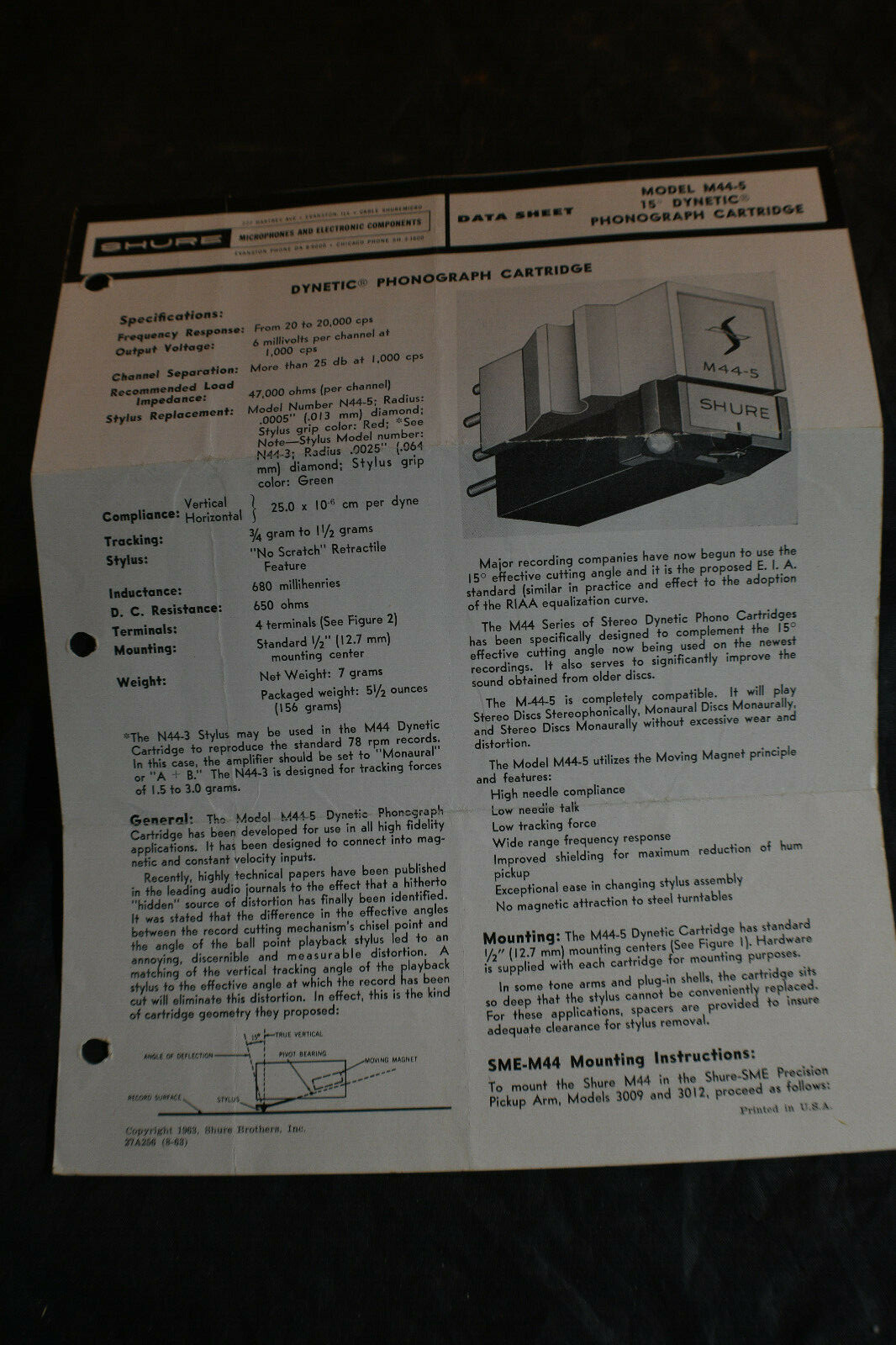
The M44-5 was the lighter-tracking entry in Shure's M44 Stereo Dynetic line. The number to know is compliance: 25 x 10⁻⁶ cm/dyne, against 20 x 10⁻⁶ for its M44-7 sibling. That extra compliance let Shure rate it down to three-quarters of a gram. The tracking range was 3/4 to 1½ grams, which suited tonearms that couldn't be trusted with heavier forces. The stylus is a .0005-inch diamond, and the replacement part was N44-5.
The headline claim for the whole M44 family was the 15-degree effective vertical tracking angle. Shure built the line around it while the record companies were moving toward that cutting standard. That's marketing copy, and it should be read as such. The engineering claim underneath it was specific, though: lower IM and harmonic distortion, and channel separation greater than 25 dB at 1000 cps.
The rest of the electrical package is standard Shure fare for the period. Output is 6 millivolts per channel at 5 cm/sec peak velocity. That's on the low side next to the M44-7's 9 millivolts, so keep it in mind if a phono stage is marginal. Recommended load is 47,000 ohms. Inductance is 680 millihenries per channel and DC resistance is 650 ohms per channel, both identical to the M44-7. That points to a shared generator body, with the difference living in the stylus assembly. Frequency response was quoted as 20 - 20,000 cps.
High Fidelity (August 1964, p.63) put the M44-5 on the bench and confirmed the price at $49.50. The magazine found channel separation fine through the mid-frequencies but noted it falling off above 5 kc, down to a minimum of 6.5 dB at 15 kc on the left channel and 1 dB at 14 kc on the right — a real limitation, and one that matters more on wide stereo pressings than on mono. Tracking ability, both vertical and lateral, was judged very good. That's the honest picture: a cartridge that tracked beautifully and imaged less impressively at the top than the spec sheet's "greater than 25 dB at 1000 cps" might suggest.
The pricing story is messier than a single figure. Shure announced the M44-5 at $49.50 net in early 1964, and High Fidelity confirmed that number that August. By 1965 the company's own advertising was describing both M44 models as "under $25.00," and by the spring of 1966 the M44-5 was listed at $21.95 against the M44-7's $19.95. Treat the $49.50 as the introduction price and the low-twenties figure as the later street price. The gap is big enough to badly confuse anyone comparing old magazine pages to a current asking price.
One design detail to check on a used example: the M44 stylus was retractile, marketed as scratch-proof, and designed to momentarily retract when excessive force was applied to the tonearm. It's a genuine period feature and a reason these cartridges survived in better condition than many contemporaries. It also makes the stylus assembly a moving part, so a worn or sticky retractile mechanism is a failure mode to check before trusting one.
Shure also offered monophonic styli for the body: the N44-1 with a .001-inch diamond for mono LP records, and the N44-3 with a .0025-inch diamond for 78 rpm records. The same generator could be pushed into mono and shellac duty with a stylus swap.
eBay Listings
As an eBay Partner, we earn from qualifying purchases. This helps support our independent vintage technology research.