Shure 55S
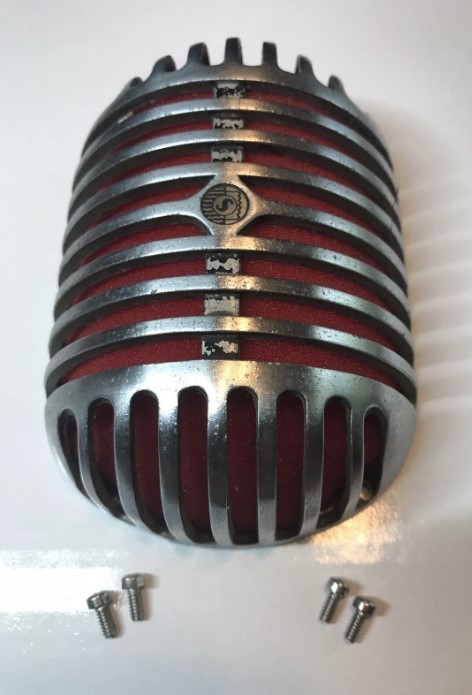
A three-pound-and-change slab of satin chrome, the "Small Unidyne," and the microphone most people picture when they hear the word.
Overview
The 55S is the small one. The model number invites confusion with the original Unidyne that made the shape famous, and collectors have mixed the two up for decades. Shure's own documentation is explicit about the relationship. The "Small Unidyne" has all the advantages of the world-famous Shure Model 55 Unidyne, but it is a smaller microphone, aimed at installations where keeping the physical size down mattered while retaining maximum operating efficiency. The acoustic phase-shift network was redesigned for the new model, and the moving-coil system was revised for high efficiency and extended, smooth frequency response. Shure described the case as modern in design with attractive streamlining and grille treatment. Mix (November 1996, p.314) put it plainly: sleek in design, with a futuristic look suited for a 1930s science-fiction movie, the 55 Series symbolizes what many think of when someone says the word "microphone." That article noted the series debuted in Shure's 1939 catalog and, six decades on, remained popular and sought after.
The 55S is a moving-coil dynamic with a frequency range of 50 to 15,000 Hz. The figure appears identically in both the general specification and the architect's specification. The polar pattern is the main event. Shure called it "Ultra-Cardioid," describing a characteristic that resembles a cardioid but is slightly more directional: a wide, useful pickup angle at the front, response down approximately 6 dB at the sides, and down roughly 15 dB at the rear. The documentation is careful to distinguish this from the accidental high-frequency directionality that baffle effects produce in a conventional pressure microphone. In practice, as Shure's literature framed it, the microphone can be used closer to loudspeakers than usual without creating feedback problems, and reverberation energy pickup drops by about two-thirds.
The impedance switch is the other thing that separates the 55S from a modern stage mic. A three-position switch at the rear of the body selects low, medium, or high impedance, marked "L," "M," and "H." The documentation gives the low position as 30-50 ohms, the medium as 150-250 ohms, and the high as 40,000 ohms in the architect's spec. A separate passage in the same manual cites the high position as 35,000 ohms and the recommended load as 100,000 ohms or more. The manufacturer's own documents don't agree on the high-impedance figure, so treat both numbers as period documentation. Shure recommended the low and medium positions where long cable runs were required or under conditions of severe hum disturbance, noting that permissible line length was practically unlimited because neither response nor level was appreciably affected by reasonable lengths of line.
The sensitivity figures are where the manual gets genuinely interesting, and where the 55S's multi-impedance design shows its age. At 1,000 Hz, the L position produces an open-circuit voltage level of 87.9 dB and an RTMA microphone rating Gm of 153.6 dB; the M position drops to 81.0 dB open-circuit with an RTMA rating of 152.8 dB; and the H position falls off a cliff to 60.5 dB open-circuit, loaded at 100,000 ohms for 62.3 dB, with an RTMA rating of 157.0 dB. Those RTMA figures follow Standard SE-105 of August 1949, which dates the specification language even where it doesn't date the microphone. The architect's specification in a companion document lists the same sensitivity levels with slightly different values — 153.6, 152.8, and 157.0 dB — within ±3 dB. The practical read: the low-impedance position is the hot one, the high-impedance position trades level for the convenience of plugging straight into a high-impedance input, and the middle position is the compromise most users landed on.
The physical package is compact and heavy. Net weight is 3⅛ pounds, shipping weight 4¼ pounds. Overall height is 7⅜ inches, the case itself 3 15/16 inches tall, 2 3/16 inches wide, and 3 1/16 inches deep. The architect's spec repeats those dimensions with tolerances of ±¼ inch in height and ±⅛ inch in width and depth. The finish is satin chrome, and the model also existed in gold as the 55S-Gold, identical to the standard 55S except for the finish. The mounting is the standard 5/8"-27 thread, so it fits any conventional desk, banquet, or floor stand. A self-tensioning swivel permits tilting through 45 degrees forward and 80 degrees backward. The architect's spec says 0 to 80 degrees, which is another small internal inconsistency in the documentation. A 20-foot two-conductor shielded cable with a microphone plug attached is included, and the connector is detachable.
The cartridge is shock-mounted for quiet operation, and the moving system uses large air-gap clearances with a rugged coil construction. Shure's stated purpose was immunity to abnormal atmospheric conditions and severe mechanical shock. The documentation calls the mechanical design very rugged and reliable under severe conditions of use, and recommends the 55S for fixed-station duty in police, fire, and transportation services because of that durability. The cable was selected specifically for good shielding against hum pickup.
Shure's application notes are specific about what the 55S is for. High-quality public address, theatre-stage sound systems, remote broadcasting, and recording applications are named, along with hotels, stadiums, and public auditoriums. The response is described as effective for announcing, narration, vocal music, and combo groups. For studio broadcasting and television work where the utmost in quality was wanted, Shure pointed users to the Model 556S Broadcast Unidyne instead.
The accessories list is short and practical: the A95A line-matching transformer for coupling the low-impedance line to a high-impedance amplifier input, the S39A vibration-isolation stand, the S36A desk stand, the Model A47 quick-disconnect isolation unit, and the Model AC55 carrying case. Replacement parts are documented too - the R55 dynamic cartridge, the C55 cable and plug assembly, and the RK32S replacement switch for the 55SW variant. The switch replacement procedure is spelled out step by step, down to the two No. 2-56 screws holding the nameplate and the instruction to observe lead color and terminal arrangement. The guarantee ran one year from date of purchase, covering parts and labor, and was voided if the case was opened. So the switch instructions were meant for authorized service, not the kitchen table.
The model designation is the most common source of confusion in the used market. The 55S has no on-off switch. The 55SW is the same microphone with a built-in on-off switch. The 55S-Gold and 55SW-Gold are identical to their respective base models except for the gold finish. The 55S is not the Shure 55, and it is not the 55SH. The documentation names the Model 55 Unidyne as the larger predecessor whose advantages the 55S carries, and treats the 55S as its own smaller design with a redesigned phase-shift network and a revised moving-coil system.
Where the 55S sits in the collector's imagination has a lot to do with that silhouette. The 55 Series made its debut in Shure's 1939 catalog, and by the time Mix (November 1996, p.314) ran its retrospective, the series had attained what the magazine called an unmatched level of recognition — six decades of visibility that had nothing to do with chance. EQ (February 1991, p.71) characterized the sound of the era's 55-family microphones as having a certain smoothness and rich low-frequency response, noting that the high-frequency response was a different story in those pre-hi-fi days. That's a fair summary of what a modern user should expect: a warm, mid-forward character with a rolled-off top, not a bright condenser. The 55S is a period piece in the most literal sense — its frequency range tops out at 15,000 Hz, its sensitivity is specified against a 1949 RTMA standard, and its impedance switch exists because the amplifiers it was designed to feed didn't agree on what a microphone input should look like. None of that is a flaw. It's the reason to own one, and the reason it still works when everything downstream of it has been replaced twice over.
eBay Listings



As an eBay Partner, we earn from qualifying purchases. This helps support our independent vintage technology research.