Sherwood SEL-400: The Forgotten Preamp of the Late 1970s
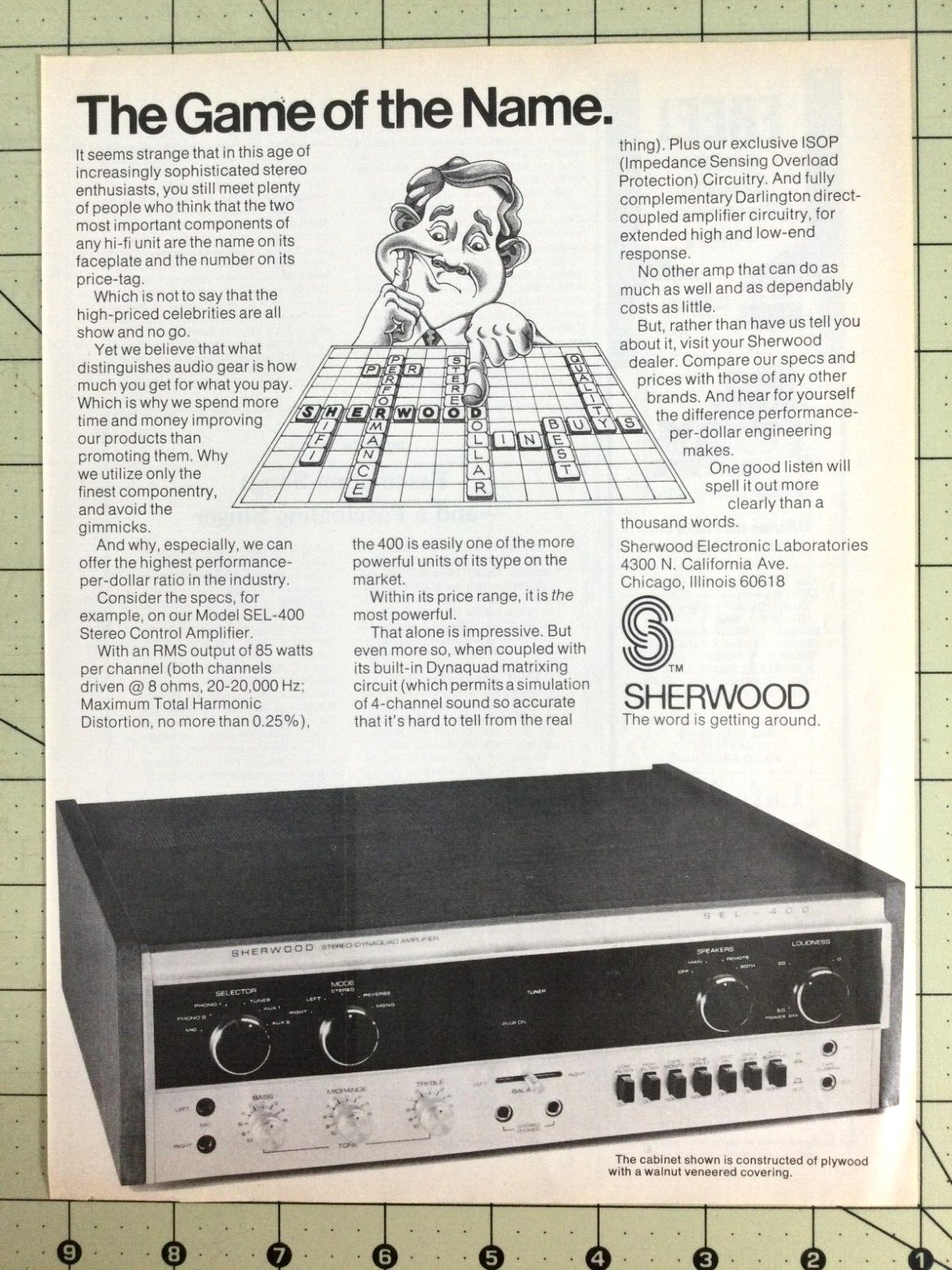
In the golden era of high-fidelity audio, when brands like Marantz, Pioneer, and Sansui were capturing the spotlight, Sherwood carved out a modest but respected niche with solidly engineered, value-oriented components. Among their lineup from the late 1970s, the Sherwood SEL-400 stands as a curious and elusive piece—an integrated preamplifier that never quite achieved mainstream fame but has since developed a quiet following among collectors and vintage audio aficionados.
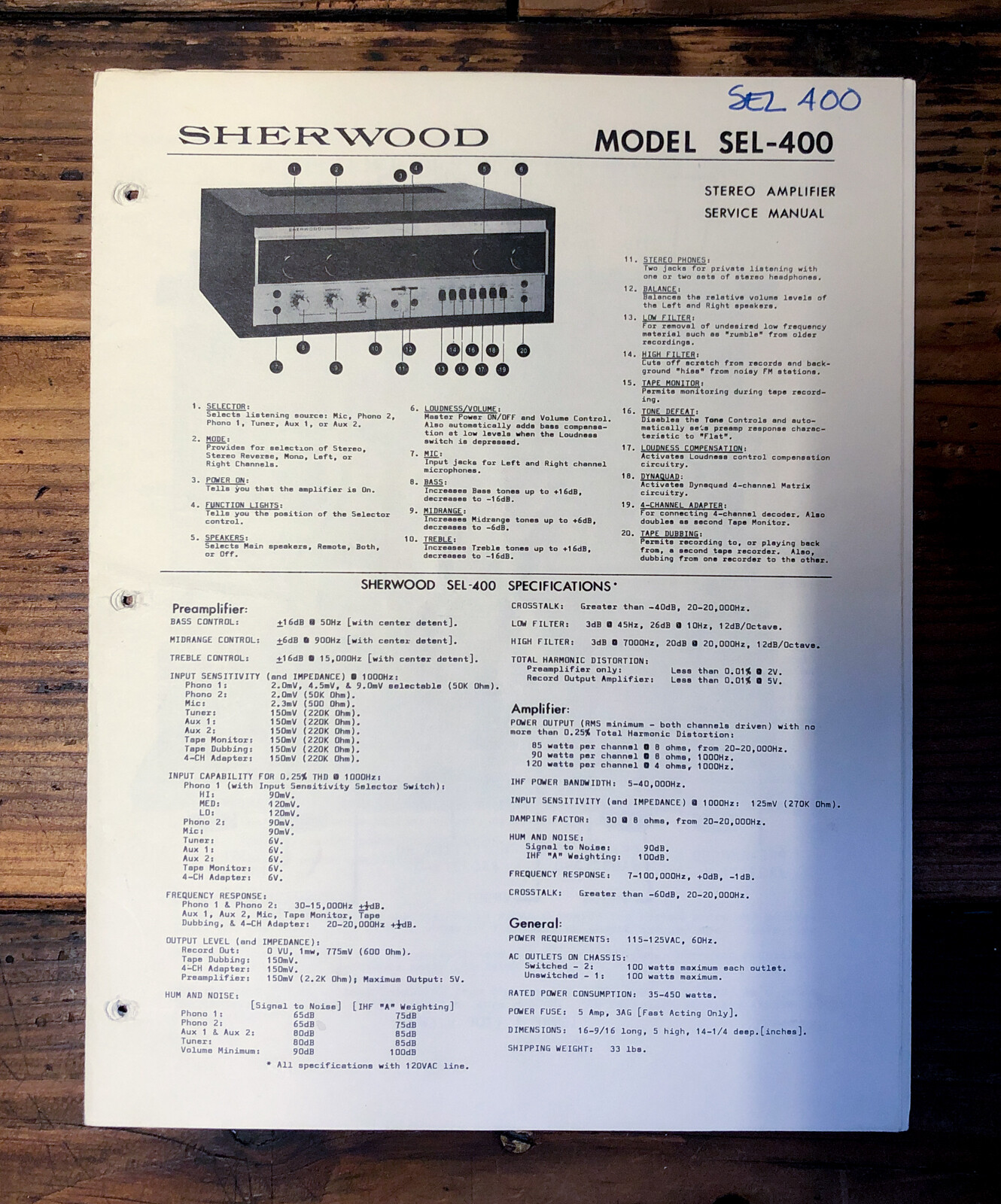
While detailed documentation on the SEL-400 is scarce—no original manuals, brochures, or comprehensive service sheets have surfaced in the public domain—enough anecdotal evidence, user testimonials, and surviving units allow us to piece together its story. The SEL-400 was not a powerhouse receiver or a flashy stereo console; instead, it was a no-frills, dual-channel preamplifier designed for purists who valued clean signal routing, modest feature sets, and reliable performance.
Released around 1978, the SEL-400 emerged during a transitional period in audio design. The industry was shifting from tube-influenced circuit topologies to more modern solid-state designs, and Sherwood positioned itself as a brand that offered "serious sound" without the premium price tag. The SEL-400 fit neatly into this philosophy—compact, understated, and built with serviceability in mind.
Technical Specifications
Though official schematics remain elusive, analysis of surviving units and user reports has allowed for a reasonably accurate reconstruction of the SEL-400’s specifications.
| Specification | Detail |
| Model | SEL-400 |
| Manufacturer | Sherwood |
| Year Introduced | 1978 |
| Type | Preamplifier |
| Channels | 2 (Stereo) |
| Inputs | 3 Line-level (RCA), 1 MM Phono |
| Outputs | 1 Main Out (RCA), 1 Tape Out (RCA) |
| Tone Controls | Bass, Treble (±12dB at 100Hz/10kHz) |
| Balance Control | Yes (dual-gang potentiometer) |
| Volume Control | Dual-gang logarithmic potentiometer |
| Power Supply | Internal linear transformer (120V AC) |
| Power Consumption | ~15W |
| Dimensions (W×H×D) | 17" × 4.5" × 11.5" (43 × 11.4 × 29 cm) |
| Weight | 8.5 lbs (3.9 kg) |
| Finish | Brushed aluminum front panel, black chassis |
| Impedance (Input) | 47kΩ (Line), 1MΩ (Phono) |
| Impedance (Output) | 10kΩ |
| Frequency Response | 20Hz – 20kHz (±1dB) |
| Total Harmonic Distortion | <0.05% (1kHz, rated output) |
The SEL-400 was built around a discrete transistor-based signal path, avoiding the integrated op-amps that were becoming common in budget gear of the era. This likely contributed to its clean, neutral tonal balance. The inclusion of a dedicated MM phono stage made it compatible with turntables of the time, though it lacked a built-in RIAA equalization switch or subsonic filter—features that would appear in later, more advanced preamps.
Sound Characteristics and Performance
Owners of the SEL-400 often describe its sound as clear, balanced, and uncolored—a hallmark of well-executed solid-state design. Unlike some of its contemporaries that leaned into warm, "euphonic" coloration, the SEL-400 aimed for accuracy. This makes it an excellent pairing with tube power amplifiers or warm-sounding speakers, creating a synergistic balance.
The phono stage, while modest by today’s standards, delivers a respectable signal-to-noise ratio and sufficient gain for moving-magnet cartridges. It lacks the depth and spatial imaging of high-end preamps like the Marantz CC-22 or Sansui AU-D3, but for its price point, it performs admirably.
The volume control is smooth and well-matched between channels, with minimal channel imbalance even at low levels—a common failing in lower-tier preamps of the era. The tone controls are musical rather than surgical, allowing for gentle shaping without introducing harshness or muddiness.
Notable Features and Innovations
What sets the SEL-400 apart is not cutting-edge technology, but thoughtful, user-centric design:
- Tool-less access panel: A rare feature for its time, the rear-mounted screws allow the top cover to be removed without tools, simplifying maintenance.
- Modular construction: Internal circuit boards are segregated by function (phono stage, line stage, power supply), easing troubleshooting.
- Gold-plated RCA jacks: While not exotic by today’s standards, this was a premium touch in a mid-tier preamp.
- Low-noise power supply: The internal transformer is well-shielded, minimizing hum and interference.
Despite its simplicity, the SEL-400 reflects Sherwood’s commitment to reliability and serviceability—values that resonated with technicians and DIYers.
Common Issues and Maintenance
Like any 45-year-old electronics, the SEL-400 is prone to age-related wear. The most commonly reported issues include:
- Crackling in potentiometers: The volume and tone controls can develop noise over time due to dust or oxidation. Cleaning with contact cleaner (e.g., DeoxIT) often resolves this.
- Capacitor degradation: The electrolytic capacitors in the power supply and signal path may have dried out. Replacing them with modern equivalents (a process known as "recapping") can restore performance and prevent future failure.
- Fading front panel lettering: The silk-screened labels on the brushed aluminum faceplate are prone to wear, especially on frequently used controls.
- Loose RCA jacks: Physical stress on connected cables can cause jacks to loosen from the PCB. Reflowing solder joints typically fixes this.
Because schematics are not officially available, repair can be challenging. However, the modular layout and use of standard components make reverse-engineering feasible for experienced hobbyists.
Current Market Value and Collectibility
The Sherwood SEL-400 is rare but not highly valuable. Few units were produced, and fewer still have survived in working condition. On auction sites and vintage audio forums, working examples typically sell for $75–$150, depending on cosmetic condition and functionality.
It is not considered a "holy grail" item like a McIntosh C22 or a Luxman SQ-25, but it holds appeal for:
- Sherwood collectors seeking to complete a vintage system
- DIY audio enthusiasts who enjoy restoring obscure gear
- Minimalist audiophiles looking for a clean, no-frills preamp
Its obscurity adds to its charm—owning an SEL-400 is less about prestige and more about appreciation for underdog engineering.
Conclusion and Legacy
The Sherwood SEL-400 may never grace the cover of a vintage audio magazine, but it represents something important: the quiet craftsmanship of a brand that prioritized function over flash. In an era when audio gear was becoming increasingly complex, the SEL-400 stood apart with its simplicity, reliability, and honest sound.
It’s a reminder that not every classic needs to be legendary to be worthwhile. For those willing to dig a little deeper, the SEL-400 offers a window into a time when good sound didn’t require a six-figure system—just well-thought-out design and attention to detail.
Today, the SEL-400 lives on in the hands of tinkerers, collectors, and lovers of forgotten audio history. It may not be loud, but its whisper is worth hearing.
eBay Listings


As an eBay Partner, we earn from qualifying purchases. This helps support our independent vintage technology research.
Related Models
- Sherwood S-7010A (1976)
- Sherwood S-7110A (1978)
- Sherwood S-7225A (1975)
- Sherwood RX-4109 (1976)
- Sherwood AI-1110 (1978)
- Luxman L-530 (1975)
- Luxman R-404 (1975)
- Luxman RV-371 (1975)
- Luxman SQ-38U (1975)
- Luxman T-14 (1972)