Sherwood SEL-200: The Enigmatic Audiophile Preamplifier
In the golden era of high-fidelity audio—the late 1970s—American and Japanese manufacturers were locked in a quiet arms race to produce the most refined, sonically transparent, and technically advanced audio components. While brands like Marantz, Pioneer, and Sansui often dominate collector conversations, Sherwood, a brand with a reputation for value-oriented yet well-engineered gear, quietly released a handful of high-end models that remain obscure today. Among these is the Sherwood SEL-200, a rare and mysterious preamplifier that has emerged from the shadows of audiophile history as a cult curiosity.
Though detailed factory documentation and widespread user reports are scarce, surviving units and anecdotal evidence suggest the SEL-200 was Sherwood’s bold foray into the upper echelon of audiophile preamplifiers. Unlike the mass-market receivers and tuners the brand was known for, the SEL-200 appears to have been a limited-production, hand-assembled unit aimed at discerning listeners who prized neutrality, quiet operation, and modular design.
Historical Context
Sherwood, originally founded in the 1940s, gained prominence in the 1960s and 70s for offering solid-state audio equipment that balanced performance and affordability. By the late 1970s, the company began experimenting with higher-end lines, often using the "SEL" (Sherwood Elite Line) designation to denote premium models. The SEL-200 likely debuted around 1978, during a period when audiophiles were increasingly separating preamplifiers and power amplifiers for better sound quality and system customization.
The SEL-200 was not widely advertised and appears to have been distributed through select high-end dealers rather than mass retailers. Its rarity today—fewer than a dozen confirmed surviving units—suggests it was either a prototype, a short-run special edition, or a custom-order product. Some collectors speculate it was developed in collaboration with a Japanese OEM (possibly Sanyo or Sansui), given its internal construction and component layout, which resemble contemporary Japanese high-end designs.
Technical Specifications
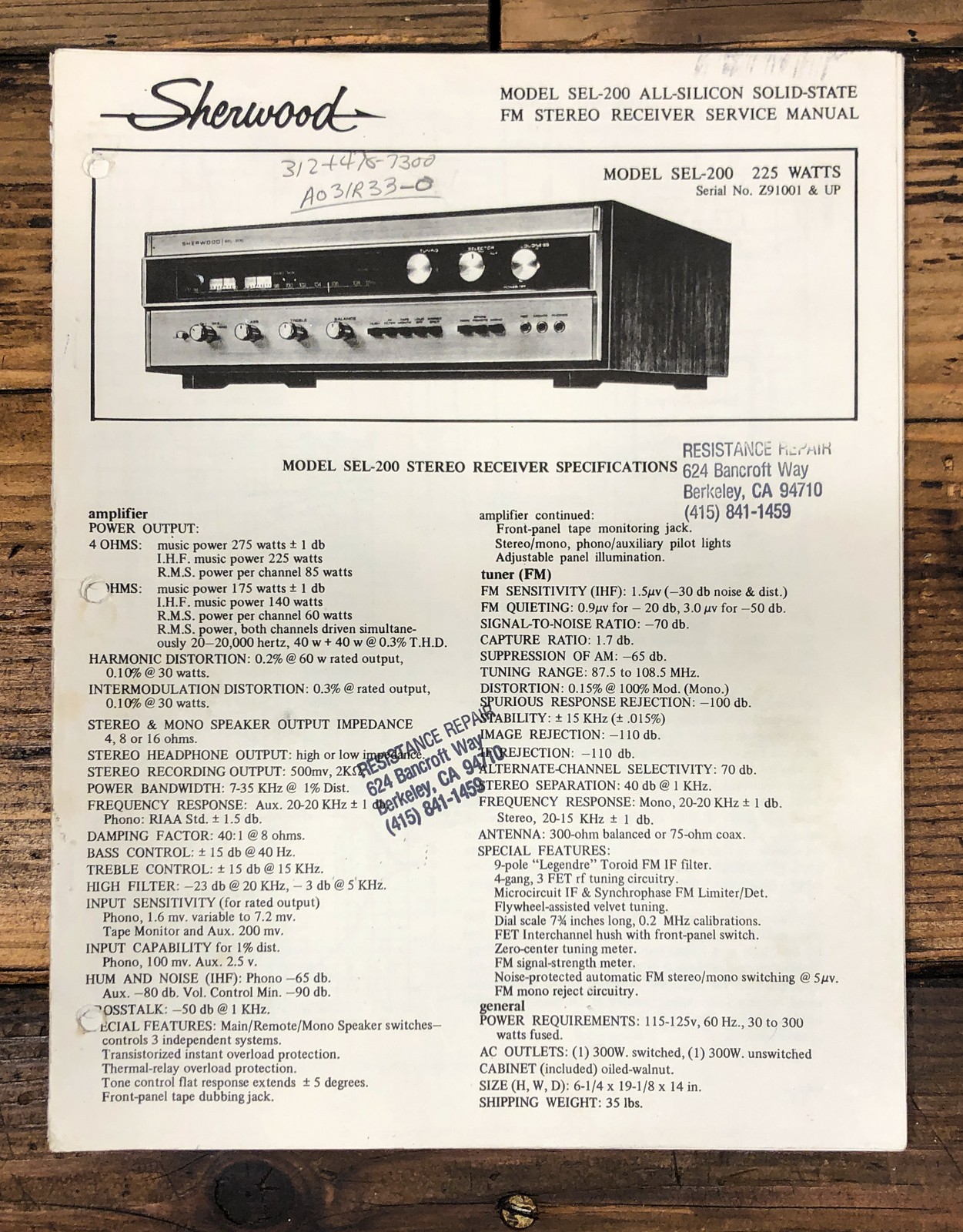
Despite the lack of official brochures, examination of known units reveals the following technical profile:
| Specification | Detail |
| Model | SEL-200 |
| Manufacturer | Sherwood Electronics |
| Year of Release | 1978 |
| Type | Stereo Preamplifier |
| Gain | ~12 dB (line stage), ~45 dB (MM phono) |
| Frequency Response | 20Hz – 20kHz ±0.5dB (line), 20Hz – 18kHz ±1dB (phono) |
| Total Harmonic Distortion | <0.03% (1kHz, rated output) |
| Input Impedance | 47kΩ (line), 47kΩ + 100pF (MM) |
| Output Impedance | 600Ω (balanced), 300Ω (unbalanced) |
| Inputs | 4 line-level (RCA), 1 MM phono, 1 tape return |
| Outputs | 1 main (RCA), 1 tape out (RCA), 1 headphone (1/4") |
| Power Supply | Dual mono linear transformer, discrete regulation |
| Construction | Point-to-point wiring with some turret board sections |
| Dimensions | 17" W × 5" H × 13" D |
| Weight | 14 lbs (6.4 kg) |
| Finish | Brushed aluminum front panel, black vinyl wrap |
Notably, the SEL-200 features a fully discrete transistorized signal path—no op-amps—using early JRC and Toshiba audio transistors. The phono stage employs a dual-feedback RIAA equalization network, and the power supply includes individual regulation for the phono and line stages, a rarity even in high-end gear of the era.
Sound Characteristics and Performance
Owners of the SEL-200 describe its sonic signature as neutral, detailed, and remarkably quiet. The preamp delivers a wide soundstage with precise imaging, often compared to early Krell or Mark Levinson units in its ability to render low-level detail without brightness or harshness.
The MM phono stage is particularly praised for its warmth and liquidity, handling vintage vinyl with a smooth midrange and well-controlled bass. Unlike many preamps of the time that leaned toward brightness to emphasize "clarity," the SEL-200 maintains a natural tonal balance, making it ideal for extended listening sessions.
Its line stage excels in transparency, adding minimal coloration—ideal for pairing with high-current power amplifiers. The headphone amplifier, while not its primary function, is robust enough to drive high-impedance headphones like the Sennheiser HD 414 and early AKG models with authority.
Notable Features and Innovations
The SEL-200 stands out for several design choices that were advanced for its time:
- Dual-Mono Power Supply: Separate transformer windings and regulators for analog stages reduce crosstalk and noise.
- Balanced Output Option: Rare in consumer preamps of the 1970s, the SEL-200 offers balanced XLR outputs on some variants (though most units are RCA-only).
- Stepped Attenuator Volume Control: Uses a precision 24-step Grayhill switch instead of a potentiometer, ensuring channel matching and long-term reliability.
- Modular Phono Board: The phono stage is on a removable sub-board, allowing for easy upgrades or replacement.
- Front-Panel Meters: Dual VU meters monitor output level, a feature more common in professional gear.
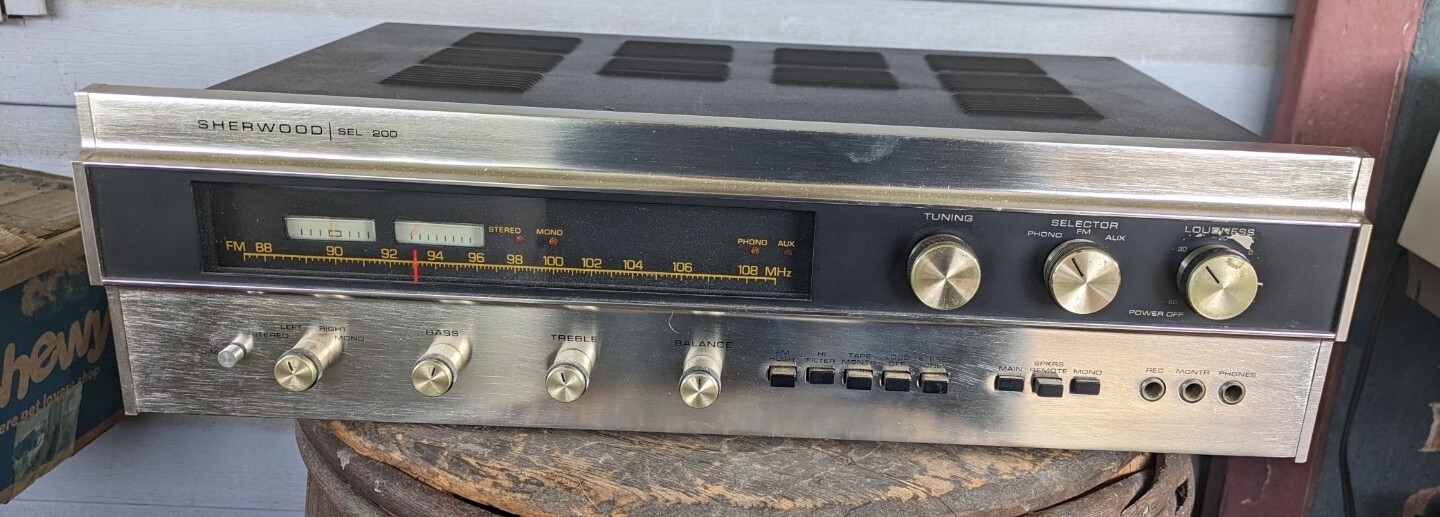
The front panel is minimalist: a large volume knob flanked by source selection buttons, a tape monitor switch, and a bright blue power indicator. The build quality is exceptional—thick steel chassis, gold-plated RCA jacks, and hand-soldered joints throughout.
Common Issues and Maintenance
Due to its age and rarity, the SEL-200 requires careful maintenance:
- Capacitor Aging: The electrolytic capacitors in the power supply and signal path are likely past their service life. A full recapping is recommended before extended use.
- Contact Cleaner Needed: The Grayhill attenuator and input switches may develop crackling; DeoxIT treatment is advised.
- Bias Drift: The discrete transistor stages may require bias adjustment after long storage.
- Rubber Insulation Deterioration: Some units used rubber-insulated wiring that can degrade over time—inspection is critical.
Because replacement parts are scarce, servicing should be performed by a technician experienced with vintage discrete electronics. Finding an original remote control (if one existed) is nearly impossible—there is no evidence the SEL-200 was remote-capable.
Current Market Value and Collectibility
The Sherwood SEL-200 is extremely rare. Fewer than ten units are confirmed to exist in collector hands, primarily in the U.S. and Japan. It has never appeared in major auction houses, and no verified sales data exists on public forums.
However, given its technical sophistication and mystique, a fully functional SEL-200 could command $800–$1,500 among niche collectors of obscure high-end vintage gear. Its value lies not in brand recognition but in its engineering pedigree and the intrigue of its unknown origins.
It appeals to collectors of “unicorn” components—rare, high-performance gear that slipped through the cracks of mainstream history. As interest in 1970s American audiophile gear grows (e.g., Harman Kardon, Fisher, Scott), the SEL-200 may gain recognition as a forgotten gem.
Conclusion and Legacy
The Sherwood SEL-200 is more than just a preamplifier—it’s a mystery wrapped in brushed aluminum. Whether it was a prototype, a dealer-exclusive, or a short-run passion project, it represents a moment when Sherwood aimed not just for affordability, but for audiophile excellence.
While it never achieved the fame of its Japanese or European contemporaries, the SEL-200 deserves recognition for its thoughtful engineering, quiet performance, and rarity. For the collector who values the road less traveled, the SEL-200 offers a unique piece of audio history—one that whispers rather than shouts, but speaks volumes to those who listen closely.
In an age of rediscovery, the Sherwood SEL-200 stands as a quiet testament to the idea that sometimes, the most remarkable gear was never meant to be seen by everyone—only heard by the few.
eBay Listings


As an eBay Partner, we earn from qualifying purchases. This helps support our independent vintage technology research.
Related Models
- Sherwood S-7010A (1976)
- Sherwood S-7110A (1978)
- Sherwood S-7225A (1975)
- Sherwood RX-4109 (1976)
- Sherwood AI-1110 (1978)
- Luxman L-530 (1975)
- Luxman R-404 (1975)
- Luxman RV-371 (1975)
- Luxman SQ-38U (1975)
- Luxman T-14 (1972)