Sherwood S-9910: The Forgotten Control Hub of the Quadraphonic Era
In the late 1970s, as home audio systems grew more complex and component-based, manufacturers began experimenting with centralized control units to streamline the user experience. Among these was the Sherwood S-9910, a unique and somewhat enigmatic device that defied easy categorization. Not quite a receiver, not quite a preamplifier, and certainly not a tuner in the traditional sense, the S-9910 occupied a niche all its own: a system control center designed for the burgeoning high-fidelity and quadraphonic audio markets.
Sherwood, a brand long respected for its value-oriented yet solidly engineered receivers and tuners, ventured into more specialized territory with the S-9910. Released around 1978, this unit was part of a broader trend where audiophiles were stacking separates—tuners, preamps, power amps, tape decks—and needed a way to manage inputs, sources, and monitoring without constant repatching or juggling multiple remote controls (which didn’t yet exist). The S-9910 stepped in as a kind of "traffic controller" for the audio chain.
Technical Specifications
While detailed service manuals and schematics for the S-9910 are scarce today, surviving units and user recollections allow us to reconstruct its core functionality and design philosophy.
| Specification | Detail |
| Model | Sherwood S-9910 |
| Year Introduced | 1978 |
| Category | System Control Center / Integrated Monitor Unit |
| Primary Function | Source switching, tape monitoring, AM/FM tuner integration |
| Tuner Bands | AM, FM |
| Tuner Type | Analog needle meter with manual tuning |
| Inputs | 3x Line-level (Aux, Tape, Tuner), Phono (MM) |
| Outputs | Main out, Tape Out, Headphones (¼") |
| Tape Monitoring | Yes, with dedicated loop and monitor switch |
| Speaker Outputs | None (preamp-level only) |
| Power Output | Not applicable (no built-in amplifier) |
| Impedance | Not applicable |
| Frequency Response | 20Hz – 20kHz (±1dB) |
| Total Harmonic Distortion | <0.1% (at 1kHz) |
| Signal-to-Noise Ratio | >70dB (A-weighted) |
| Power Supply | Internal linear transformer |
| Dimensions (W×H×D) | 17" × 5.5" × 13.5" |
| Weight | 14 lbs (6.4 kg) |
| Finish | Brushed aluminum faceplate with black accents |
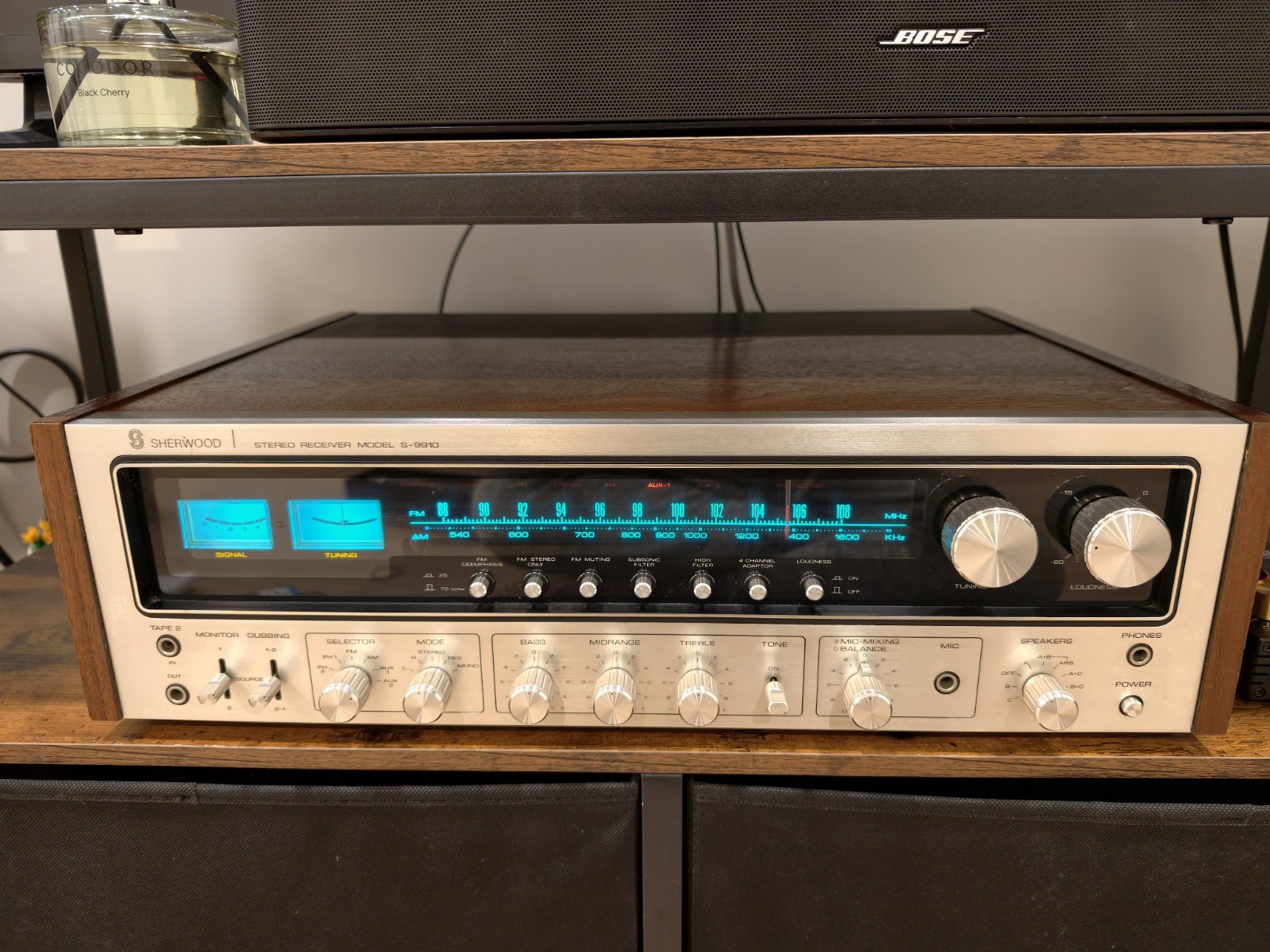
The S-9910 featured a clean, minimalist front panel with a large center-mounted analog FM/AM tuner dial, flanked by input selectors, a prominent tape monitor switch, and a single volume knob. The build quality was typical of Sherwood’s mid-to-upper-tier offerings: solid steel chassis, quality potentiometers, and a reassuring heft that signaled durability.
Sound Characteristics and Performance
As a preamp/control center, the S-9910 doesn’t drive speakers directly, but its sonic signature is still relevant. Users consistently report a neutral, transparent tonal balance—a hallmark of Sherwood’s engineering during this era. The phono stage, designed for moving magnet (MM) cartridges, delivers warm but well-defined vinyl playback with a slightly laid-back high end, making it forgiving of less-than-perfect records.
The line-level circuitry is clean and low-noise, with minimal coloration. This makes the S-9910 an excellent front-end for pairing with high-current power amplifiers of the period, such as those from Pioneer, Sansui, or Yamaha. Its tape monitoring loop is particularly well-implemented, allowing for accurate A/B comparisons between source and tape playback—critical for audiophiles who valued tape duplication and reel-to-reel recording.
The built-in AM/FM tuner, while not as refined as standalone units like the Sony ST-555 or Marantz 1501, holds its own. FM reception is solid with a good external wire antenna, and the analog meter provides precise tuning feedback. Stereo separation on FM is decent for the era, though modern tuners will outperform it. AM reception is surprisingly good, with effective noise filtering for a unit of this class.
Notable Features and Innovations
What sets the S-9910 apart from conventional preamps or receivers is its system integration philosophy:
- Tape Monitor Loop: One of the most appreciated features, allowing users to switch between live source and tape playback with a single button. This was essential for evaluating recording quality or dubbing tapes.
- Integrated Tuner: At a time when many separates systems required a standalone tuner, Sherwood built a competent one directly into the unit, saving space and cost.
- Phono/Line Flexibility: The inclusion of a dedicated MM phono input meant users didn’t need an external phono preamp, making it a true all-in-one front end.
- Headphone Amplifier: A modest but functional headphone output on the front panel, useful for late-night listening.
- Clean Signal Path: Designed with minimal feedback and short internal traces, the S-9910 avoids the muddiness that plagued some contemporary units.
It’s worth noting that the S-9910 was often marketed as a companion to Sherwood’s power amplifiers, such as the P-8800 or P-9900, forming a modular high-end system. Its lack of speaker terminals reinforces this role as a preamp/tuner hybrid.
Common Issues and Maintenance
Like all vintage electronics from the 1970s, the S-9910 is prone to age-related wear. Common issues include:
- Capacitor Degradation: The electrolytic capacitors in the power supply and signal path should be checked or replaced, especially if the unit has been stored for decades. This is critical for preventing hum, channel imbalance, or complete failure.
- Tuner Alignment Drift: The FM section may require realignment for optimal stereo separation and sensitivity. This should be done by a technician with proper test equipment.
- Dirty Pots and Switches: The volume and input selector controls can develop crackling due to oxidation. Cleaning with contact cleaner (e.g., DeoxIT) often resolves this.
- Worn Tuning Knob Damping: The tuner’s tuning knob uses a rubberized damping wheel that can dry out, leading to overshoot or uneven tuning. Replacement kits are occasionally available from vintage audio specialists.
Despite these potential issues, the S-9910 is generally reliable when maintained. Its simple, analog design means fewer failure points than later solid-state or digital units.
Current Market Value and Collectibility
The Sherwood S-9910 is rare—so rare that it’s often overlooked in collector circles. You won’t find it listed in most vintage audio price guides, and completed eBay sales are infrequent. When units do appear, they typically sell for $75–$150, depending on condition and whether they’ve been serviced.
Its collectibility is niche but growing among enthusiasts who appreciate modular systems and the aesthetics of late-1970s audio design. It’s particularly sought after by collectors restoring full Sherwood separates systems or building period-correct quadraphonic setups (though the S-9910 itself is stereo-only).
Conclusion and Legacy
The Sherwood S-9910 may not be a household name like the Pioneer SX-1980 or the Marantz 2270, but it represents an important moment in audio history: the transition from all-in-one consoles to modular separates, and the need for intelligent system management. It’s a bridge device—part tuner, part preamp, part control hub—that embodies Sherwood’s practical, user-focused engineering.
While it lacks the raw power or prestige of flagship receivers, the S-9910 delivers excellent signal integrity, thoughtful design, and a window into how audiophiles managed complex systems before the digital age. For the vintage audio enthusiast, it’s a hidden gem: a quiet workhorse that deserves recognition not for its fame, but for its quiet competence.
If you stumble upon a working Sherwood S-9910, consider giving it a second life. It might just become the centerpiece of a beautifully balanced, authentically vintage system.
eBay Listings


As an eBay Partner, we earn from qualifying purchases. This helps support our independent vintage technology research.
Related Models
- Sherwood AX-9030R (1980)
- Sherwood AD-266R (1978)
- Sherwood AX-5015R (1978)
- Sherwood S-7000 (1977)
- Sherwood S-7110 (1978)
- Aiwa CS-250 (1978)
- Denon TU-1500RD (1995)
- Denon TU-280 (1976)
- Denon TU-501 (1977)
- Denon TU-550 (1978)