Sherwood S-9900: The Forgotten Tuner That Defined 1970s FM Fidelity
In the golden era of high-fidelity audio—the late 1970s—when every major brand was pushing the boundaries of analog performance, Sherwood carved out a niche with a reputation for serious, no-nonsense audio gear. Among their lineup, the Sherwood S-9900 stands as a quiet legend: not a receiver, not an amplifier, but a dedicated high-performance AM/FM stereo tuner built for purists who demanded the absolute best in broadcast reception.
Released in 1977, the S-9900 emerged during a time when FM radio was undergoing a renaissance. Stations were broadcasting in stereo with increasing clarity, and audiophiles were tuning in to classical, jazz, and progressive rock with newfound appreciation for the medium. Sherwood, already respected for its solid-state receivers and amplifiers, responded with the S-9900—an over-engineered, feature-rich tuner designed to extract every nuance from the airwaves.
Though not as widely remembered as contemporaries from Sony, Pioneer, or Sansui, the S-9900 has developed a cult following among vintage tuner enthusiasts for its exceptional build quality, precise tuning, and remarkably transparent sound.
Technical Specifications
The Sherwood S-9900 was engineered to meet—and exceed—the expectations of the most discerning listeners. It featured a dual-gauge design, a heavy-duty chassis, and a host of technical refinements uncommon in even high-end receivers of the era.
| Specification | Detail |
| Model | Sherwood S-9900 |
| Year of Release | 1977 |
| Type | AM/FM Stereo Tuner |
| Tuning System | Analog needle-pointer with digital frequency counter |
| FM Frequency Range | 87.5–108 MHz |
| AM Frequency Range | 530–1710 kHz |
| IF Frequencies (FM/AM) | 10.7 MHz / 455 kHz |
| Tuning Steps (FM) | 50 kHz |
| Signal-to-Noise Ratio | >70 dB (weighted, FM) |
| Total Harmonic Distortion | <0.5% (FM, 1 kHz) |
| Output Level (FM) | 250 mV (max) |
| Output Impedance | 1 kΩ |
| Input Impedance (Antenna) | 75Ω (FM), 300Ω (AM) |
| Power Requirement | 120V AC, 60 Hz, 25W |
| Dimensions | 17" W × 5.5" H × 14" D |
| Weight | 22 lbs (10 kg) |
| Finish | Black textured vinyl with brushed aluminum faceplate |
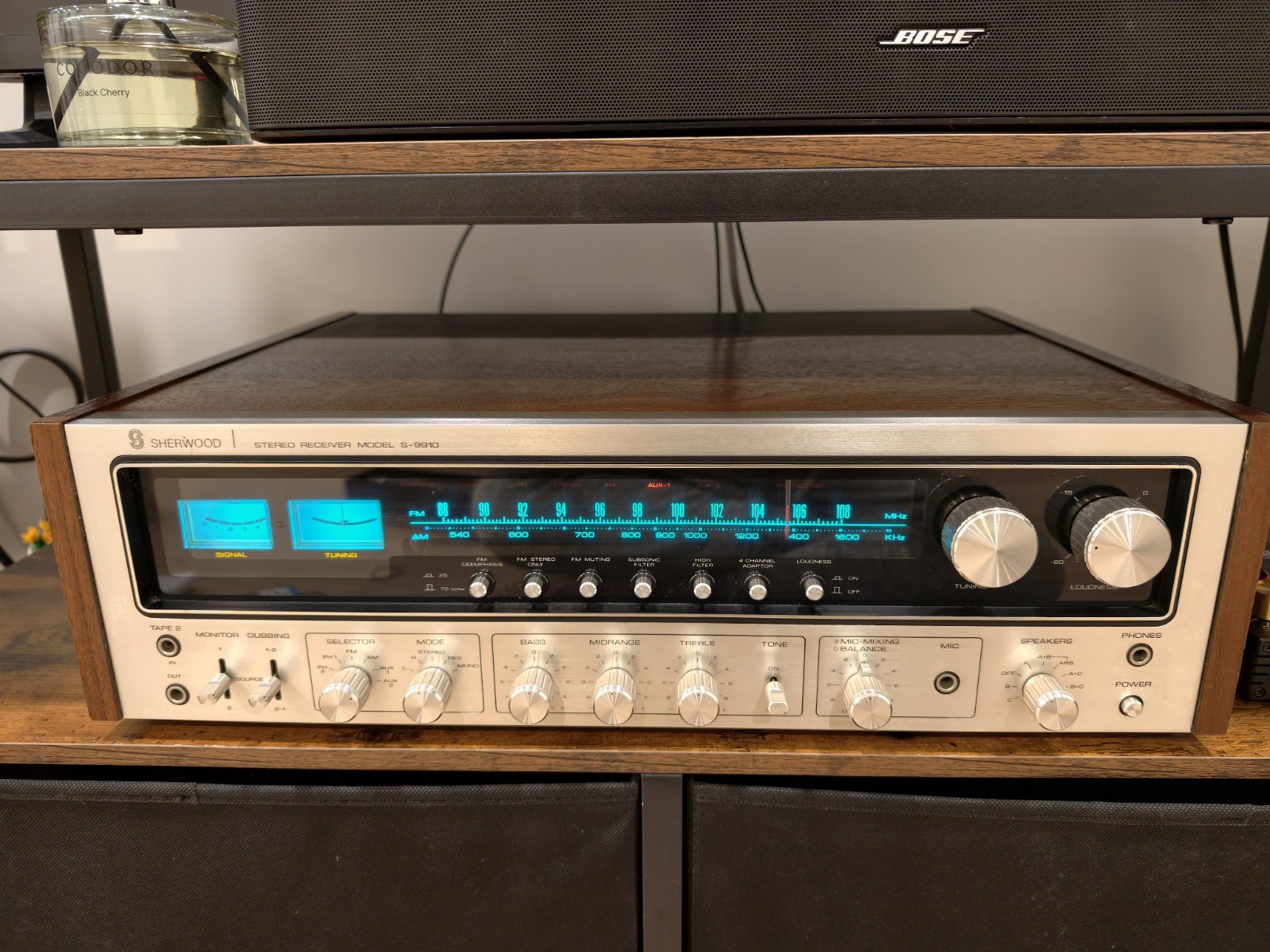
One of the most striking features of the S-9900 was its dual analog metering system. Unlike many tuners that relied solely on a center-zero S-meter, the S-9900 included separate meters for tuning accuracy and signal strength, allowing users to precisely align stations for optimal stereo separation and minimal noise. This dual-meter design, reminiscent of professional broadcast equipment, was a hallmark of Sherwood’s commitment to precision.
Additionally, the tuner included a digital frequency readout—a rare and advanced feature for 1977—displaying the exact frequency in 50 kHz increments via red LED digits. This hybrid analog-digital interface made the S-9900 both intuitive and highly accurate.
Sound Characteristics and Performance
The S-9900 was not designed for show—it was built for sonic transparency. Its FM section employed a double-tuned IF amplifier and a quadrature FM detector, contributing to exceptional stereo separation (typically over 40 dB) and wide frequency response (30 Hz–15 kHz ±1 dB). The result was a sound that was clean, detailed, and spatially accurate, with a natural midrange and smooth highs.
Listeners often describe the S-9900’s sound as “effortless”—it doesn’t color the broadcast but instead reveals the true character of the transmission. Whether receiving a local jazz station or a distant classical broadcast, the tuner handled weak signals with grace, thanks to its high-gain RF front end and low-noise amplifier design.
AM performance was equally impressive for its time. The S-9900 featured double conversion on the AM band, reducing image interference and improving selectivity. Its audio stage included switchable bandwidth filtering, allowing users to reduce noise on weak stations or preserve fidelity on strong ones.
Notable Features and Innovations
The Sherwood S-9900 packed a number of advanced features that set it apart from the competition:
- Dual Analog Meters: Independent tuning and signal strength meters for surgical station alignment.
- LED Frequency Display: One of the earliest consumer tuners to include digital frequency readout.
- Motorized Tuning Dial: Smooth, precise tuning with a weighted knob and direct-drive mechanism.
- Stereo/Mono Switch: To optimize reception in low-signal areas.
- Front-Panel Headphone Jack: With its own amplifier—unusual for a tuner.
- Remote Antenna Relay: Allowed switching between indoor and outdoor antennas via a front-panel button.
- Defeatable De-emphasis: For compatibility with non-standard broadcasts or tape playback.
The build quality was exceptional: a steel chassis, gold-plated RCA jacks, and hand-soldered circuitry. The front panel featured a brushed aluminum faceplate with crisp, legible labeling—functional and elegant.
Common Issues and Maintenance
Like all vintage electronics, the S-9900 requires some care after 45+ years. The most common issues include:
- Deteriorating Electrolytic Capacitors: The power supply and audio coupling caps should be checked or replaced to prevent hum or failure.
- Sticky Tuning Potentiometer: The motorized tuning mechanism can gum up; cleaning with contact cleaner often resolves this.
- Failing LED Display: The red LED frequency counter may dim or flicker due to aging driver ICs or solder joints.
- Worn Meter Dampening Fluid: The analog meters may become sluggish; reconditioning is possible but delicate.
Regular cleaning of controls and connectors, along with a fresh set of batteries in the memory backup (if applicable), will keep the S-9900 performing like new. Due to its modular design, many parts are serviceable by skilled technicians.
Current Market Value and Collectibility
The Sherwood S-9900 is a sleeper classic. While not as hyped as a Sony ST-S505 or a Kenwood KT-9000, it commands respect among tuner aficionados. In excellent working condition, prices typically range from $250 to $400 on the secondary market, with fully restored units occasionally fetching more.
Its collectibility is growing, particularly among:
- FM broadcast enthusiasts who appreciate its precision.
- Vintage audio restorers drawn to its robust construction.
- Minimalist audiophiles using it in modern tube or Class A setups.
Because it was not produced in massive quantities, finding a clean, fully functional S-9900 can be a challenge—making it a rewarding find.
Conclusion and Legacy
The Sherwood S-9900 may not have the brand cachet of a Marantz or the flashy design of a Yamaha, but it represents the quiet excellence of late-1970s American audio engineering. It was built for one purpose—to deliver the purest possible radio signal—and it does so with remarkable fidelity.
In an age where streaming dominates, the S-9900 reminds us of the joy of tuning in—of carefully adjusting the dial, watching the meters dance, and discovering music carried through the air. It’s a machine that rewards patience and attention, and for those who appreciate the craft of listening, the Sherwood S-9900 remains a timeless tool.
If you’re building a vintage system or simply want to experience FM radio as it was meant to be heard, the S-9900 deserves a place on your rack. It’s not just a tuner—it’s a portal to the golden age of broadcast sound.
eBay Listings



As an eBay Partner, we earn from qualifying purchases. This helps support our independent vintage technology research.
Related Models
- Sherwood AX-9030R (1980)
- Sherwood AD-266R (1978)
- Sherwood AX-5015R (1978)
- Sherwood S-7000 (1977)
- Sherwood S-7110 (1978)
- Aiwa CS-250 (1978)
- Denon TU-1500RD (1995)
- Denon TU-280 (1976)
- Denon TU-501 (1977)
- Denon TU-550 (1978)