Sherwood S-9500B: The Precision FM Tuner of the Late 1970s
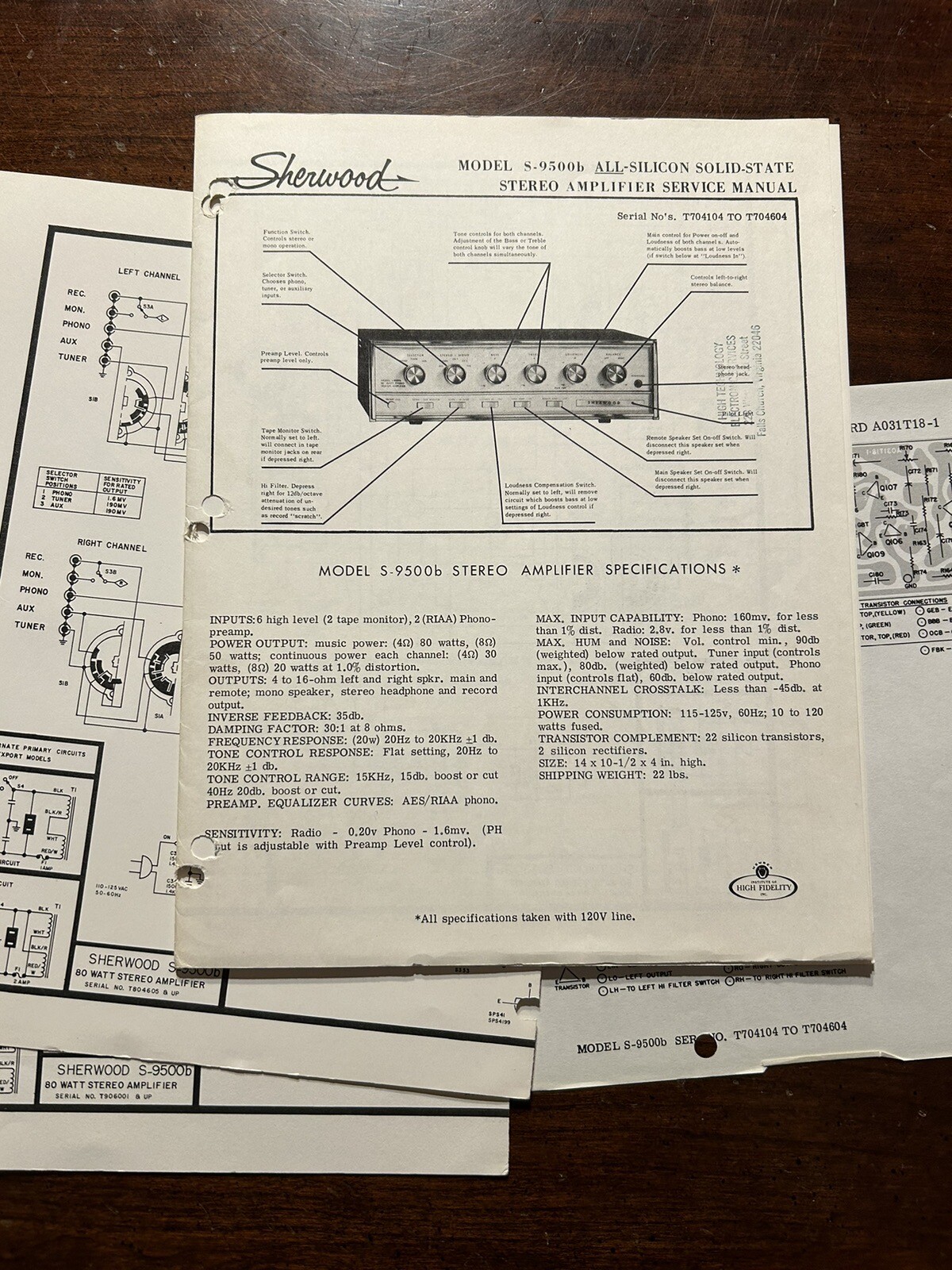
In the golden era of high-fidelity audio—the late 1970s—when manufacturers were pushing the limits of analog performance and design, Sherwood carved out a respected niche with a series of high-end tuners. Among these, the Sherwood S-9500B stands as a notable example of precision engineering and audiophile-grade FM reception. Released in 1978, the S-9500B was positioned as a top-tier FM stereo tuner, designed for discerning listeners who demanded clarity, stability, and superior signal capture from their broadcast sources.
At a time when FM radio was experiencing a cultural and sonic renaissance—offering everything from classical broadcasts to progressive rock and jazz in stereo—the S-9500B emerged as a serious tool for the audiophile’s system. It was not merely a tuner to catch a signal; it was engineered to extract every nuance from the airwaves with minimal distortion and maximum fidelity.
Technical Specifications
The Sherwood S-9500B was built to meet the highest standards of its time, featuring a double-conversion superheterodyne design, quartz-locked digital tuning, and a host of refinements aimed at maximizing signal-to-noise ratio and selectivity.
| Specification | Detail |
| Model | S-9500B |
| Year | 1978 |
| Type | FM Stereo Tuner |
| Tuning System | Digital Quartz-Locked Synthesizer |
| Frequency Range | 87.5–108 MHz |
| Tuning Steps | 50 kHz or 100 kHz selectable |
| IF Frequency | 10.7 MHz (double conversion) |
| Sensitivity | 1.8 µV for 30 dB SNR (mono) |
| Selectivity | 75 dB at ±400 kHz |
| Signal-to-Noise Ratio | 70 dB (A-weighted) |
| Stereo Separation | 45 dB at 1 kHz |
| Output Level | 350 mV (1.0 µV input, 50 dB µV) |
| Output Impedance | 1 kΩ |
| Audio Outputs | Fixed and variable RCA (L/R) |
| Antenna Inputs | 75Ω coaxial, 300Ω twin-lead |
| Power Requirement | 120V AC, 60 Hz, 25W |
| Dimensions (W×H×D) | 440 × 146 × 330 mm (17.3 × 5.75 × 13") |
| Weight | 10.5 kg (23.1 lbs) |
The S-9500B employed a digital frequency display using red LED readouts—advanced for its time—offering precise tuning and excellent readability. Its quartz-locked synthesis system minimized drift and allowed for stable reception even under marginal signal conditions. The inclusion of both fixed and variable audio outputs made it compatible with a wide range of preamplifiers and integrated systems, whether users preferred to control volume from the tuner or through their main amplifier.
Sound Characteristics and Performance
The Sherwood S-9500B was engineered for transparency and neutrality. Its audio circuitry used high-quality components and careful shielding to prevent interference, resulting in a clean, open soundstage. When tuned to a strong stereo FM signal, the S-9500B delivered rich stereo imaging, with excellent channel separation and minimal crosstalk.
Listeners praised its low noise floor and tight stereo decoding, which preserved the spatial cues and dynamics of live broadcasts. The tuner handled multipath distortion well, thanks to its high selectivity and IF filtering, making it a reliable performer even in urban environments where signal reflections were common.
In direct comparison with contemporaries like the Sony ST-555ES or Yamaha TU-E5, the S-9500B held its own with a slightly warmer tonal balance—some describe it as more "musical" than clinical—while still maintaining excellent technical accuracy. Its ability to resolve low-level detail and maintain phase coherence contributed to a listening experience that felt immersive and authentic.
Notable Features and Innovations
The Sherwood S-9500B packed several advanced features that set it apart in the crowded tuner market of the late 1970s:
- Digital Quartz-Locked Tuning: This ensured exceptional frequency stability, eliminating the tuning drift common in analog variable-capacitor tuners.
- Dual Antenna Inputs: The inclusion of both 75Ω coaxial and 300Ω twin-lead inputs provided flexibility for different antenna types, from rooftop Yagis to indoor dipoles.
- LED Frequency Display: Bright red LEDs made tuning easy even in dimly lit environments, and the digital readout allowed for precise station identification.
- High Selectivity & Sensitivity: With 75 dB selectivity and a sensitivity of just 1.8 µV, the S-9500B could pull in weak stations while rejecting adjacent-channel interference.
- Stereo Pilot Indicator: A dedicated LED showed stereo lock status, helping users optimize antenna positioning.
- Muting Circuit: Automatically silenced the output during weak signal conditions to reduce noise and distortion.
Additionally, the chassis was built with a rigid steel frame and copper shielding to minimize RF interference and microphonics—a hallmark of serious high-end tuners of the era.
Common Issues and Maintenance
Like all vintage electronics, the Sherwood S-9500B benefits from periodic maintenance to ensure optimal performance. Over time, several issues may arise:
- LED Display Dimming: The red LED display can fade or develop dead segments. While not repairable, replacement LED modules or full display board swaps are possible with skilled technicians.
- Capacitor Aging: Electrolytic capacitors in the power supply and audio stages may dry out, leading to hum or reduced performance. A full recapping is recommended for units that have been dormant.
- Tuning Encoder Wear: The digital tuning knob (often a mechanical encoder) can become noisy or erratic. Cleaning with contact spray may help, but replacement is sometimes necessary.
- Antenna Terminal Corrosion: Especially in coastal areas, the 300Ω screw terminals can corrode. Regular inspection and cleaning with deoxidizer are advised.
- Quartz Oscillator Drift: Rare, but possible. If tuning accuracy degrades significantly, the crystal may need replacement.
Despite these potential issues, the S-9500B is generally considered robust and reliable. Its modular construction makes servicing more accessible than in some integrated receivers of the era.
Current Market Value and Collectibility
The Sherwood S-9500B is not as widely collected as some of its Japanese counterparts, but it has developed a loyal following among vintage tuner enthusiasts and FM broadcast aficionados. Its combination of solid build quality, excellent performance, and distinctive industrial design makes it a desirable addition to any classic audio system.
On the secondary market, a fully functional S-9500B in good cosmetic condition typically sells for $150–$250, with pristine, boxed units occasionally fetching higher prices. Units with working LED displays and clean tuning are particularly sought after.
While not a "holy grail" item like the rare Sansui TU-919 or Marantz HD-77, the S-9500B represents excellent value for those seeking high-performance FM reception with vintage charm. It’s also a favorite among DIY restorers due to its serviceability and modularity.
Conclusion and Legacy
The Sherwood S-9500B stands as a testament to the craftsmanship and innovation of late-1970s audio engineering. In an age increasingly dominated by digital streaming, it reminds us of the joy of discovering music through the airwaves—crisp, uncompressed, and full of life.
Though Sherwood never achieved the same cult status as brands like Pioneer, Sansui, or Yamaha, the S-9500B proves that the company was capable of producing world-class components. It delivers performance that rivals more famous tuners of its era, wrapped in a no-nonsense, functional design.
For the vintage audio enthusiast, the S-9500B is more than just a tuner—it’s a gateway to the golden age of FM broadcasting. Whether used as a centerpiece in a retro setup or restored as a collector’s item, it remains a worthy ambassador of analog fidelity and the enduring appeal of high-quality radio reception.
eBay Listings


As an eBay Partner, we earn from qualifying purchases. This helps support our independent vintage technology research.
Related Models
- Sherwood AX-9030R (1980)
- Sherwood AD-266R (1978)
- Sherwood AX-5015R (1978)
- Sherwood S-7000 (1977)
- Sherwood S-7110 (1978)
- Aiwa CS-250 (1978)
- Denon TU-1500RD (1995)
- Denon TU-280 (1976)
- Denon TU-501 (1977)
- Denon TU-550 (1978)