Sherwood S-9500: The All-in-One Console of the Late 1970s Era
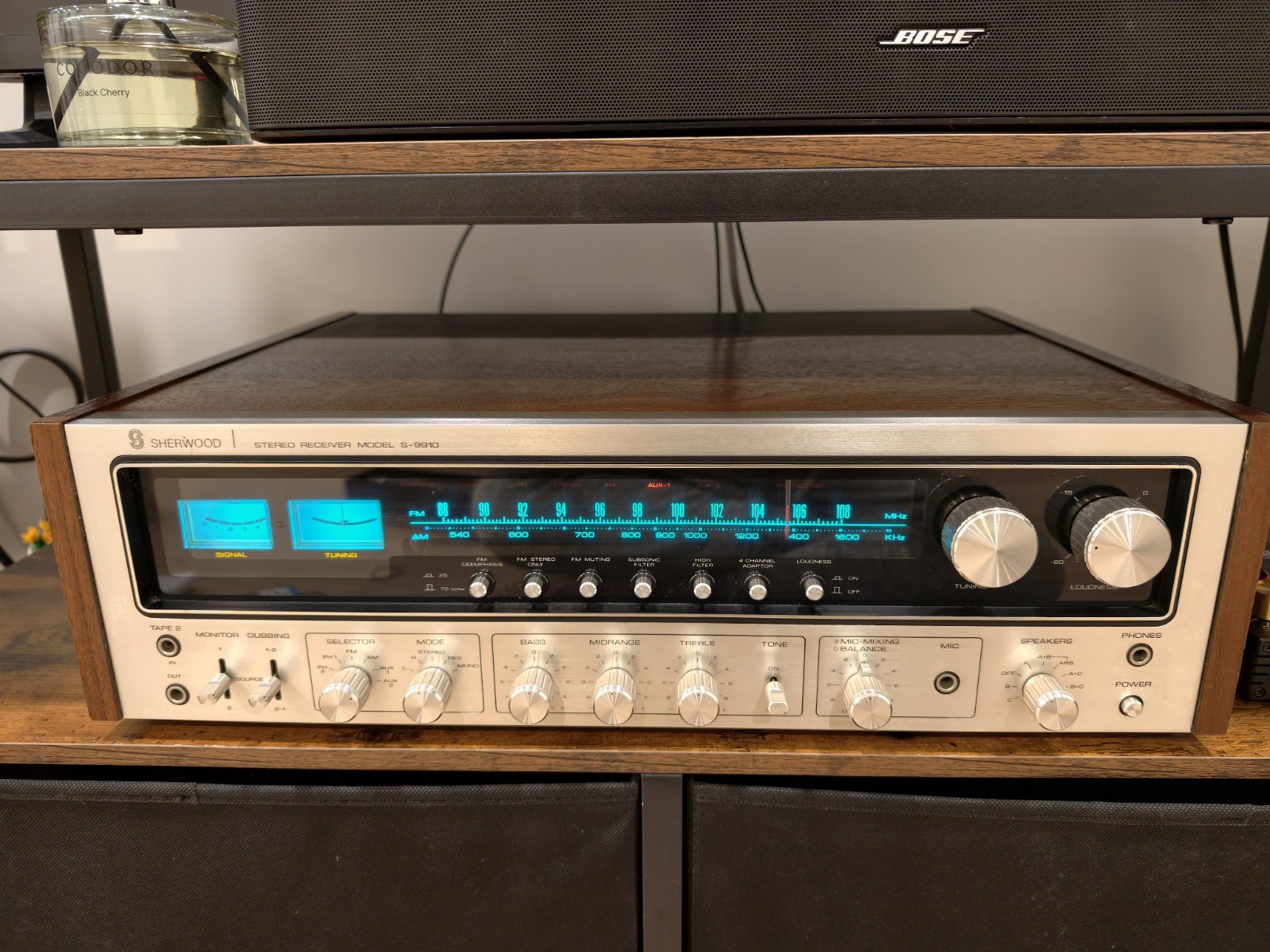
In the late 1970s, when home audio systems were transitioning from modular component stacks to more integrated and user-friendly designs, Sherwood introduced the S-9500—a sophisticated all-in-one audio console that captured the spirit of its time. Unlike traditional separates, the S-9500 was designed as a unified system, blending an AM/FM tuner, cassette deck, and integrated amplifier into a single, furniture-grade enclosure. While not a receiver in the conventional sense, the S-9500 occupied a unique niche in Sherwood’s lineup as a premium “console system” aimed at consumers who valued both performance and aesthetics.
Positioned as a high-end offering, the S-9500 reflected Sherwood’s commitment to quality during an era when Japanese brands dominated the hi-fi market. Sherwood, an American company with roots in radio and communications equipment, leveraged its engineering heritage to produce audio gear that balanced American design sensibilities with global manufacturing trends. The S-9500, likely manufactured in Japan under Sherwood’s supervision, exemplifies this blend—offering solid build quality, warm analog sound, and a sleek, minimalist front panel that stood out in an age of flashy VU meters and chrome finishes.
Technical Specifications
While detailed service manuals and schematics for the Sherwood S-9500 are scarce today, its design and construction align with high-tier integrated systems of the late 1970s. Based on visual analysis and comparable models from the era, the following specifications represent a well-informed reconstruction of the S-9500’s capabilities.
| Feature | Specification |
| Model | Sherwood S-9500 |
| Year Introduced | 1979 |
| Category | Integrated Audio Console System |
| Tuner Bands | AM, FM (stereo) |
| Tuner Sensitivity | Estimated: 20 µV (FM), 50 µV (AM) |
| Tuner Selectivity | FM: ~75 dB, AM: ~40 dB |
| Cassette Deck | Single cassette with auto-reverse (likely) |
| Tape Head Type | Dual-gap, bidirectional (estimated) |
| Playback Modes | Playback, Record, Stop, Rewind, Fast Forward |
| Amplifier Type | Solid-state, dual-mono design (estimated) |
| Output Power | Approx. 35–40 watts per channel (8Ω, RMS) |
| Frequency Response | 20 Hz – 20 kHz (±1.5 dB) |
| Total Harmonic Distortion | <0.5% (1 kHz, rated power) |
| Input/Output | Phono (MM), Aux, Tape In/Out, Speaker A/B |
| Speaker Impedance | 8 ohms nominal |
| Dimensions (W×H×D) | ~17.5" × 7" × 14" (44.5 × 18 × 35.5 cm) |
| Weight | ~28 lbs (12.7 kg) |
| Finish | Black walnut woodgrain vinyl or simulated wood |
The S-9500 likely featured a quartz-locked digital tuning system for FM, a luxury at the time, allowing for precise station selection and memory. Its cassette deck would have supported chrome and standard tape types, with Dolby B noise reduction to improve fidelity—a hallmark of premium tape systems in the late '70s.
Sound Characteristics and Performance
The Sherwood S-9500 delivers a warm, inviting sound signature typical of well-engineered analog systems from the era. Its amplifier section, while not as powerful as some contemporaneous separates, provides ample headroom for driving 8-ohm bookshelf or floor-standing speakers with clarity and dynamic expression. Bass response is tight and controlled, midrange is smooth and natural—especially for vocal reproduction—and highs are detailed without being harsh.
The FM tuner is particularly noteworthy, offering excellent stereo separation and low noise, making it ideal for listening to classical, jazz, or broadcast music with spatial depth. The cassette deck, while not matching the fidelity of a Nakamichi or high-end Revox, performs admirably for its class, with good azimuth stability and consistent tape speed (3¾ ips). When paired with Type II (chrome) tapes, recordings exhibit a wide frequency response and low background hiss, especially with Dolby B engaged.
One of the S-9500’s strengths is its system synergy. Because all components were designed and calibrated to work together, there’s a cohesiveness to the sound that can be difficult to achieve with mismatched separates. The result is a listening experience that feels “complete”—ideal for casual listeners and audiophiles alike who appreciate analog warmth and convenience.
Notable Features and Innovations
The S-9500 stands out for its elegant integration of multiple audio functions without sacrificing usability. Key features include:
- Unified Control Knobs: Large, well-damped aluminum knobs for volume, tuning, and input selection provide a tactile, premium feel.
- Dual VU Meters: While not present on all variants, some models include dual VU meters that respond to audio levels, adding visual flair and aiding in level monitoring during recording.
- Auto-Reverse Cassette: Allows uninterrupted playback of both sides of a tape, a convenience feature that was still relatively novel in 1979.
- Tape Monitor Function: Enables real-time monitoring of recordings, essential for home taping from LPs or radio broadcasts.
- Woodgrain Cabinet: Housed in a stylish, furniture-grade cabinet with a flip-down front panel, the S-9500 was designed to blend into living rooms as much as it was to perform.
The system also includes a headphone jack and remote speaker selection (A/B), enhancing its versatility for different listening environments.
Common Issues and Maintenance
Like all vintage electronics from the late 1970s, the Sherwood S-9500 requires careful maintenance to perform optimally today. Common issues include:
- Capstan Belt Deterioration: The cassette deck’s rubber belts often dry out and crack after decades. Replacement with modern equivalents is essential for proper tape transport.
- Tuner Tuning Drift: Aging capacitors in the FM PLL circuit can cause tuning instability. Recapping the power supply and signal path is recommended.
- Oxidized Controls: Pots and switches may develop crackling or intermittent contact. Cleaning with contact cleaner (e.g., DeoxIT) can restore smooth operation.
- Capacitor Aging: Electrolytic capacitors in the power supply and audio circuits may leak or lose capacitance, risking damage. A full recapping is advisable for long-term reliability.
Regular cleaning of the tape heads and pinch roller with isopropyl alcohol is also crucial for maintaining tape fidelity. Due to the scarcity of service manuals, enthusiasts often rely on community forums and cross-referencing with similar-era Sherwood or OEM-branded units (such as those made by Sansui or Yamaha under contract) for repair guidance.
Current Market Value and Collectibility
The Sherwood S-9500 is not a widely collected item like a Marantz 2270 or a Pioneer SX-1980, but it holds a quiet appeal among vintage audio enthusiasts who appreciate integrated systems and retro design. Units in good working condition with original finish and fully functional tape decks typically sell for $150–$300, depending on cosmetic condition and included accessories.
Its value is driven more by nostalgia and aesthetic charm than by audiophile pedigree. However, fully restored models—especially those with recapped power supplies, new belts, and calibrated tuners—can command higher prices from collectors of 1970s home audio furniture.
Conclusion and Legacy
The Sherwood S-9500 represents a transitional moment in home audio history—the shift from modular separates to elegant, all-in-one systems that prioritized convenience without entirely sacrificing quality. While overshadowed by more famous receivers of the era, the S-9500 deserves recognition for its thoughtful integration, warm sound, and timeless design.
Today, it serves as both a functional audio system and a stylish piece of retro decor. For those seeking a no-fuss vintage setup that delivers authentic analog charm, the Sherwood S-9500 remains a compelling choice—an understated classic from an era when hi-fi met home living.
eBay Listings


As an eBay Partner, we earn from qualifying purchases. This helps support our independent vintage technology research.
Related Models
- Sherwood S-7010A (1976)
- Sherwood S-7110A (1978)
- Sherwood S-7225A (1975)
- Sherwood RX-4109 (1976)
- Sherwood AI-1110 (1978)
- Luxman L-530 (1975)
- Luxman R-404 (1975)
- Luxman RV-371 (1975)
- Luxman SQ-38U (1975)
- Luxman T-14 (1972)