Sherwood S-9000: The Forgotten Audiophile Preamplifier of the Late 1970s
In the late 1970s, the high-fidelity audio market was a battleground of innovation, where brands like Marantz, Denon, and Sansui vied for the attention of discerning audiophiles. Amid this golden era of analog audio, Sherwood—a brand often associated with value-oriented receivers—quietly released a product that defied expectations: the Sherwood S-9000. Though not as widely recognized as its contemporaries, the S-9000 stands as a testament to Sherwood’s ambition to compete in the upper echelons of audiophile equipment. More than just a preamplifier, the S-9000 was a modular, precision-engineered command center for the serious listener—a rare and intriguing piece of vintage audio history.
Historical Context: Sherwood’s Quest for Audiophile Credibility
Sherwood, a subsidiary of the Japanese company Iwadatsu Engineering (also behind the better-known Sansui brand), had built its reputation in the 1960s and 70s on offering solid-performing, mid-tier receivers and amplifiers. However, by the late 1970s, the company sought to elevate its image and tap into the growing audiophile market. The S-9000 was part of this strategic push—a high-end, modular preamplifier designed not for casual listeners, but for those who demanded transparency, flexibility, and build quality.
Released in 1979, the S-9000 arrived during a period of rapid technological evolution in audio. The era saw the rise of discrete transistor amplification, the decline of vacuum tubes in mainstream gear, and increasing interest in modular design. Sherwood’s answer was a sleek, silver-faced preamp with a modular architecture that allowed users to customize functionality—a concept that was both innovative and forward-thinking.
Technical Specifications
The Sherwood S-9000 was not a standalone amplifier but a modular preamplifier system, meaning its functionality could be expanded through plug-in modules. This design philosophy was shared by only a few elite manufacturers at the time, such as Harman Kardon and Fisher.
| Specification | Detail |
| Model | S-9000 |
| Year of Release | 1979 |
| Type | Modular Preamplifier |
| Inputs | 4 Line-Level (RCA), 1 Phono (MM), 1 Tape Monitor |
| Outputs | Main Out, Tape Out (x2), Headphone |
| Frequency Response | 20Hz – 20kHz (±0.5dB) |
| Total Harmonic Distortion | < 0.05% |
| Signal-to-Noise Ratio | > 90dB |
| Power Supply | Internal linear transformer |
| Dimensions | 440mm (W) × 145mm (H) × 360mm (D) |
| Weight | 11.5 kg (25.3 lbs) |
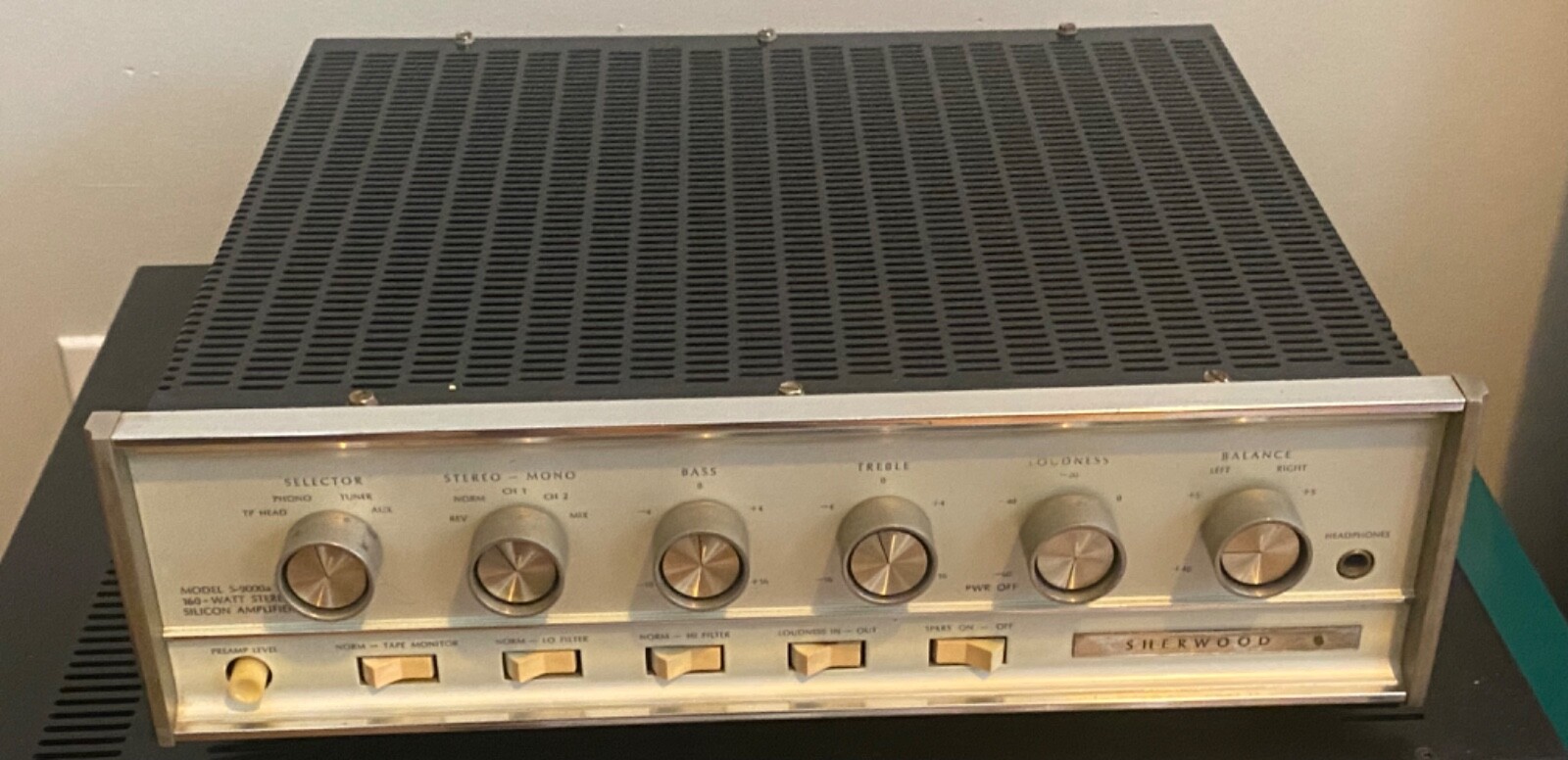
| Finish | Silver anodized aluminum front panel |
| Modular Slots | 2 (for optional EQ, noise reduction, or metering) |
The S-9000 featured a fully discrete, direct-coupled circuit design—avoiding capacitors in the signal path where possible—to preserve signal integrity. Its phono stage was specifically tuned for moving magnet (MM) cartridges, with a standard RIAA equalization curve. The unit also included a high-quality Alps potentiometer for volume control, a hallmark of premium audio gear from the era.
Sound Characteristics and Performance
The S-9000 delivered a sound signature that was both refined and neutral—unusual for Sherwood, which often leaned toward warmer, more forgiving tonality in its mass-market models. In contrast, the S-9000 aimed for accuracy and transparency, making it a favorite among listeners who valued detail retrieval and spatial imaging.
Bass response was tight and well-controlled, with minimal bleed into the midrange. Mids were clear and articulate, allowing vocals and acoustic instruments to shine. High frequencies were extended but never harsh, avoiding the sibilance that plagued some solid-state designs of the time. The wide soundstage and precise imaging made the S-9000 particularly well-suited for classical and jazz recordings.
Its modular nature also meant that sound could be tailored. Optional equalization modules allowed for room correction or tonal shaping, while a VU meter module provided visual feedback on signal levels—useful for optimizing gain structure.
Notable Features and Innovations
The modular design was the S-9000’s most striking innovation. Two rear-mounted slots allowed users to install optional modules:
- Graphic Equalizer Module: A 7-band EQ for room tuning or personal preference.
- Dolby B Noise Reduction Module: For reducing tape hiss during cassette playback.
- VU Meter Module: Dual analog meters for monitoring output levels.
This flexibility was rare in preamps at the time and gave the S-9000 a level of customization typically reserved for professional studio gear.
Other notable features included:
- Tape Monitor Function: Allowed users to switch between sources and tape loops seamlessly.
- High-Quality Internal Wiring: Teflon-insulated signal paths minimized interference.
- Dual-Level Gain Control: Separate controls for line and phono inputs to prevent overdriving.
- Heavy-Duty Chassis: A rigid steel and aluminum construction reduced microphonics and vibration.
The front panel design was minimalist yet functional, with large, clearly labeled knobs and a clean layout that emphasized usability over flashiness.
Common Issues and Maintenance
As with any vintage electronics from the late 1970s, the Sherwood S-9000 requires careful attention to maintain optimal performance. Common issues include:
- Capacitor Aging: Electrolytic capacitors in the power supply and signal path may have dried out, leading to hum, channel imbalance, or complete failure. A full recapping by a qualified technician is often recommended.
- Oxidized Controls: The Alps volume pot and selector switches can develop crackling or dropouts due to oxidation. Deoxit treatment or replacement may be necessary.
- Module Contact Corrosion: The modular slots can accumulate oxidation, disrupting connections. Regular cleaning with contact cleaner is advised.
- Tape Relay Wear: The internal relays for tape monitoring can wear out over time, causing switching issues.
Despite these age-related concerns, the S-9000 is generally well-built and reliable when properly maintained. Its modular nature also makes repairs more manageable—faulty modules can often be replaced or serviced independently.
Current Market Value and Collectibility
The Sherwood S-9000 remains a rare find in the vintage audio market. Unlike more famous contemporaries such as the Marantz 2270 or Sansui 9090, the S-9000 never achieved widespread popularity, which contributes to its obscurity today. However, this also makes it a hidden gem for collectors and restorers.
Units in good working condition typically sell for $250–$400, depending on included modules and cosmetic state. Fully loaded models with original packaging and documentation can fetch higher prices, especially among enthusiasts of modular audio systems.
Its collectibility is driven by:
- Rarity and unique modular design
- High build quality for a Sherwood product
- Growing interest in lesser-known audiophile gear from the 1970s
While not a mainstream classic, the S-9000 appeals to those who appreciate engineering ingenuity and understated elegance.
Conclusion: A Quiet Classic Worth Rediscovering
The Sherwood S-9000 may not have the name recognition of a Marantz or a McIntosh, but it represents a bold and sophisticated chapter in Sherwood’s history. As a modular preamplifier from an era when customization was still a novelty, it showcased what the brand was capable of when it aimed for the high end.
Today, the S-9000 serves as a reminder that great audio engineering wasn’t confined to the usual suspects. For the vintage audio enthusiast, it offers a rare combination of flexibility, fidelity, and craftsmanship. Whether used as a centerpiece in a restored 1970s system or appreciated as a collector’s item, the Sherwood S-9000 deserves a second look—a quiet classic that speaks volumes through its performance.
eBay Listings


As an eBay Partner, we earn from qualifying purchases. This helps support our independent vintage technology research.
Related Models
- Sherwood S-7010A (1976)
- Sherwood S-7110A (1978)
- Sherwood S-7225A (1975)
- Sherwood RX-4109 (1976)
- Sherwood AI-1110 (1978)
- Luxman L-530 (1975)
- Luxman R-404 (1975)
- Luxman RV-371 (1975)
- Luxman SQ-38U (1975)
- Luxman T-14 (1972)