Sherwood S-8910 Preamplifier: The Forgotten Gem of Late '70s Hi-Fi
In the golden era of high-fidelity audio—the late 1970s—American consumers were treated to a wave of innovative, performance-driven equipment from both domestic and Japanese manufacturers. Among the brands that carved out a loyal following during this time was Sherwood, a company known for delivering solid engineering and value-oriented designs without sacrificing sonic integrity. While Sherwood is perhaps best remembered for its receivers and tuners, the S-8910 stands out as a lesser-known but highly capable solid-state preamplifier that quietly represented the brand’s commitment to audiophile-grade components.
Released in 1979, the Sherwood S-8910 was part of a small but thoughtful lineup of separates aimed at serious listeners who wanted to build modular, high-performance systems. Unlike the more common integrated receivers of the era, the S-8910 was designed to be paired with external power amplifiers, offering greater flexibility and refined control over source selection and tonal balance. Though it never achieved the cult status of contemporaries from Marantz, Sansui, or Pioneer, the S-8910 has slowly gained recognition among vintage audio enthusiasts for its clean design, reliable operation, and surprisingly transparent sound.
Technical Specifications
Despite its relative obscurity, the Sherwood S-8910 was engineered with care and attention to detail. It featured a fully discrete solid-state signal path—common for high-end preamps of the time—and avoided the use of integrated circuits in critical audio stages, contributing to its clean, analog character.
| Specification | Detail |
| Model | Sherwood S-8910 |
| Year of Release | 1979 |
| Type | Solid-State Preamplifier |
| Inputs | 4 Line-Level (RCA), 1 Phono (MM) |
| Outputs | 1 Tape Out, 1 Main Out (RCA) |
| Frequency Response | 20Hz – 20kHz (±0.5dB) |
| Total Harmonic Distortion | <0.05% (1kHz, rated output) |
| Signal-to-Noise Ratio | >80dB (A-weighted) |
| Gain (Line) | ~10dB |
| Gain (Phono) | ~40dB (RIAA equalized) |
| Power Supply | Internal linear transformer, dual rail |
| Power Consumption | 25 watts |
| Dimensions (W×H×D) | 420 × 140 × 300 mm (16.5 × 5.5 × 11.8 in) |
| Weight | 5.8 kg (12.8 lbs) |
| Finish | Black or walnut woodgrain (side panels) |
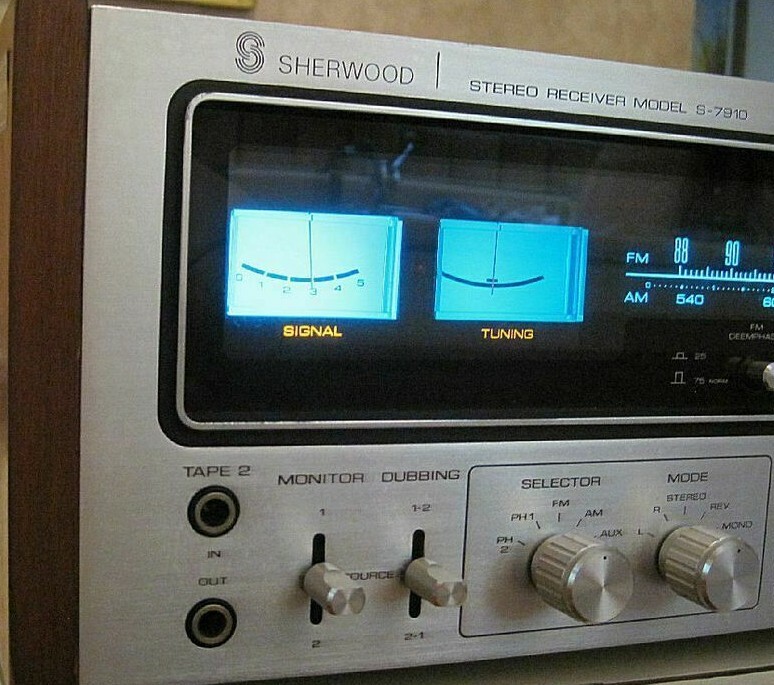
The S-8910 featured a magnetic-tuned VU meter display for output level monitoring—a stylish and functional touch that was both informative and visually appealing. The front panel was clean and intuitive, with large, knurled aluminum knobs for volume, balance, input selection, and bass/treble controls. A dedicated loudness contour switch compensated for reduced bass at low listening levels, a common feature in preamps of the era.
One of the more distinctive aspects of the S-8910 was its modular internal layout. Circuit boards were arranged for easy access, and the phono stage was often implemented on a separate sub-board, allowing for future upgrades or servicing. This design philosophy reflected Sherwood’s engineering pragmatism and focus on long-term reliability.
Sound Characteristics and Performance
The Sherwood S-8910 delivers a balanced, neutral tonal presentation with a slight warmth in the midrange—typical of well-designed American electronics from the late '70s. Its solid-state amplification avoids the harshness sometimes associated with early transistor designs, instead offering a smooth and musical character that pairs well with both vintage and modern speakers.
The phono stage is a standout feature. Designed for moving magnet (MM) cartridges, it provides excellent gain and low noise, making it suitable for all but the most low-output cartridges. The RIAA equalization is accurate, resulting in tight bass and clear highs. Vinyl enthusiasts who pair the S-8910 with a quality turntable like a Technics SL-1200 or a Dual 1019 often praise its ability to extract detail without sounding clinical.
In line-level mode, the preamp excels at transparency and dynamic control. Its low output impedance ensures compatibility with a wide range of power amplifiers, and its high input impedance prevents loading down source components. Whether driving a classic solid-state amp like a Harman Kardon HK-630 or a tube-based model like a Fisher 500C, the S-8910 maintains composure and clarity.
Notable Features and Innovations
While not packed with gimmicks, the S-8910 includes several thoughtful design elements:
- Dual-level VU meters that respond dynamically to audio signals, providing both aesthetic appeal and practical feedback.
- Separate left/right channel balance control, allowing precise stereo image adjustment—a feature often omitted in budget models.
- Tape monitor function with a dedicated switch, enabling easy comparison between live and recorded sources.
- High-quality RCA jacks mounted on a rigid rear panel, minimizing vibration and signal loss.
- Internal shielding and grounding layout designed to reduce hum and crosstalk, contributing to its low noise floor.
The S-8910 also reflects the transitional design language of the late 1970s—angular edges, brushed aluminum faceplate, and a recessed display window that gives it a slightly futuristic look for its time. It’s a preamp that feels substantial without being ostentatious.
Common Issues and Maintenance
Like any vintage electronic device, the Sherwood S-8910 benefits from periodic maintenance. Common issues include:
- Capacitor aging: Electrolytic capacitors in the power supply and signal path may dry out over time, leading to hum, reduced channel output, or instability. A full recapping is recommended for units that have been in storage.
- Potentiometer noise: The volume and tone controls may develop crackling sounds due to dust or oxidation. Cleaning with contact cleaner (e.g., DeoxIT) often resolves this.
- VU meter dimming: The internal bulbs in the VU meters can burn out. Replacement bulbs are typically standard grain-of-wheat types and easy to source.
- Oxidized jacks: RCA inputs and outputs may need cleaning to restore optimal connectivity.
Due to its modular design, servicing the S-8910 is relatively straightforward for technicians familiar with vintage gear. Its lack of microprocessors or complex ICs makes it more repairable than later digital-era equipment.
Current Market Value and Collectibility
The Sherwood S-8910 remains a rare find in the vintage audio market. It was never produced in the same quantities as Sherwood’s receivers, and few units have survived in working condition. As of 2024, working examples typically sell for $150–$250, depending on cosmetic condition and included accessories.
While not yet a “blue chip” collectible like a Marantz 2270 or a Sansui G-3300, the S-8910 is gaining attention among modders and DIY audio enthusiasts who appreciate its clean signal path and upgrade potential. Some have retrofitted it with modern op-amps or discrete buffers to enhance performance, though purists prefer to keep it in original form.
Its value lies not just in nostalgia, but in its authentic late-'70s American hi-fi character—a reminder of a time when solid engineering and user-friendly design went hand in hand.
Conclusion and Legacy
The Sherwood S-8910 may not be a household name, but it represents the quiet excellence of American audio engineering at the close of the 1970s. It’s a preamplifier built for real-world use—durable, sonically honest, and elegantly designed. For the listener who values transparency over hype, and craftsmanship over branding, the S-8910 offers a rewarding experience.
In an era increasingly obsessed with rare Japanese receivers and tube gear, the Sherwood S-8910 stands as a compelling alternative: a well-built, under-the-radar component that delivers far more than its modest reputation suggests. Whether used as the centerpiece of a vintage system or as a nostalgic nod to American hi-fi heritage, the S-8910 deserves a second look—and a proper place on the shelf.
eBay Listings


As an eBay Partner, we earn from qualifying purchases. This helps support our independent vintage technology research.
Related Models
- Sherwood S-7010A (1976)
- Sherwood S-7110A (1978)
- Sherwood S-7225A (1975)
- Sherwood RX-4109 (1976)
- Sherwood AI-1110 (1978)
- Luxman L-530 (1975)
- Luxman R-404 (1975)
- Luxman RV-371 (1975)
- Luxman SQ-38U (1975)
- Luxman T-14 (1972)