Sherwood S-8600: The Integrated Command Center of Late '70s Hi-Fi
In the golden era of analog audio—when wood-grain fascias, sweeping VU meters, and warm tube-like sound defined the high-fidelity experience—Sherwood carved out a reputation for building sophisticated, feature-rich audio equipment that balanced performance with practicality. Among its most intriguing offerings from the late 1970s was the Sherwood S-8600, a unique hybrid component that defied simple categorization. Not quite a receiver, not quite a standalone preamp or tuner, the S-8600 was an integrated control center designed for audiophiles who wanted centralized command over their expanding stereo systems.
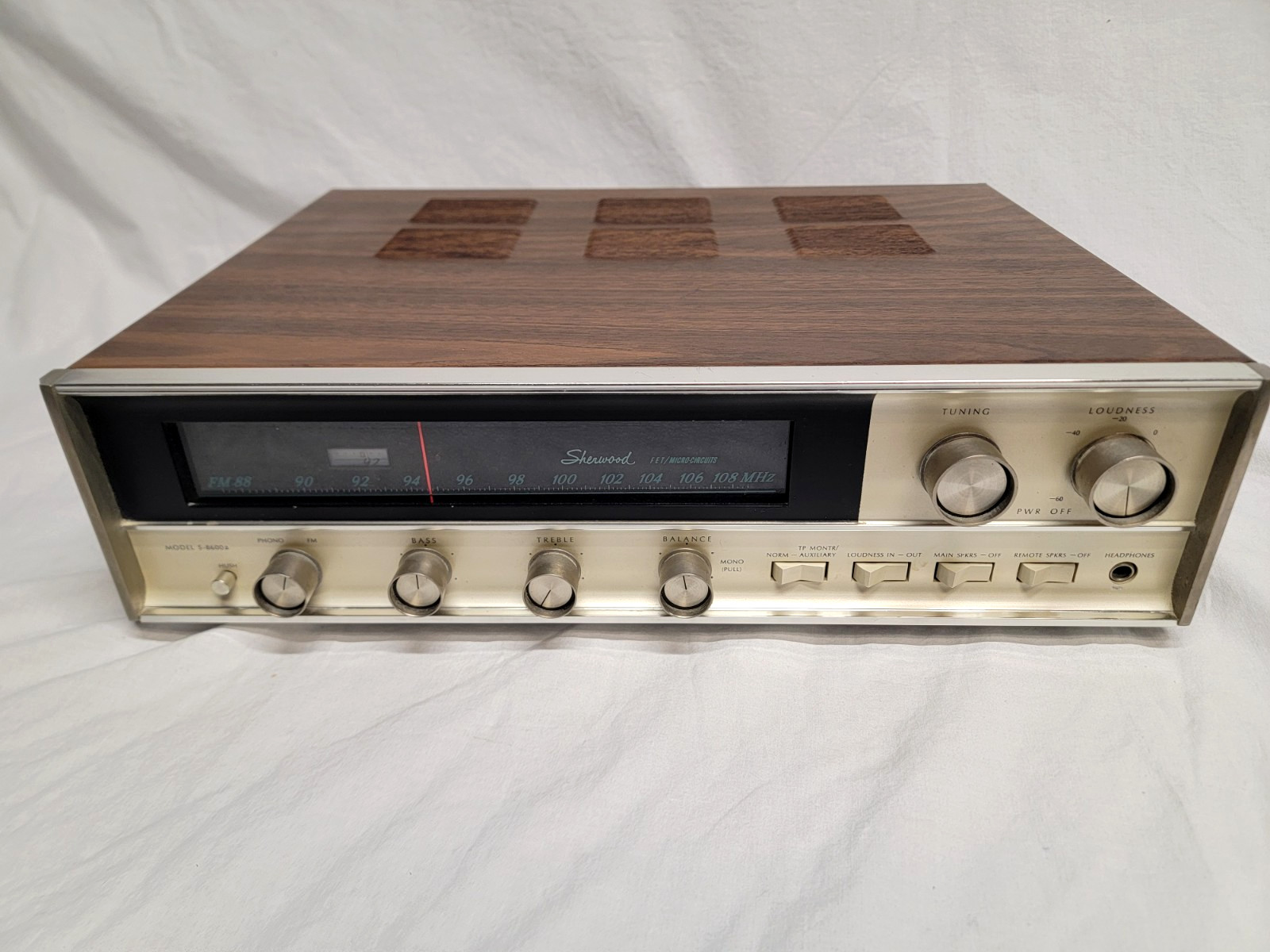
Released in 1978, the S-8600 arrived at a time when home audio systems were growing more complex. Turntables, tape decks, FM tuners, and multiple amplification stages were common, and managing source selection, volume, tone, and balance across components could be cumbersome. Sherwood addressed this with the S-8600: a high-performance preamplifier and tuner combo housed in a single, elegantly designed chassis with a striking horizontal meter bridge and luxurious finish options, typically in matte black or wood-veneer side panels.
Rather than integrating a power amplifier (as receivers did), the S-8600 focused on signal routing, source management, and FM reception, making it ideal for users pairing it with external power amplifiers. This modular approach appealed to purists who wanted to mix and match components for optimal sound quality—a philosophy that was gaining traction in the late '70s audiophile community.
Technical Specifications
The Sherwood S-8600 was engineered with precision and built to high standards for its time. While detailed service manuals are scarce today, surviving units and user reports confirm its robust construction and thoughtful design.
| Specification | Detail |
| Model | S-8600 |
| Year Introduced | 1978 |
| Category | Integrated Control Center (Preamp + Tuner) |
| Inputs | 4 line-level (Tape, Aux, Phono, Tuner), MM phono stage |
| Outputs | Main out, Tape out, Headphones |
| Tuner Bands | FM, AM (via ferrite bar antenna) |
| FM Tuning | Analog dial with fine-tuning knob |
| Signal-to-Noise Ratio | Approx. 70dB (FM), 60dB (phono) |
| Total Harmonic Distortion | <0.1% (line), <0.5% (phono) |
| Frequency Response | 20Hz–20kHz (±1dB) |
| Tone Controls | Bass, Treble (±12dB at 100Hz/10kHz), Loudness |
| Power Supply | Internal linear transformer |
| Power Consumption | 45 watts |
| Dimensions | 440mm (W) × 140mm (H) × 320mm (D) |
| Weight | 10.5 kg (23 lbs) |
| Finish Options | Black faceplate with silver knobs, wood-veneer side panels |
Notably, the S-8600 featured a dual VU meter bridge that displayed both left and right channel output levels—a visual hallmark that gave the unit a professional, studio-grade appearance. The FM section included quad differential amplifier circuitry, a design Sherwood touted for improved signal clarity and reduced distortion, especially in weak signal areas.
Sound Characteristics and Performance
The S-8600 delivered a sound signature typical of high-end late-'70s gear: smooth, warm, and detailed, with a slightly forward midrange that brought vocals and acoustic instruments to life. Its discrete transistor-based preamp stage offered excellent channel separation and low noise, making it ideal for high-resolution analog sources like vinyl and reel-to-reel tape.
The MM phono stage was well-regarded for its clarity and low hum, though it lacked RIAA accuracy adjustments or subsonic filtering—features that would become standard in later decades. Still, for listeners using quality moving magnet cartridges of the era (such as Shure or Audio-Technica), the phono stage provided ample gain and a pleasingly musical presentation.
FM reception was strong for its class, with good selectivity and stereo separation. The analog tuning dial, while lacking digital precision, offered a satisfying tactile experience, and the fine-tuning knob allowed users to lock onto weak or adjacent stations with care.
Notable Features and Innovations
What set the S-8600 apart from contemporaries was its system integration philosophy:
- Centralized Control: With four inputs and dedicated tape monitoring, the S-8600 acted as a hub for turntables, cassette decks, and tuners.
- High-Visibility VU Meters: More than just decorative, the meters helped users optimize recording levels and monitor channel balance.
- Tone Defeat Switch: A welcome feature for purists, allowing listeners to bypass tone controls for a more direct signal path.
- Headphone Amplifier: A built-in headphone amp with a front-panel 1/4" jack provided private listening without needing external gear.
- Heavy-Duty Construction: Double-sided circuit boards, high-quality potentiometers, and a massive toroidal-like transformer contributed to long-term reliability.
Sherwood also emphasized electromagnetic shielding in the S-8600’s design to reduce crosstalk and interference—especially important given the proximity of the sensitive tuner section to the preamp circuitry.
Common Issues and Maintenance
Like all vintage electronics from this era, the Sherwood S-8600 benefits from periodic maintenance:
- Capacitor Aging: Electrolytic capacitors in the power supply and signal path may have dried out, leading to hum, channel imbalance, or power issues. A full recapping is recommended for units not serviced in decades.
- Potentiometer Noise: The volume and balance controls can develop crackling or channel dropouts. Cleaning with contact cleaner may help, but replacement with modern equivalents is often necessary.
- Tuner Alignment: FM sensitivity can degrade over time. A professional alignment ensures optimal reception.
- Dust and Oxidation: Internal dust buildup and oxidation on switches and jacks can affect performance. A thorough cleaning is advised before powering up a long-stored unit.
Despite these age-related concerns, the S-8600 is generally considered well-built and repairable, with many surviving units still operational today thanks to the availability of generic replacement parts.
Current Market Value and Collectibility
The Sherwood S-8600 is not as widely collected as models from Marantz, Sansui, or Pioneer, but it holds a cult following among vintage audio enthusiasts who appreciate its unique form factor and integrated functionality. Units in good working condition typically sell for $150–$300, with pristine, fully serviced examples commanding higher prices, especially if accompanied by original documentation or packaging.
Its collectibility is enhanced by its distinctive aesthetics—the dual VU meters and horizontal layout make it a standout on any vintage rack. While not a "holy grail" component, it represents a fascinating intersection of form, function, and late-'70s hi-fi philosophy.
Conclusion and Legacy
The Sherwood S-8600 stands as a testament to an era when audio components were designed not just for performance, but for user experience and system cohesion. It wasn’t merely a preamp or tuner—it was a command center for the analog enthusiast, blending utility with elegance.
Though overshadowed by more famous brands, the S-8600 deserves recognition for its thoughtful engineering, premium build, and distinctive design. For collectors and restorers, it offers a rewarding project. For listeners, it delivers the rich, analog warmth that defines vintage hi-fi at its best.
In a world increasingly dominated by digital streaming and minimalist design, the Sherwood S-8600 reminds us of a time when listening to music was a tactile, visual, and deeply immersive experience—one where every knob turned, every needle danced, and every note resonated with intention.
eBay Listings


As an eBay Partner, we earn from qualifying purchases. This helps support our independent vintage technology research.
Related Models
- Sherwood S-7010A (1976)
- Sherwood S-7110A (1978)
- Sherwood S-7225A (1975)
- Sherwood RX-4109 (1976)
- Sherwood AI-1110 (1978)
- Luxman L-530 (1975)
- Luxman R-404 (1975)
- Luxman RV-371 (1975)
- Luxman SQ-38U (1975)
- Luxman T-14 (1972)