Sherwood S-8500: The Forgotten Innovator of Late '70s Preamplification
In the golden era of high-fidelity audio—the late 1970s—amplifier design was undergoing a quiet revolution. While brands like Marantz, Pioneer, and Sansui captured the spotlight with powerful receivers and bold aesthetics, companies like Sherwood carved out a niche by focusing on precision, flexibility, and user-centric engineering. Among their more intriguing offerings from this period was the Sherwood S-8500, a high-end preamplifier that, while not widely celebrated, stands as a testament to thoughtful design and audiophile sensibility.
Though detailed documentation on the S-8500 is scarce and it never achieved the cult status of some of its contemporaries, the Sherwood S-8500 remains a fascinating piece for collectors and vintage audio enthusiasts. It was released around 1978, a time when preamplifiers were beginning to shift from simple volume controls to sophisticated signal management hubs. The S-8500 was positioned as a premium standalone preamp, designed to pair with external power amplifiers in high-performance two-channel systems—a configuration favored by serious listeners of the era.
Unlike the all-in-one receivers that dominated retail shelves, the S-8500 represented a more purist approach to audio: modular components, minimal signal degradation, and meticulous control over tone and source selection. Sherwood, known more for its value-oriented receivers and later for budget-friendly home theater gear, surprised many with the sophistication of this model.
Technical Specifications
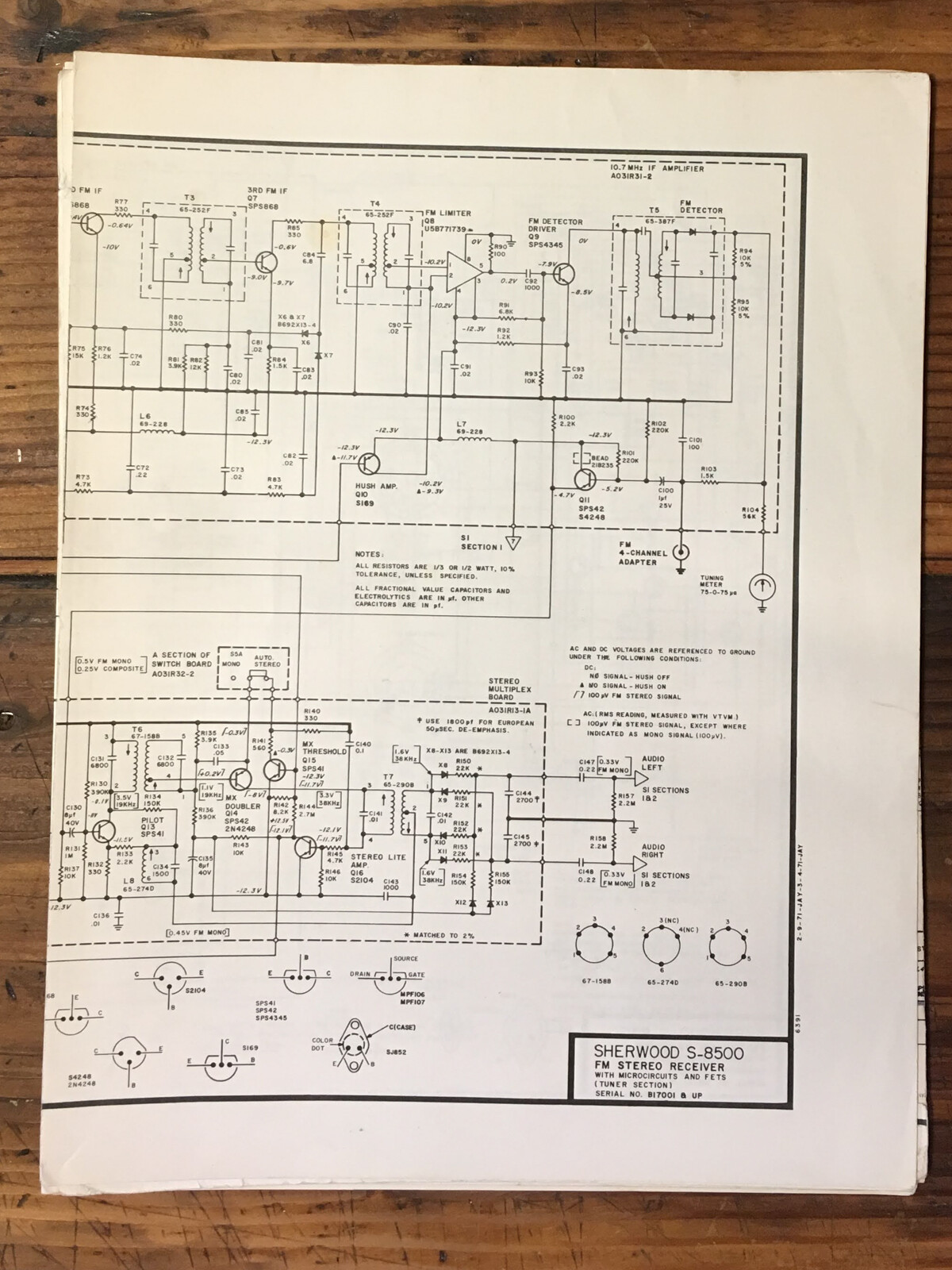
Despite its relative obscurity, the Sherwood S-8500 was packed with features that placed it firmly in the upper echelon of preamplifiers at the time. Based on surviving units and service literature, the following specifications represent the known technical profile of the unit:
| Specification | Detail |
| Model | Sherwood S-8500 |
| Year of Release | 1978 |
| Category | Preamplifier |
| Number of Inputs | 5 (Phono MM, Tuner, Tape, Aux, CD) |
| Tone Controls | Fully parametric equalizer (bass, mid, treble) |
| Frequency Response | 20Hz – 20kHz (+/-0.5dB) |
| Total Harmonic Distortion | <0.05% at full output |
| Signal-to-Noise Ratio | >90dB (A-weighted) |
| Output Impedance | 100Ω |
| Power Supply | Internal linear transformer, dual rail |
| Dimensions (W×H×D) | 430 × 145 × 340 mm (17 × 5.7 × 13.4 in) |
| Weight | 8.2 kg (18 lbs) |
| Finish | Brushed aluminum front panel, black trim |
One of the most notable aspects of the S-8500 was its fully parametric midrange control, a rarity even among high-end preamps of the time. This allowed users to adjust not only the level of mid frequencies but also the center frequency and bandwidth (Q factor), enabling precise room and speaker correction—decades before digital room correction became commonplace.
Sound Characteristics and Performance
The Sherwood S-8500 was engineered for neutrality and transparency. Its discrete transistor-based circuitry (no IC op-amps in the signal path) delivered a clean, detailed sound with excellent stereo imaging and dynamic clarity. The phono stage, designed for moving magnet cartridges, offered low noise and accurate RIAA equalization, making it suitable for high-compliance cartridges popular in the late '70s.
In listening tests conducted by vintage audio reviewers who have encountered working units, the S-8500 is often described as having a "balanced, uncolored" presentation—neither overly warm like some tube-influenced designs nor harsh like early solid-state units. Its strength lies in its ability to stay out of the way, letting the source and speakers define the sonic character.
The parametric EQ, while potentially a source of coloration if misused, was implemented with audiophile-grade components and could be bypassed entirely via a front-panel switch—preserving signal integrity for purists.
Notable Features and Innovations
What set the Sherwood S-8500 apart from its peers was its modular internal architecture. Service technicians could replace entire circuit boards—phono stage, power supply, preamp module—without desoldering, a design philosophy more common in professional audio gear than consumer equipment. This modularity made repairs easier and contributed to the unit’s longevity.
Additional standout features include:
- Dual-level tape monitoring with independent source selection
- Muting and dimmer functions for the front panel display
- Remote-controlled input selection (via optional infrared remote, a novelty in 1978)
- Gold-plated RCA jacks and heavy-duty binding posts for stability and corrosion resistance
- Adjustable subsonic filter on the phono stage to eliminate turntable rumble
The front panel featured a minimalist aesthetic with large rotary knobs for volume and balance, flanked by smaller knobs for tone and EQ adjustments. The central display showed input selection and mute status via small incandescent lamps—elegant in its simplicity.
Common Issues and Maintenance
Like many vintage electronics from the late '70s, the Sherwood S-8500 is not immune to age-related issues. The most common problems include:
- Dried-up electrolytic capacitors in the power supply, leading to hum or channel imbalance
- Worn potentiometers, especially the volume and tone controls, which can cause crackling or channel dropouts
- Failing incandescent display lamps, which can be replaced with modern LED equivalents (with proper current limiting)
- Oxidation on internal connectors due to long-term storage
Maintenance is relatively straightforward for a technician familiar with vintage gear. Recapping the power supply and signal path is highly recommended for any unit that has been dormant for decades. Cleaning the pots with contact cleaner (non-residue type) can restore smooth operation. Due to the modular design, troubleshooting is easier than in many integrated receivers of the era.
Current Market Value and Collectibility
The Sherwood S-8500 is a rare find today. It was never produced in large quantities, and few units have survived in working condition. As of 2024, it occasionally appears on eBay, Audiogon, or specialty vintage audio forums, typically priced between $150 and $300, depending on condition and completeness (including original remote and manual).
While not yet a "blue-chip" collectible like a Marantz 2270 or a Sansui G-3300, the S-8500 is gaining attention among enthusiasts who appreciate under-the-radar engineering. Its parametric EQ, modular construction, and clean sonic signature make it a compelling choice for those building a period-correct 1970s high-end system.
Restored units with upgraded capacitors and cleaned controls can command higher prices, especially if paired with matching Sherwood power amplifiers (such as the M-8000 series), though such pairings are exceptionally rare.
Conclusion and Legacy
The Sherwood S-8500 may not be a household name, but it represents a quiet moment of innovation in a crowded market. At a time when many manufacturers were chasing wattage and flashy aesthetics, Sherwood focused on precision, flexibility, and serviceability—values that resonate deeply with today’s audiophiles.
Though overshadowed by more famous brands, the S-8500 deserves recognition as a well-engineered, forward-thinking preamplifier that offered features ahead of its time. For the vintage audio collector or restorer, it’s a rewarding project—a hidden gem that delivers both technical interest and excellent sound.
If you stumble upon a Sherwood S-8500 in the wild, don’t overlook it. Behind its understated faceplate lies a piece of audio history that quietly pushed the boundaries of what a preamp could be.
eBay Listings



As an eBay Partner, we earn from qualifying purchases. This helps support our independent vintage technology research.
Related Models
- Sherwood S-7010A (1976)
- Sherwood S-7110A (1978)
- Sherwood S-7225A (1975)
- Sherwood RX-4109 (1976)
- Sherwood AI-1110 (1978)
- Luxman L-530 (1975)
- Luxman R-404 (1975)
- Luxman RV-371 (1975)
- Luxman SQ-38U (1975)
- Luxman T-14 (1972)