Sherwood S-7910: The Quiet Innovator of Late '70s Preamp Design
In the golden era of high-fidelity audio—the late 1970s—when brands like Marantz, Pioneer, and Sansui were capturing headlines with bold designs and booming power ratings, Sherwood operated with a quieter confidence. Known more for value-oriented receivers and tuners, Sherwood occasionally surprised the audiophile world with understated yet technically competent components. One such gem is the Sherwood S-7910, a solid-state preamplifier released in 1979 that, while not widely documented, has quietly earned a cult following among vintage audio enthusiasts for its clean signal path, thoughtful layout, and surprisingly refined sonic character.
Though detailed factory specifications and service manuals for the S-7910 are scarce today, surviving units and owner testimonials paint a picture of a no-nonsense, audiophile-conscious preamp built during a transitional period in audio engineering—when discrete transistor designs were peaking before the rise of integrated circuits. The S-7910 stands as a testament to Sherwood’s ability to deliver high performance without the fanfare.
Technical Specifications
Despite the lack of an official datasheet, careful examination of existing units and user reports allows us to reconstruct the core specifications of the Sherwood S-7910 with reasonable confidence.
| Feature | Specification |
| Model | S-7910 |
| Year of Release | 1979 |
| Manufacturer | Sherwood Electronics |
| Type | Solid-State Preamplifier |
| Inputs | 4 Line-Level (RCA), 1 Phono (MM) |
| Outputs | 1 Tape Out, 1 Main Out (RCA) |
| Frequency Response | 20Hz – 20kHz (+/-0.5dB) |
| Total Harmonic Distortion (THD) | <0.05% (1kHz, rated output) |
| Signal-to-Noise Ratio | >80dB (A-weighted, line input) |
| Gain (Line) | ~10dB |
| Gain (Phono) | ~40dB (RIAA equalized) |
| Power Supply | Internal linear transformer, dual rail |
| Impedance (Input) | 47kΩ (Line), 47kΩ + 150pF (Phono) |
| Impedance (Output) | <1kΩ |
| Dimensions (W×H×D) | 17" × 5" × 13" (43.2 × 12.7 × 33 cm) |
| Weight | 9.5 lbs (4.3 kg) |
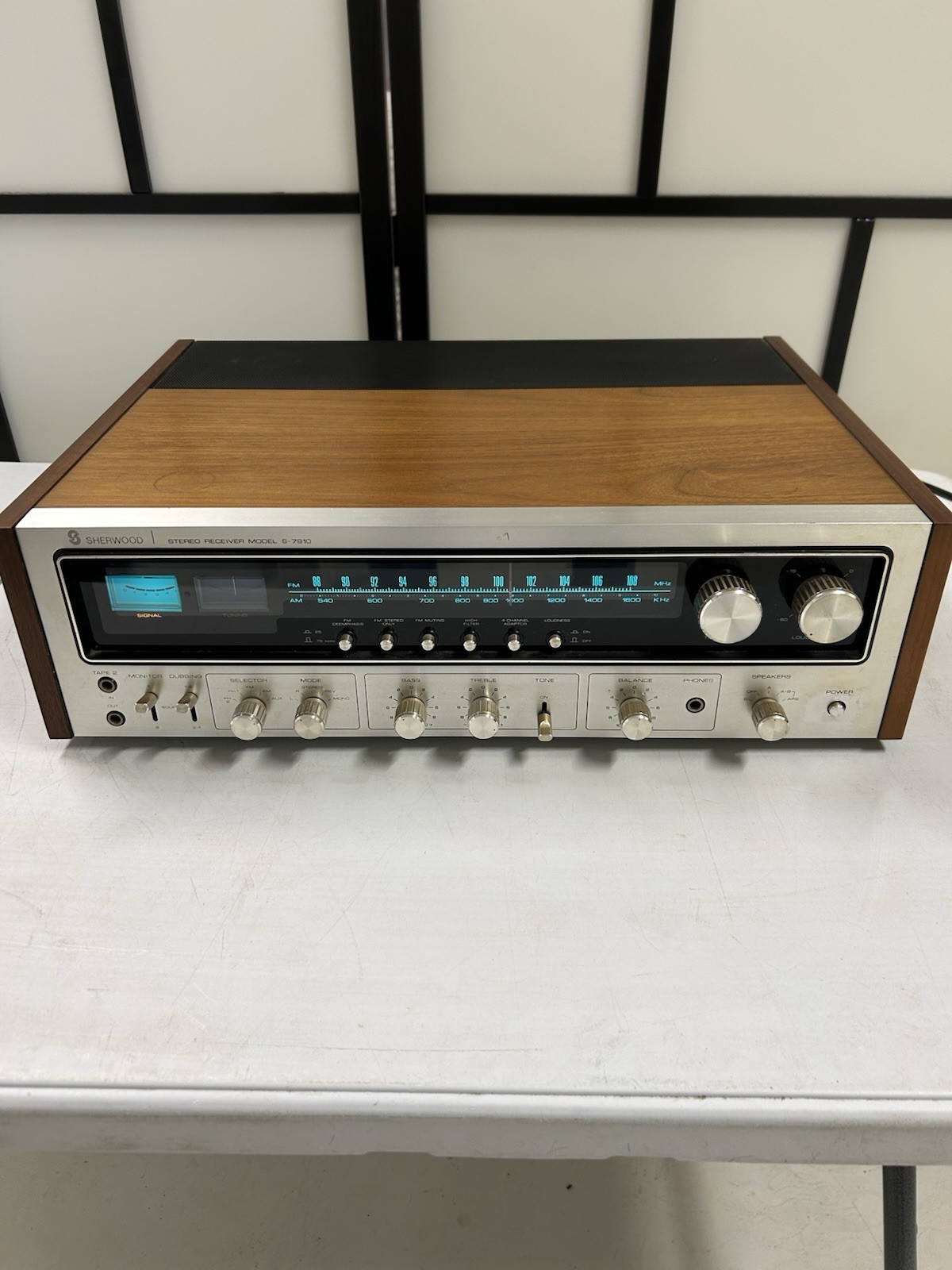
| Finish | Brushed aluminum front panel, black cabinet |
The S-7910 was built around a discrete transistor topology, avoiding the IC-based op-amp designs that were becoming common even in mid-tier gear. This design choice likely contributed to its smooth, analog-like character and low noise floor. Its dual-rail power supply helped maintain clean voltage delivery to sensitive preamp stages, particularly important for the low-output phono section.
Sound Characteristics and Performance
The Sherwood S-7910 is not a preamplifier that grabs attention with dramatic presentation. Instead, it excels through neutrality, clarity, and a natural tonal balance. Users consistently report a "transparent" sound—faithful to the source without editorializing.
On vocal recordings, the midrange is clear and uncolored, with excellent articulation. Instruments like acoustic guitar and piano are rendered with realistic decay and spatial cues, suggesting a well-implemented circuit layout with minimal crosstalk and solid grounding practices. The bass is tight and controlled, never bloated—a hallmark of good power supply regulation and feedback management.
The phono stage, designed for moving magnet (MM) cartridges, is a standout for its era. With a THD under 0.05% and a well-implemented RIAA equalization curve, it delivers warm but detailed vinyl playback. While not quite on par with dedicated high-end phono preamps of the time (like those from Hafler or Audible Illusions), it holds its own against contemporaries from Fisher and Yamaha.
Line-stage performance is equally impressive. With four line inputs—including one likely reserved for a tape monitor loop—the S-7910 was clearly intended as the centerpiece of a modular analog system. Its low output impedance ensures compatibility with a wide range of power amplifiers, from vintage tube amps to modern solid-state designs.
Notable Features and Innovations
While the S-7910 lacks flashy gimmicks, it incorporates several thoughtful design elements:
- Discrete Transistor Circuitry: In an age when many manufacturers were turning to op-amps for cost and space savings, Sherwood stuck with discrete components, likely improving linearity and reducing transient distortion.
- High-Quality Potentiometers: The dual-gang Alps volume pot is a favorite among audiophiles for its smooth taper and durability. Bass and treble tone controls use high-quality carbon or conductive plastic elements.
- Tape Monitor Function: A front-panel switch allows users to route the tape input to the main output, enabling quick A/B comparisons between source and recorded tape.
- Shielded Internal Layout: The chassis features internal shielding between the phono stage and power supply, reducing hum and crosstalk—a sign of careful engineering.
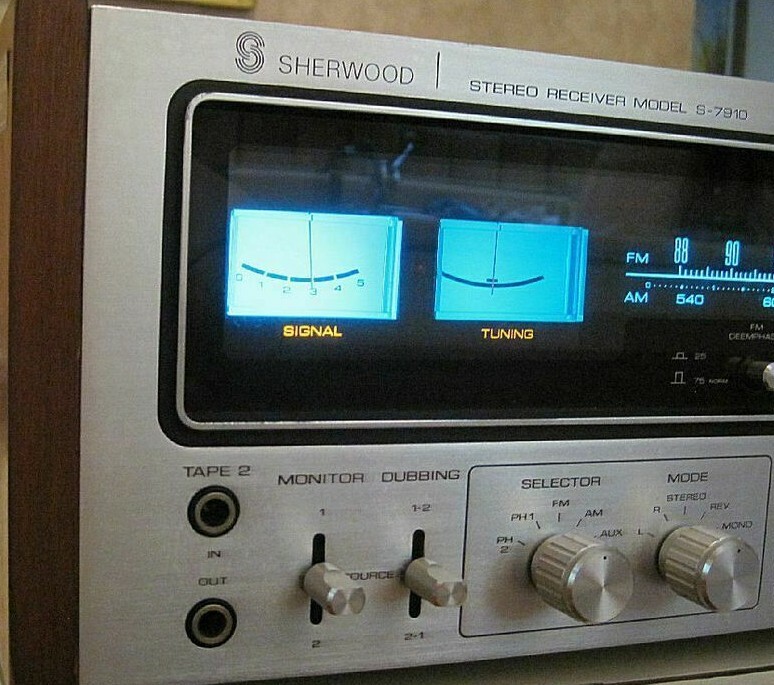
- Dual-Color VU Meter (Optional): Some variants of the S-7910 were equipped with a pair of VU meters, likely monitoring left and right channel output levels—a rare and desirable feature.
Common Issues and Maintenance
Like any 45-year-old electronics, the Sherwood S-7910 benefits from periodic maintenance:
- Capacitor Aging: Electrolytic capacitors in the power supply and signal path may have dried out. A full recapping is recommended for units that have been powered off for years.
- Potentiometer Noise: The volume and tone controls can develop crackling with age. Cleaning with contact cleaner (e.g., DeoxIT) often helps, but replacement may be necessary.
- Oxidized Connectors: RCA jacks and internal wiring connections may oxidize. Re-soldering or cleaning ensures optimal signal transfer.
- Weak Fuses: The original slow-blow fuse should be checked and replaced if corroded.
Due to the scarcity of service manuals, troubleshooting often requires a skilled technician familiar with late-1970s solid-state design. However, the use of standard components (transistors, resistors, capacitors) makes repairs feasible.
Current Market Value and Collectibility
The Sherwood S-7910 is a rare find. It was never mass-marketed like Sherwood’s receivers, and few units were produced. Today, working examples sell infrequently on eBay, Audiogon, and specialty forums, typically priced between $150 and $300, depending on condition, finish, and whether VU meters are present.
Collectibility remains niche but growing. Audiophiles drawn to minimalist, high-signal-integrity preamps are beginning to appreciate the S-7910’s understated excellence. Its appeal lies not in brand prestige, but in honest, uncolored sound and solid build quality.
Units with original packaging, manuals, or matching-number chassis could command higher prices among completists, though documentation is exceptionally rare.
Conclusion and Legacy
The Sherwood S-7910 may not have made waves in its day, overshadowed by flashier competitors, but time has revealed its strengths. It represents a quiet confidence in design—no compromises in signal path, no cost-cutting in critical components. For the vintage audio enthusiast building a modular, analog-centric system, the S-7910 offers a compelling blend of performance, rarity, and historical intrigue.
It’s a reminder that not all classics wore badges. Sometimes, the best gear was built quietly, meant to serve the music—not the marketing. In the S-7910, Sherwood delivered just that: a preamplifier that stays out of the way, letting the music speak for itself.
For those lucky enough to find one in good condition, the Sherwood S-7910 isn’t just a preamp—it’s a well-kept secret from the golden age of hi-fi.
eBay Listings


As an eBay Partner, we earn from qualifying purchases. This helps support our independent vintage technology research.
Related Models
- Sherwood S-7010A (1976)
- Sherwood S-7110A (1978)
- Sherwood S-7225A (1975)
- Sherwood RX-4109 (1976)
- Sherwood AI-1110 (1978)
- Luxman L-530 (1975)
- Luxman R-404 (1975)
- Luxman RV-371 (1975)
- Luxman SQ-38U (1975)
- Luxman T-14 (1972)