Sherwood S-7800A: The Understated Preamp Gem of the Late 1970s
In the golden era of high-fidelity audio—the late 1970s—amidst the rise of integrated receivers and the growing demand for separates, Sherwood carved out a niche with a series of well-engineered, no-frills components. Among these, the Sherwood S-7800A stands as a quiet but compelling example of thoughtful preamplifier design from an era when American audio brands sought to balance performance, reliability, and affordability. Though not as widely celebrated as contemporaries from Marantz, Pioneer, or Sansui, the S-7800A has earned a loyal following among vintage audio enthusiasts for its clean signal path, modular construction, and understated functionality.
Released in 1978, the S-7800A was positioned as a high-quality preamplifier in Sherwood’s premium lineup. Unlike the company’s more common receivers, this unit was part of a growing trend toward separates—components designed to be paired with external power amplifiers for improved sonic performance. The S-7800A was not built to dazzle with flashy features or excessive power output; instead, it focused on precision, clarity, and system integration, making it a favorite among audiophiles who valued transparency and long-term reliability.
Technical Specifications
Despite its relative obscurity in modern collector circles, the Sherwood S-7800A boasts a solid set of specifications that reflect the engineering standards of its time. It was designed with a dual-mono preamplifier topology, ensuring minimal crosstalk and a stable, balanced signal. The unit features discrete transistor circuitry—common for the era—with no reliance on integrated circuits in the audio path, which many purists believe contributes to a more natural sound.
| Specification | Detail |
| Model | Sherwood S-7800A |
| Year of Release | 1978 |
| Category | Preamplifier |
| Construction Type | Discrete transistor, dual-mono design |
| Inputs | 4 line-level (RCA), 1 tape loop |
| Outputs | Main out, tape out, preamp out |
| Frequency Response | 20Hz – 20kHz (+/-0.5dB) |
| Total Harmonic Distortion | <0.05% at full output |
| Signal-to-Noise Ratio | >80dB |
| Channel Separation | >40dB at 1kHz |
| Power Supply | Internal linear transformer |
| Dimensions (W×H×D) | 420 × 145 × 305 mm (16.5 × 5.7 × 12 in) |
| Weight | 7.8 kg (17.2 lbs) |
| Finish | Black or woodgrain vinyl (regional variants) |
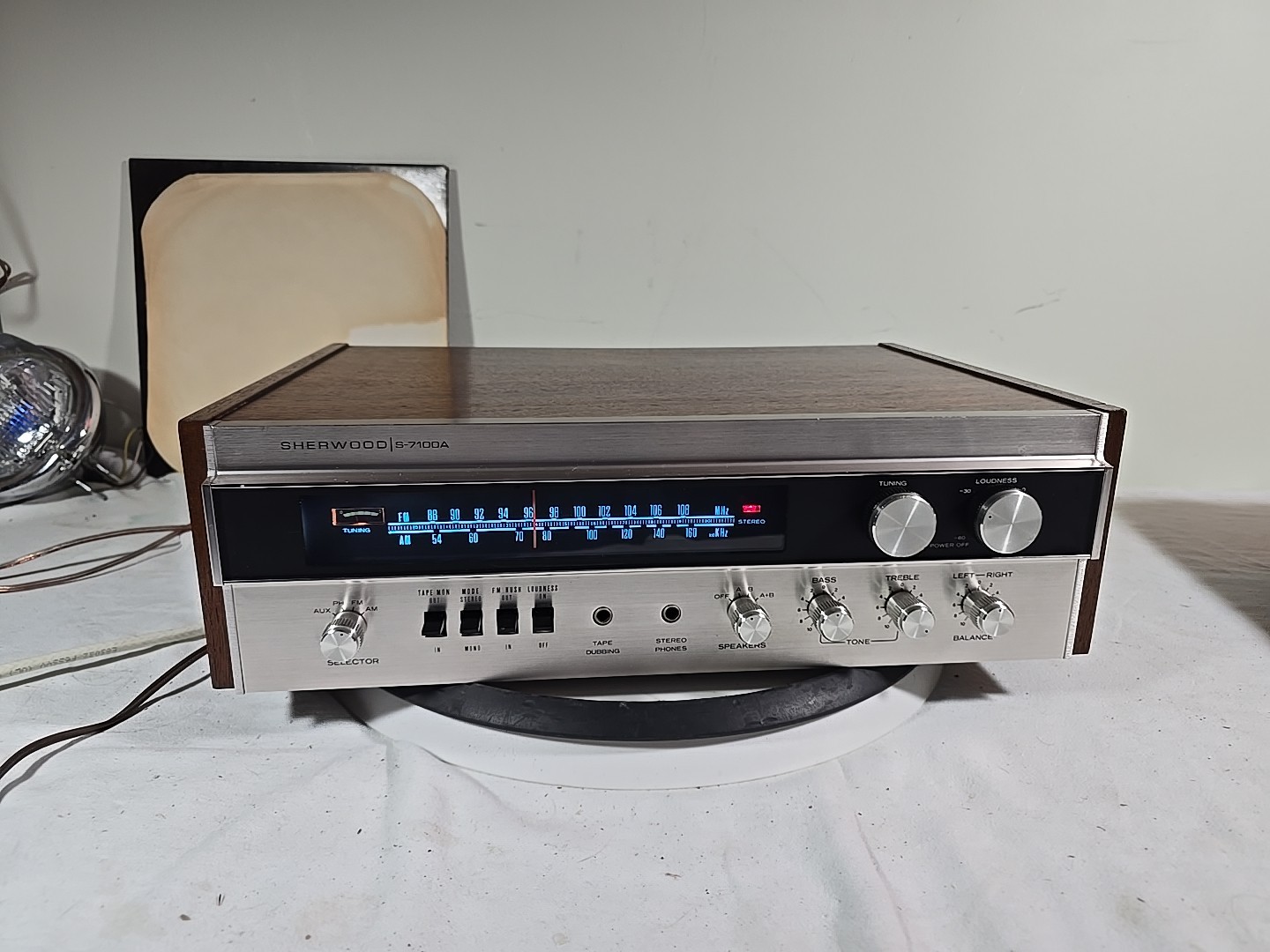
The S-7800A features a straightforward front panel layout: a large central volume knob, source selector, balance control, and dedicated switches for mute, mono, and tape monitoring. The rear panel includes gold-plated RCA jacks for improved connectivity and shielding against interference. Notably, the unit includes a modular circuit board design, allowing for easier servicing—a feature that was ahead of its time and appreciated by technicians.
Sound Characteristics and Performance
The sonic signature of the Sherwood S-7800A is best described as neutral, detailed, and well-controlled. Unlike some of its contemporaries that leaned into warm, tube-like coloration, the S-7800A delivers a transparent and accurate representation of the source material. This makes it an excellent match for both vintage and modern speakers, especially those that benefit from a clean, uncolored signal.
Bass response is tight and well-defined, without the bloat sometimes found in receivers of the era. Midrange clarity is excellent, making vocals and acoustic instruments sound lifelike and present. High frequencies are smooth and extended, avoiding the harshness that can plague poorly designed transistor gear. The wide channel separation and low distortion contribute to a spacious stereo image, with precise instrument placement and good depth.
When paired with a high-quality power amplifier—such as a vintage Yamaha, Harman Kardon, or even a restored Leak amplifier—the S-7800A reveals its true potential as a serious preamplifier capable of driving high-end systems with authority and finesse.
Notable Features and Innovations
While the S-7800A may appear modest at first glance, it incorporates several thoughtful design choices:
- Modular Construction: Internal circuit boards are designed for easy replacement, a rarity in consumer audio gear of the 1970s. This modularity simplifies repairs and extends the unit’s lifespan.
- Tape Monitor Function: Allows users to switch between live input and tape playback seamlessly—a feature prized by audiophiles who recorded and archived music on reel-to-reel or cassette.
- Dual-Mono Signal Path: Minimizes interference between channels, enhancing stereo imaging and dynamic range.
- High-Quality Potentiometer: The Alps volume control ensures smooth, precise adjustment and long-term reliability.
- Low-Noise Design: Careful grounding and shielding reduce hum and background noise, even in sensitive systems.
These features, while not revolutionary, reflect a commitment to quality and user experience that was not always present in mid-tier audio brands.
Common Issues and Maintenance
Like all vintage electronics, the Sherwood S-7800A requires periodic maintenance to perform at its best. The most common issues include:
- Capacitor Aging: Electrolytic capacitors in the power supply and signal path may dry out over time, leading to hum, channel imbalance, or complete failure. A full recapping is recommended for units that have been in storage.
- Dirty Controls: The volume pot and selector switches can develop crackling or dropouts. Cleaning with contact cleaner (e.g., DeoxIT) often resolves this.
- Oxidized Jacks: RCA connectors may corrode, especially if stored in humid environments. Light polishing or replacement ensures optimal signal transfer.
- Transformer Issues: While rare, the internal transformer can develop hum if damaged. This usually requires professional repair.
Given its modular design, the S-7800A is relatively serviceable. Replacement parts—especially Alps pots and standard capacitors—are readily available, making restoration feasible for DIY enthusiasts.
Current Market Value and Collectibility
The Sherwood S-7800A remains a rare find on the vintage audio market. It was never produced in the same volumes as Sherwood receivers, and many units have been lost to time or discarded. As of 2024, working examples in good cosmetic condition typically sell for $150–$300, depending on finish, included accessories, and provenance.
Collectibility is growing slowly, driven by enthusiasts seeking high-quality separates from lesser-known brands. While it lacks the cult status of a Marantz 2270 or a Sansui G-3300, the S-7800A appeals to purists who value performance over brand name. Its potential for restoration and integration into modern tube-or-transistor hybrid systems adds to its appeal.
Conclusion and Legacy
The Sherwood S-7800A may not be a household name, but it represents the quiet excellence of American audio engineering in the late 1970s. Built with care, designed for longevity, and sonically competent, it stands as a testament to Sherwood’s commitment to quality beyond their more commercial receiver lines.
For the vintage audio collector or restorer, the S-7800A offers a rewarding project and a capable preamplifier that can hold its own in a high-fidelity system. It may not have the glamour of Japanese contemporaries, but in its simplicity, reliability, and honest sound, it earns a quiet respect.
If you stumble upon a Sherwood S-7800A in a basement, thrift store, or online auction, don’t overlook it. Beneath its modest exterior lies a well-crafted piece of audio history—one that deserves a second life in a lovingly restored vintage setup.
eBay Listings


As an eBay Partner, we earn from qualifying purchases. This helps support our independent vintage technology research.
Related Models
- Sherwood S-7010A (1976)
- Sherwood S-7110A (1978)
- Sherwood S-7225A (1975)
- Sherwood RX-4109 (1976)
- Sherwood AI-1110 (1978)
- Luxman L-530 (1975)
- Luxman R-404 (1975)
- Luxman RV-371 (1975)
- Luxman SQ-38U (1975)
- Luxman T-14 (1972)