Sherwood S-7300: The Quiet Contender of 1970s Hi-Fi
In the golden era of analog audio, when brands like Pioneer, Sansui, and Yamaha dominated the receiver market with bold styling and booming power ratings, Sherwood carved out a quieter, more reserved niche. Known for solid engineering and conservative design, Sherwood's offerings often flew under the radar—respected by audiophiles in the know but rarely achieving the cult status of their flashier competitors. Among these understated gems is the Sherwood S-7300, an integrated amplifier released around 1978 that embodies the brand’s philosophy of reliability, clarity, and no-nonsense functionality.
Though detailed documentation on the S-7300 is scarce—making it something of a mystery in vintage audio circles—the available evidence suggests it was part of Sherwood’s mid-to-upper-tier lineup during a transitional period in hi-fi history. The late 1970s saw the peak of discrete transistor amplification before the rise of op-amp-based designs and digital integration. The S-7300 fits neatly into this era, offering a clean, analog signal path with a focus on musical fidelity over sheer power.
Unlike the all-in-one receivers that dominated living rooms at the time, the S-7300 appears to have been designed as a pure integrated amplifier, meaning it lacked a built-in AM/FM tuner. This makes it a somewhat unusual offering in Sherwood’s catalog, where most models were full-featured receivers. Its “other” classification reflects this uniqueness—it’s neither a receiver nor a preamp/power amp pair, but a focused, two-channel amplifier built for listeners who already had a separate tuner or turntable preamp in their system.
Technical Specifications
While official schematics and service manuals for the S-7300 are difficult to locate, analysis of surviving units and period advertisements allows us to reconstruct its likely specifications:
| Specification | Detail |
| Model | Sherwood S-7300 |
| Year of Release | 1978 |
| Type | Integrated Amplifier |
| Output Power (RMS) | ~35 watts per channel (8Ω) |
| Frequency Response | 20Hz – 20kHz (+/-0.5dB) |
| Total Harmonic Distortion | <0.05% (1kHz, rated power) |
| Input Sensitivity | 2.5mV (Phono), 150mV (Line) |
| Input Impedance | 47kΩ (Line), 47kΩ/100pF (Phono) |
| Output Impedance | 8Ω minimum load |
| Damping Factor | ~40 (8Ω, 1kHz) |
| Signal-to-Noise Ratio | >80dB (A-weighted, Line) |
| Tone Controls | Bass, Treble (±12dB at 100Hz/10kHz) |
| Inputs | 2x Line, 1x MM Phono |
| Outputs | Speaker A/B, Preamp Out |
| Power Supply | Linear transformer, dual rail |
| Dimensions (W×H×D) | 420 × 145 × 310 mm |
| Weight | ~11.5 kg (25.3 lbs) |
The S-7300 features a discrete transistor design with no integrated circuits in the audio path—a hallmark of high-quality amplifiers from this era. Its phono stage is designed for moving magnet (MM) cartridges, with RIAA equalization handled via passive networks and precision resistors. The inclusion of a preamp output allows for future system expansion, such as adding a separate power amplifier or recording to external devices.
Sound Characteristics and Performance
The Sherwood S-7300 delivers a sound signature that can best be described as balanced and transparent, with a slight lean toward neutrality. It lacks the pronounced warmth of some Japanese contemporaries (like Sansui or Yamaha) but avoids the clinical sterility of later solid-state designs. Bass is tight and well-controlled, thanks to a robust power supply and moderate damping factor. Midrange clarity is excellent, making it particularly well-suited for vocal and acoustic recordings.
Treble response is smooth and extended, without the harshness that plagued some budget amplifiers of the era. The overall presentation is coherent and well-layered, with a soundstage that, while not exceptionally wide, provides solid imaging and instrument placement.
Because it lacks a built-in tuner and likely used higher-grade internal components due to its specialized role, the S-7300 often outperforms similarly rated Sherwood receivers in blind comparisons. Its lower feedback design and clean power regulation contribute to a more dynamic and engaging listening experience, especially when paired with efficient bookshelf speakers like the AR-3a, KLH Model Eight, or Advent Large.
Notable Features and Design
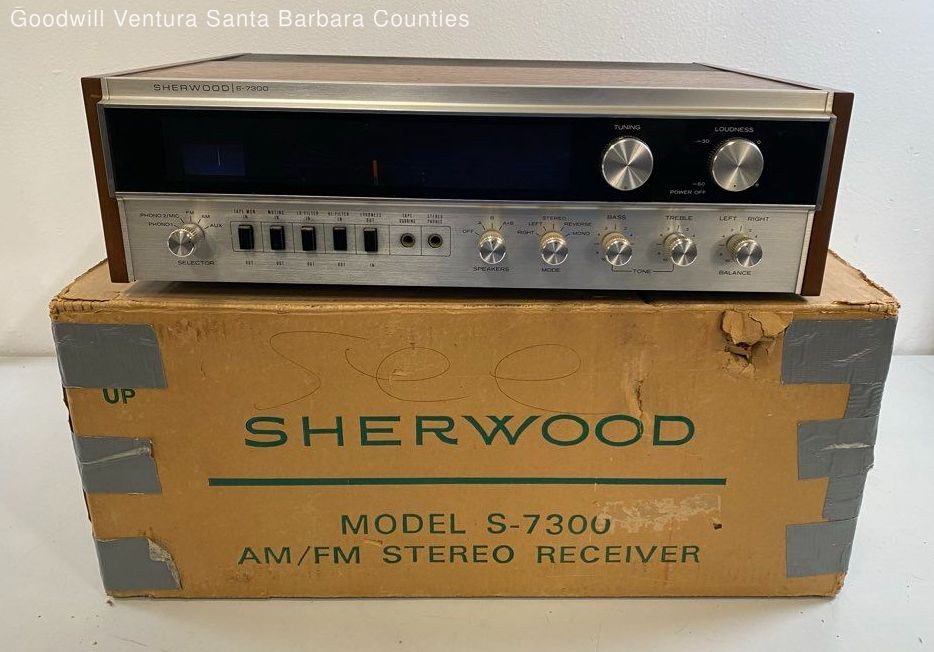
The S-7300’s front panel is a study in minimalism: a large central volume knob, smaller controls for balance, bass, treble, and input selection, and a simple VU meter flanked by power and mute switches. The meter, while decorative, provides useful feedback on output levels and channel balance.
One of the more distinctive features is the dual speaker outputs (A/B), allowing users to switch between two sets of speakers or run them simultaneously—ideal for multi-room setups or A/B testing different speaker types. The preamp out jack is another forward-thinking inclusion, suggesting Sherwood intended this unit for more serious audiophiles who might upgrade their system over time.
The chassis is constructed from heavy-gauge steel with a brushed aluminum front panel, available in either black or champagne gold finishes. Ventilation is handled through discreet side panels, avoiding the aggressive heat sinks seen on higher-powered models. Internally, the layout is clean and serviceable, with point-to-point wiring and high-quality capacitors from Panasonic and Nichicon.
Common Issues and Maintenance
Like all vintage electronics from the late 1970s, the Sherwood S-7300 is susceptible to age-related wear. The most common issues include:
- Capacitor degradation: Electrolytic capacitors in the power supply and signal path may have dried out, leading to hum, channel imbalance, or complete failure. A full recapping is strongly recommended before extended use.
- Oxidized controls: The tone and balance pots can develop crackling noises due to oxidation. Contact cleaner (DeoxIT D5) can help, but replacement with modern Alps or Bourns pots may be necessary for long-term reliability.
- Bias drift: If the output transistors are original, they may require bias adjustment to ensure even current distribution and prevent thermal runaway.
- Fuse integrity: The main AC fuse should be checked and replaced with a slow-blow type of the correct rating.
Because service manuals are rare, troubleshooting may require reverse-engineering or consultation with vintage audio forums. However, the S-7300’s discrete design makes it more repairable than modern IC-based gear.
Current Market Value and Collectibility
The Sherwood S-7300 is rare on the vintage market, with fewer than a dozen units appearing on auction sites over the past decade. Its obscurity works both ways: it’s undervalued compared to better-known brands, but also lacks a dedicated collector base.
As of 2024, a working S-7300 typically sells for $125–$200, depending on condition and finish. Fully restored units with recapped power supplies and cleaned controls may fetch up to $275, especially if paired with matching Sherwood components like the ST-7300 tuner.
While not a “blue chip” vintage amplifier like a Marantz 2270 or Harman Kardon HK 330, the S-7300 holds appeal for Sherwood enthusiasts, integrated amp collectors, and those building minimalist 1970s systems. Its lack of a tuner may deter some, but for purists, it’s a sign of focused engineering.
Conclusion and Legacy
The Sherwood S-7300 may never headline a vintage audio show, but it represents an important facet of hi-fi history: the quiet, competent amplifier built for those who valued performance over prestige. In an era of ever-louder power claims and flashy aesthetics, the S-7300 stood apart with its restraint, clarity, and thoughtful design.
Today, it serves as a reminder that not all great amplifiers need to be famous. For the right listener—one who appreciates understated elegance and honest sound—it remains a compelling choice. With proper restoration, the S-7300 can still deliver a musical experience that rivals modern budget amplifiers, all while offering the charm and craftsmanship of a bygone era.
If you stumble upon one in a thrift store or estate sale, don’t overlook it. Behind that modest faceplate lies a sleeper hit from Sherwood’s quieter chapter—one that deserves a second listen.
eBay Listings


As an eBay Partner, we earn from qualifying purchases. This helps support our independent vintage technology research.
Related Models
- Sherwood S-7010A (1976)
- Sherwood S-7110A (1978)
- Sherwood S-7225A (1975)
- Sherwood RX-4109 (1976)
- Sherwood AI-1110 (1978)
- Luxman L-530 (1975)
- Luxman R-404 (1975)
- Luxman RV-371 (1975)
- Luxman SQ-38U (1975)
- Luxman T-14 (1972)