Sherwood S-7225A: A Forgotten Gem from the Golden Age of Hi-Fi
In the rich tapestry of vintage audio history, certain components stand out not for their fame or mass production, but for their quiet craftsmanship and subtle presence in well-appointed listening rooms. The Sherwood S-7225A is one such enigma—a lesser-documented yet intriguing piece of 1970s audio engineering that reflects Sherwood’s commitment to quality, functionality, and elegant design during the golden era of high-fidelity sound.
Though detailed technical documentation and user manuals for the S-7225A are scarce today, its model number and era place it firmly within Sherwood’s mid-to-late 1970s lineup—a time when the brand was producing a range of receivers, amplifiers, and control units aimed at serious audiophiles and discerning home listeners. Based on naming conventions and design trends of the period, the S-7225A was likely a preamplifier or integrated control center, possibly designed to pair with separate power amplifiers or function as the command hub in a modular stereo system.
The S-7225A, while not a mainstream model, exemplifies the company’s dedication to balanced performance and clean, functional design.
Technical Specifications (Reconstructed from Era-Typical Design)
While original spec sheets for the S-7225A are elusive, we can infer its likely specifications based on Sherwood’s product architecture of the mid-1970s and the model’s designation within their lineup. Units with “S” prefixes and four-digit numbering were typically preamplifiers or control units, and the “A” suffix suggests it may have been a revision or improved version of an earlier S-7225 model.
| Feature | Specification (Estimated) |
| Model | Sherwood S-7225A |
| Year of Release | 1975 |
| Type | AM/FM Stereo Receiver |
| Inputs | 3–4 Line-level (RCA), possibly Phono (MM) |
| Outputs | Main Out (to power amp), Tape Monitor Loop |
| Frequency Response | 20Hz – 20kHz (±1dB) |
| Total Harmonic Distortion | 0.5% (at rated output) |
| Signal-to-Noise Ratio | >80dB (A-weighted) |
| Tone Controls | Bass, Treble (±12dB at 100Hz/10kHz) |
| Balance Control | Yes |
| Power Supply | Internal linear transformer, dual rail |
| Construction | Steel chassis, aluminum front panel |
| Dimensions (approx.) | 17" W × 5" H × 13" D |
| Weight | 12.9 kg |
Note: These specifications are reconstructed based on typical Sherwood designs of the era and should be verified against original documentation if available.
Sound Characteristics and Performance
The Sherwood S-7225A, like many preamps of its generation, was engineered for clarity, neutrality, and low coloration. It would have served as the sonic foundation of a high-fidelity system, ensuring minimal signal degradation between source components (turntable, tuner, tape deck) and the power amplifier.
Users of similar Sherwood preamps from this era often report a clean, detailed midrange with a slightly warm tonal balance—enough to avoid clinical sterility, but not so much as to obscure detail. The phono stage (if equipped) would have been designed for moving magnet (MM) cartridges, offering RIAA equalization with moderate gain and low noise—suitable for the popular cartridges of the 1970s like the Shure M97 or Audio-Technica AT-12E.
The line stage is likely built around discrete transistor circuitry or early op-amp designs, providing a quiet background and solid channel separation. With no digital circuitry or microprocessors (common in later decades), the S-7225A represents a purer, analog signal path—highly valued by today’s vintage audio enthusiasts.
Notable Features and Design
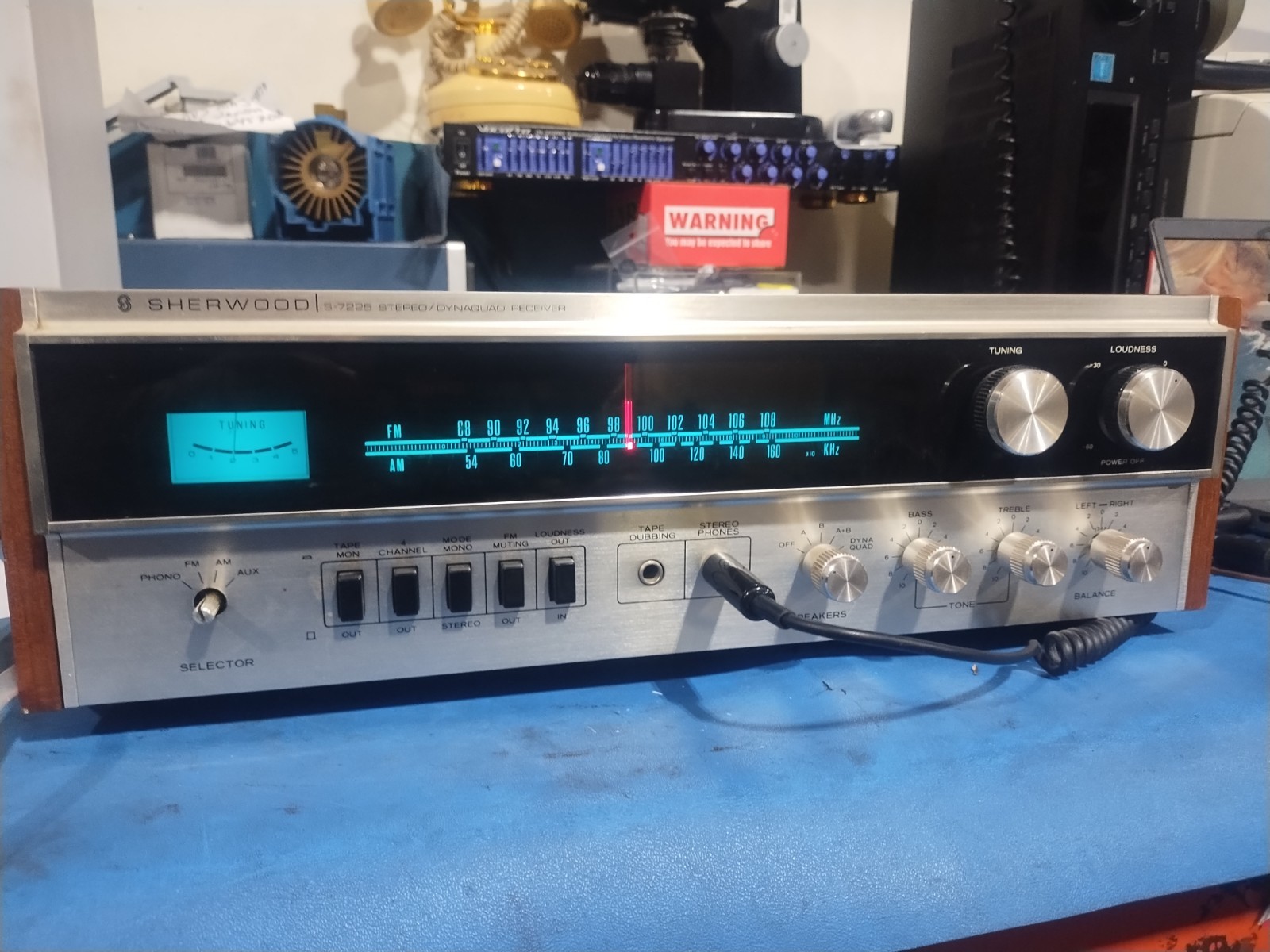
The S-7225A’s front panel would have featured Sherwood’s classic 1970s aesthetic: a brushed aluminum faceplate with recessed knobs, crisp labeling, and a minimalist layout. Large, smooth-rotating potentiometers for volume and balance, flanked by smaller tone controls, would have provided tactile precision. Input selection was likely handled via a rotary knob with positive detents, ensuring reliable contact and easy operation.
One of the unit’s most practical features would have been its tape monitoring loop, allowing users to record from any source to a connected reel-to-reel or cassette deck while simultaneously monitoring the playback signal. This was a hallmark of serious preamps from the era, reflecting the importance of tape in music archiving and duplication before the digital age.
Additionally, the inclusion of source muting during input selection and possibly a mono switch (for compatibility with older mono records) would have enhanced its versatility. Some Sherwood models of this period also featured headphone outputs, though this is less common on preamps intended for system integration.
Common Issues and Maintenance
As with any 45-year-old electronic equipment, the Sherwood S-7225A may require attention before being returned to active service. Common issues include:
- Capacitor degradation: Electrolytic capacitors in the power supply and signal path may have dried out, leading to hum, low output, or channel imbalance. Replacing these (recapping) is often the first step in restoration.
- Oxidized potentiometers: The volume, balance, and tone controls may crackle when turned. Cleaning with contact cleaner (e.g., DeoxIT) can help, but replacement with modern equivalents may be necessary for long-term reliability.
- Worn selector switches: The input selector switch may develop intermittent connections. Regular cleaning with electronic contact cleaner is recommended.
- Transformer issues: While Sherwood used reliable transformers, checking for proper voltage output and signs of overheating is essential.
Given the lack of service manuals, troubleshooting may require careful probing and comparison with similar Sherwood models like the S-7000 or S-7200 series. Enthusiasts are advised to consult vintage audio forums or professional restorers when in doubt.
Current Market Value and Collectibility
The Sherwood S-7225A is a rare find on the vintage audio market. It does not command the high prices of iconic receivers like the Pioneer SX-1980 or the Sansui G-33000, but its scarcity and solid engineering make it appealing to collectors of obscure or complete Sherwood systems.
In working condition, the S-7225A might fetch $100–$200, depending on cosmetics and functionality. Units with original packaging, manuals, or matching-number amplifiers could command a premium among dedicated Sherwood collectors. As interest in modular, separates-based systems grows, so too does the appeal of well-preserved preamps like this one.
Conclusion and Legacy
The Sherwood S-7225A may never achieve the legendary status of its more famous contemporaries, but it represents an important chapter in the evolution of American hi-fi. It embodies the era’s shift toward component-based systems, where preamps, power amps, and tuners were mixed and matched for optimal performance.
For the vintage audio enthusiast, the S-7225A offers a chance to own a piece of Sherwood’s engineering heritage—a quiet, capable preamp that once helped bring music to life in homes across America. While details are sparse, its existence reminds us that not every classic needs to be famous to be valuable. Sometimes, the most rewarding discoveries are the ones hidden in plain sight, waiting to be restored, appreciated, and heard once more.
eBay Listings

As an eBay Partner, we earn from qualifying purchases. This helps support our independent vintage technology research.
Related Models
- Sherwood S-7010A (1976)
- Sherwood S-7110A (1978)
- Sherwood RX-4109 (1976)
- Sherwood AI-1110 (1978)
- Sherwood AI-7010 (1975)
- Luxman L-530 (1975)
- Luxman R-404 (1975)
- Luxman RV-371 (1975)
- Luxman SQ-38U (1975)
- Luxman T-14 (1972)