Sherwood S-7200 FM Stereo Tuner: A Classic Slice of Analog Radio Heritage
In the mid-1970s, as stereo component audio systems reached new heights of popularity, FM radio was undergoing a golden age. With high-fidelity broadcasts becoming the norm and stereo transmission widely adopted, audiophiles sought out dedicated FM tuners to extract the best possible sound from the airwaves. Among the respected names in this niche was Sherwood, a brand known for delivering solid performance and thoughtful engineering at accessible price points. The Sherwood S-7200, introduced in 1975, stands as a notable example of the company’s commitment to quality during this analog renaissance.
Though not as widely documented as some of its contemporaries from Sony, Pioneer, or Sansui, the Sherwood S-7200 carved out a loyal following among radio enthusiasts and vintage audio collectors for its clean design, reliable tuning, and rich sonic character. As a standalone FM stereo tuner, it was designed to be paired with a preamplifier and power amplifier, allowing audiophiles to integrate high-performance radio into their custom stereo setups.
Technical Specifications
The Sherwood S-7200 was engineered with the precision expected of high-end tuners of its era. While detailed service manuals are scarce today, surviving units and user reports confirm a robust set of specifications that placed it competitively among mid-to-high-tier tuners of the 1970s.
| Specification | Detail |
| Model | Sherwood S-7200 |
| Year Introduced | 1975 |
| Category | FM Stereo Tuner |
| Tuning Range | 87.5–108 MHz |
| Tuning Method | Analog dial with illuminated pointer |
| IF Frequency | 10.7 MHz (standard for FM) |
| Sensitivity (Mono) | ~1.5 µV for 30 dB SNR |
| Sensitivity (Stereo) | ~2.5 µV for 30 dB SNR |
| Signal-to-Noise Ratio | >60 dB (A-weighted, typical) |
| Total Harmonic Distortion | <0.5% (1 kHz, full output) |
| Stereo Separation | >40 dB at 1 kHz |
| Output Level | ~0.5 V RMS (for 40 dBf input) |
| Output Impedance | ~10 kΩ |
| Input for Accessories | Remote control (optional) |
| Power Requirements | 120V AC, 60 Hz, ~15W |
| Dimensions (W×H×D) | 430 × 140 × 310 mm (approx. 17" × 5.5" × 12.2") |
| Weight | ~8.5 kg (18.7 lbs) |
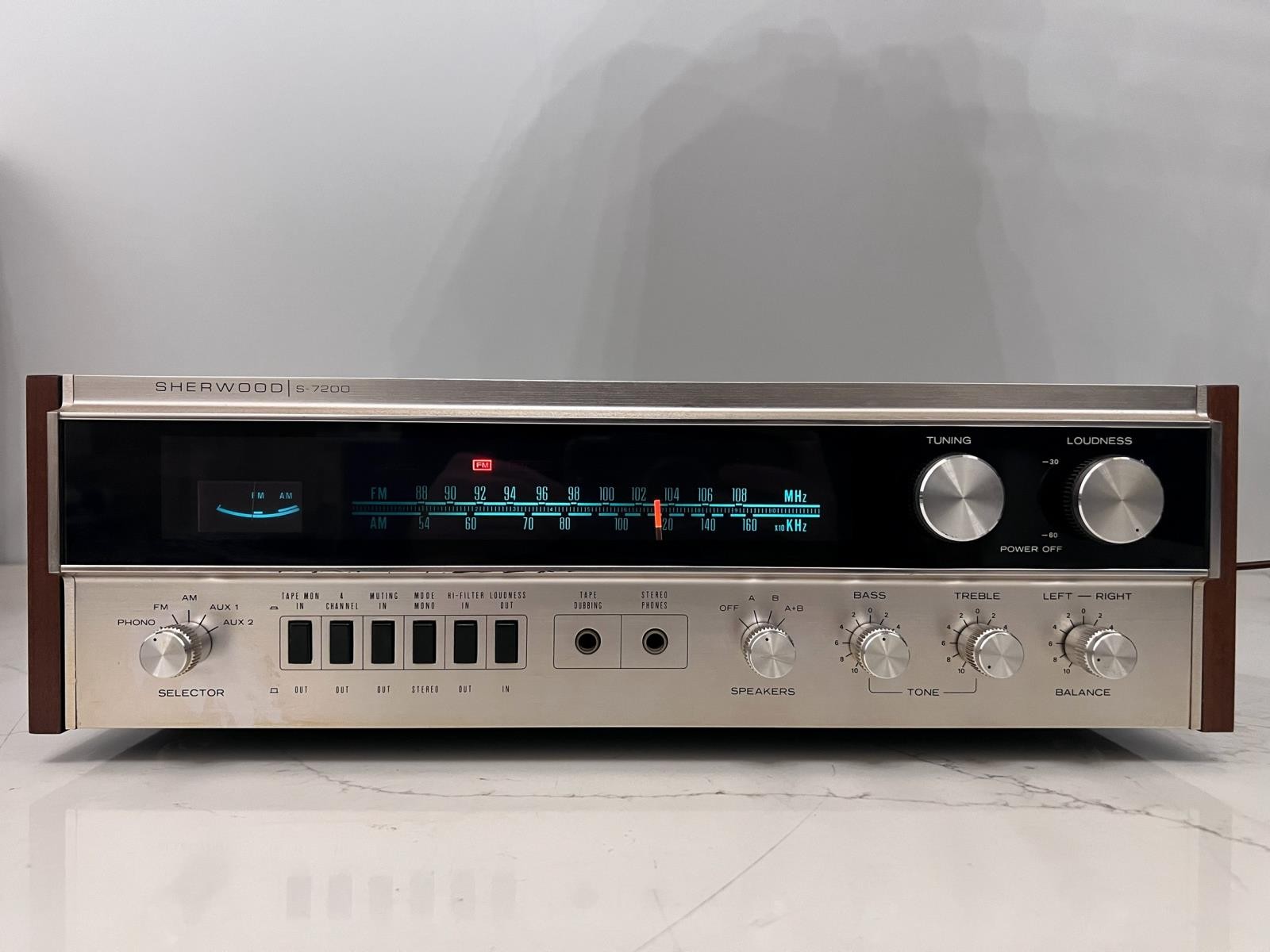
The S-7200 features a classic double-conversion superheterodyne circuit, a design favored for its excellent image rejection and stable reception—especially important in urban environments with strong signal interference. Its front panel includes a large, easy-to-read analog tuning dial with a luminous pointer, a stereo indicator LED, and controls for tuning, bandwidth (wide/narrow), and muting.
Sound Characteristics and Performance
The Sherwood S-7200 is prized for its warm, natural tonal balance—a hallmark of well-designed analog tuners from the 1970s. Unlike later digital PLL tuners, which prioritized tuning precision over sonic character, the S-7200 delivers a slightly softer, more musical presentation that many listeners find pleasing, especially with classical, jazz, and acoustic broadcasts.
Its stereo imaging is impressive for its time, with a stable center image and good channel separation that enhances the sense of space in live radio performances. The tuner handles multipath distortion gracefully, thanks to its well-tuned limiting amplifier and de-emphasis network. The audio output is clean and dynamic, with minimal background hiss when a strong signal is received.
Users often report that the S-7200 excels at pulling in weak stations with clarity, especially when paired with a high-quality outdoor antenna. Its narrow/wide bandwidth switch allows listeners to reduce noise on marginal signals or preserve full high-frequency response on strong ones—a practical feature that adds versatility.
Notable Features and Innovations
While the Sherwood S-7200 doesn’t boast the flashiest features of its era, it incorporates several thoughtful design elements:
- Double Conversion Circuitry: Enhances selectivity and reduces interference, a significant advantage over simpler single-conversion designs.
- Analog Tuning with Precision Dial: Offers a tactile, immersive tuning experience that many modern digital tuners lack.
- Bandwidth Selector: Allows optimization of reception quality depending on signal strength and interference.
- Muting Function: Silences the output during tuning to eliminate loud pops and hiss.
- High-Quality Internal Shielding: Minimizes internal noise and crosstalk, contributing to a cleaner signal path.
- Solid Build Quality: Constructed with a heavy-gauge steel chassis and high-grade components, typical of Sherwood’s mid-tier offerings.
The S-7200 also features a clean, minimalist front panel with brushed aluminum finish and soft blue illumination—styling cues that reflect the elegant industrial design trends of the 1970s.
Common Issues and Maintenance
As with any vintage electronic equipment, the Sherwood S-7200 may require maintenance after decades of use. Common issues include:
- Deteriorated Electrolytic Capacitors: The power supply and audio coupling capacitors may dry out over time, leading to hum, reduced output, or power failure. A full recapping is often recommended for long-term reliability.
- Tuning Dial Stiffness: The tuning mechanism can become sticky due to dried lubricant. Cleaning and re-lubrication with appropriate synthetic grease can restore smooth operation.
- Faded or Dim Dial Light: The incandescent bulb behind the tuning scale may burn out or dim. Replacement with a low-voltage LED (with proper current limiting) can restore brightness while reducing heat.
- Oxidized Controls and Switches: Potentiometers and toggle switches may develop crackling noises. Contact cleaner (applied carefully) can often resolve this.
- Antenna Input Corrosion: The 75-ohm coaxial and 300-ohm twin-lead inputs may suffer from oxidation. Cleaning with electrical contact spray and checking connections is advised.
Given the relative scarcity of service manuals, enthusiasts often rely on community forums and schematic comparisons with similar Sherwood models for repair guidance.
Current Market Value and Collectibility
The Sherwood S-7200 is not a mainstream collector’s item like the legendary Sony ST-5055 or the Harman Kardon T20, but it holds quiet appeal among FM tuner enthusiasts and vintage radio purists. Well-maintained units in good cosmetic and working condition typically sell for $100–$200 on the secondary market, with prices rising for fully restored examples or those with original packaging.
Its collectibility is bolstered by its solid engineering, pleasing aesthetics, and strong performance, especially for listeners who value analog tuning and warm sound. While it may not command top dollar, the S-7200 represents excellent value for those building a period-correct 1970s stereo system or exploring the art of FM DXing (long-distance radio reception).
Conclusion and Legacy
The Sherwood S-7200 FM Stereo Tuner is a testament to an era when radio was not just a source of information, but a high-fidelity entertainment medium. In a time before streaming and satellite audio, tuners like the S-7200 brought concert halls, jazz clubs, and global broadcasts into living rooms with remarkable clarity.
Though overshadowed by more famous brands, the S-7200 delivers performance that punches above its weight, combining thoughtful engineering with a musical soul. For vintage audio lovers, it’s more than a tuner—it’s a portal to the golden age of analog radio, where every twist of the dial could uncover a new sonic treasure.
If you’re lucky enough to find one in good condition, the Sherwood S-7200 is well worth restoring and integrating into a classic audio setup. It’s a quiet masterpiece of its time—modest in name, but rich in experience.
eBay Listings


As an eBay Partner, we earn from qualifying purchases. This helps support our independent vintage technology research.
Related Models
- Sherwood AX-9030R (1980)
- Sherwood AD-266R (1978)
- Sherwood AX-5015R (1978)
- Sherwood S-7000 (1977)
- Sherwood S-7110 (1978)
- Aiwa CS-250 (1978)
- Denon TU-1500RD (1995)
- Denon TU-280 (1976)
- Denon TU-501 (1977)
- Denon TU-550 (1978)