Sherwood S-5000II: The Forgotten Audiophile Preamp of the Late 1970s
In the late 1970s, the high-fidelity audio market was booming. Japanese manufacturers like Pioneer, Denon, and Sansui dominated headlines, but American brands like Sherwood carved out a loyal following with refined, no-nonsense designs that emphasized sonic clarity and build integrity. Among Sherwood’s most respected offerings from this era was the S-5000II—a high-performance preamplifier that, while not as widely celebrated as some of its contemporaries, remains a hidden gem for vintage audio enthusiasts.
Though detailed documentation on the S-5000II is scarce today, surviving units and user testimonials paint a picture of a serious piece of audio gear aimed at the discerning listener. Released in 1978, the S-5000II was positioned as Sherwood’s flagship preamplifier, sitting atop a lineup that included integrated receivers and power amps. Unlike the flashy, feature-laden designs of the time, the S-5000II embraced a minimalist, performance-first philosophy—focusing on low noise, wide bandwidth, and precise channel balance.
Technical Specifications
The S-5000II was engineered during a transitional period in audio electronics, bridging the gap between tube warmth and solid-state precision. It featured a fully discrete transistor design with no reliance on integrated circuits, which was typical of high-end preamps in the late '70s. Its circuitry emphasized signal purity, with generous power supply filtering and high-quality passive components.
| Specification | Detail |
| Model | Sherwood S-5000II |
| Year of Release | 1978 |
| Type | Preamplifier |
| Inputs | 4 line-level (RCA), 1 tape loop |
| Output | Main out, tape out, pre-out to amp |
| Frequency Response | 10Hz – 60kHz (+/-0.5dB) |
| Total Harmonic Distortion | <0.05% (1kHz, rated output) |
| Signal-to-Noise Ratio | >90dB (A-weighted) |
| Gain | 12dB (line), 40dB (MM phono) |
| Phono Input | MM only (switchable loading) |
| Tone Controls | Bass, Treble (±12dB at 50Hz/10kHz) |
| Balance Control | Yes (dual-gang potentiometer) |
| Power Supply | Linear transformer, discrete regulation |
| Dimensions (W×H×D) | 17" × 5.5" × 14" |
| Weight | 14 lbs (6.4 kg) |
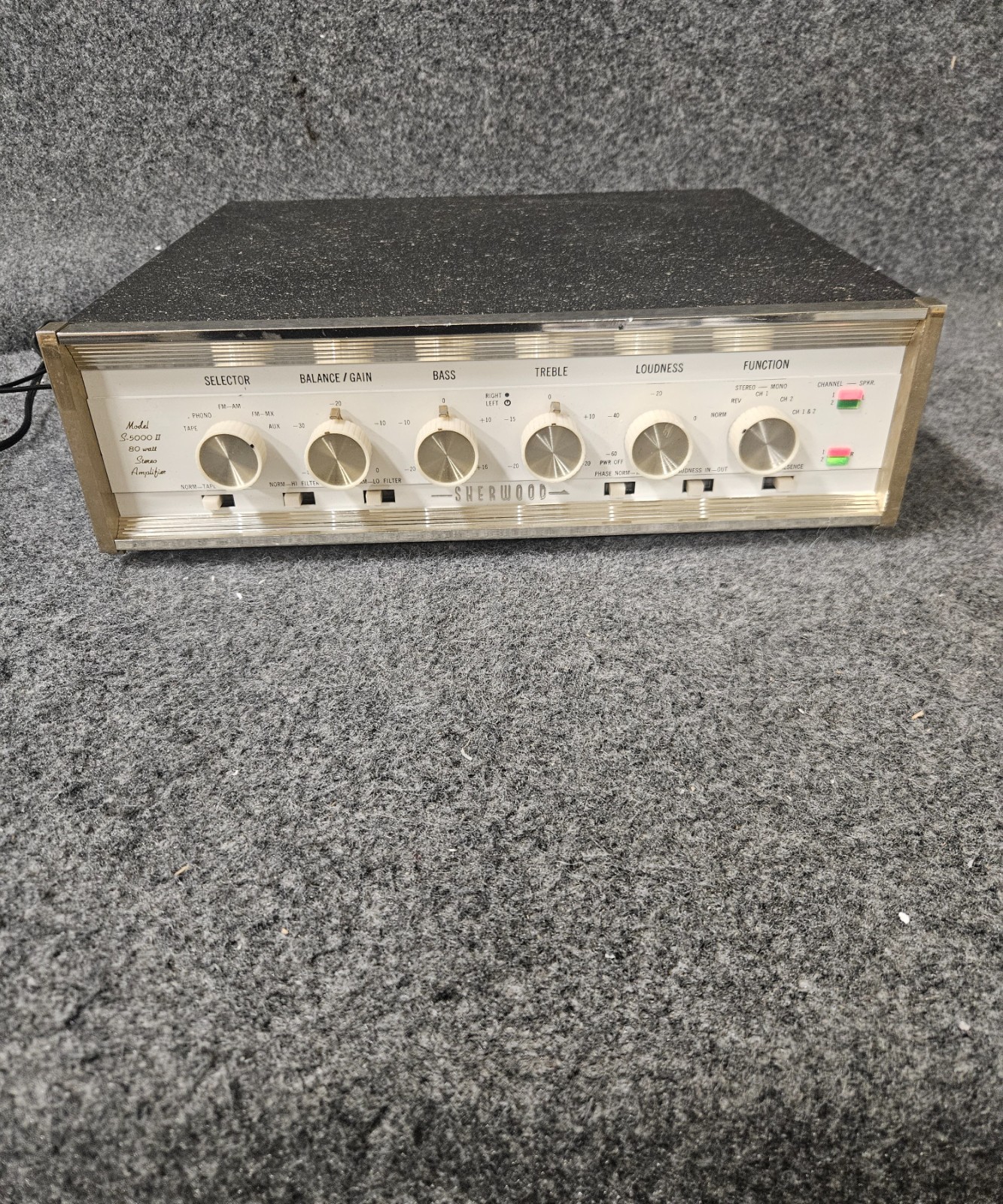
| Finish | Brushed aluminum front panel, black chassis |
Notably, the S-5000II included a high-quality moving magnet (MM) phono stage with selectable capacitive loading—a rare and thoughtful feature for the time, allowing users to fine-tune cartridge performance. The line stage used precision dual-gang potentiometers for volume and balance, contributing to excellent channel matching and long-term reliability.
Sound Characteristics and Performance
The sonic signature of the Sherwood S-5000II is best described as neutral, transparent, and dynamically expressive. Unlike some preamps of the era that leaned into warm or euphonic coloration, the S-5000II aimed for accuracy—making it an excellent match for both vintage and modern speaker systems.
Listeners often praise its exceptional clarity in the midrange, where vocals and acoustic instruments are rendered with lifelike presence. The top end is smooth and extended, avoiding the harshness that plagued some solid-state designs of the period. Bass response is tight and well-controlled, thanks to a robust power supply and low output impedance.
When paired with a high-quality power amplifier—such as a contemporaneous Dynaco, Hafler, or even a Japanese receiver like the Yamaha CA-810—the S-5000II reveals its true potential: a wide soundstage, precise imaging, and excellent micro-dynamic detail. Its phono stage, in particular, is considered among the better discrete designs of its time, capable of extracting nuanced detail from vinyl without adding coloration.
Notable Features and Innovations
While not flashy, the S-5000II incorporated several thoughtful design choices that set it apart:
- Selectable Phono Loading: A rare feature that allowed users to match the input capacitance to their cartridge (typically 100–400pF), optimizing frequency response and reducing resonance issues.
- Dual-Level Gain Switch: Some units featured a front-panel switch to toggle between normal and high-gain modes, useful when driving inefficient power amps or long interconnects.
- Tape Monitor Function: A simple but effective circuit that allowed seamless switching between source and tape output, ideal for cassette dubbing or live monitoring.
- Heavy-Duty Construction: The chassis used thick steel with internal shielding to minimize noise and microphonics. The faceplate was brushed aluminum, lending a premium feel.
- Discrete Regulation: Unlike budget units that used basic zener diodes, the S-5000II employed discrete voltage regulators for cleaner power to sensitive audio stages.
These features reflect Sherwood’s commitment to building equipment for serious listeners—not just casual consumers.
Common Issues and Maintenance
Like any vintage electronics from the 1970s, the Sherwood S-5000II requires careful attention to remain in top condition. The most common issues include:
- Dried-up Electrolytic Capacitors: The power supply and signal path capacitors degrade over time. A full recapping is highly recommended, especially if the unit has been stored for decades.
- Noisy Potentiometers: The volume and tone controls can develop scratchiness. Cleaning with contact cleaner may help, but replacement with modern high-quality pots (e.g., Alps or Noble) is often necessary.
- Oxidized Switches: The input selector and tape monitor switches can become intermittent. Regular use and occasional cleaning with DeoxIT can prevent this.
- Fading Indicator Lights: The pilot and function LEDs may dim or fail. These are typically 12V incandescent bulbs, easily replaced with modern LED equivalents (with proper current limiting).
Despite these age-related concerns, the S-5000II is generally reliable. Its fully discrete design means fewer surface-mount components and no complex ICs to fail. With proper servicing, it can deliver decades more of high-fidelity performance.
Current Market Value and Collectibility
The Sherwood S-5000II is not a mainstream collectible like a Marantz 2270 or a McIntosh C22, but it has developed a quiet following among vintage audio aficionados. Units in excellent working condition typically sell for $150–$300, depending on cosmetics and functionality.
Its value is driven more by performance than rarity—audiophiles who discover the S-5000II often keep it in their systems. Fully restored examples with upgraded capacitors and cleaned controls can command higher prices, especially when paired with matching Sherwood power amps (like the A-2500 series).
While not a “blue chip” vintage preamp, the S-5000II represents excellent value for those seeking high-end sound without the premium price tag.
Conclusion and Legacy
The Sherwood S-5000II may not have the name recognition of some of its peers, but it stands as a testament to American audio engineering during the golden age of hi-fi. Built with care, designed for accuracy, and engineered to last, it delivers a listening experience that rivals far more expensive equipment.
Today, it serves as a reminder that not all classics come from Japan or Europe—sometimes, the best finds are the quiet performers, overlooked by history but cherished by those who take the time to listen.
For the vintage audio enthusiast seeking a transparent, reliable, and musically engaging preamplifier, the Sherwood S-5000II is well worth seeking out. With a little care and attention, it can become the heart of a timeless analog system—proving that great sound never truly goes out of style.
eBay Listings


As an eBay Partner, we earn from qualifying purchases. This helps support our independent vintage technology research.
Related Models
- Sherwood S-7010A (1976)
- Sherwood S-7110A (1978)
- Sherwood S-7225A (1975)
- Sherwood RX-4109 (1976)
- Sherwood AI-1110 (1978)
- Luxman L-530 (1975)
- Luxman R-404 (1975)
- Luxman RV-371 (1975)
- Luxman SQ-38U (1975)
- Luxman T-14 (1972)