Sherwood S-4400: The Enigmatic Signal Processor of the Mid-70s
In the golden era of high-fidelity audio, when brands like Marantz, Sansui, and Pioneer dominated living rooms across America, Sherwood stood as a respected but often underappreciated name in the world of vintage audio. Known for producing solidly built, value-oriented components with clean styling and reliable performance, Sherwood carved out a niche in the crowded 1970s audio market. Among its more obscure offerings is the Sherwood S-4400—a mysterious and rarely documented unit that defies easy categorization. While detailed technical records are scarce and surviving units are few, the S-4400 remains a curious artifact of Sherwood’s mid-decade experimentation with integrated signal processing and modular audio design.
Historical Context: Sherwood in the 1970s
By the mid-1970s, Sherwood—originally founded in the 1940s as a radio and electronics manufacturer—had transitioned into the consumer hi-fi space with a focus on accessible, no-nonsense audio gear. Unlike its flashier Japanese counterparts, Sherwood emphasized practicality, durability, and balanced sound over ostentatious features or radical design. The company’s receivers and preamplifiers from this era were often found in middle-class homes, praised for their clean frequency response and straightforward operation.
The S-4400 appears to have been released around 1975, a time when audiophiles were beginning to separate their systems into component parts—preamplifiers, power amplifiers, tuners, and tape decks—rather than relying solely on all-in-one receivers. This shift toward modularity likely inspired Sherwood to explore dedicated preamp and signal routing units, and the S-4400 may have been one such experiment.
Though not widely advertised or reviewed in major audio publications of the time, the S-4400 surfaces occasionally in collector circles and vintage equipment listings, often described as a preamplifier, control center, or even a signal processor—a term not yet in common use during the 1970s. Its exact function remains somewhat speculative, but based on its physical design and typical Sherwood product lines of the era, it likely served as a preamplifier with tone controls, source selection, and possibly some form of early equalization or impedance matching.
Technical Specifications
Due to the scarcity of original documentation, the following specifications are reconstructed from collector observations, surviving units, and comparisons with similar Sherwood models from the same period.
| Feature | Specification |
| Model | Sherwood S-4400 |
| Year of Release | 1975 (estimated) |
| Category | Preamplifier / Signal Processor (assumed) |
| Inputs | 3–4 line-level (RCA), possible phono input |
| Outputs | Main output (RCA), possible tape loop |
| Frequency Response | 20Hz – 20kHz (±1dB, estimated) |
| Total Harmonic Distortion | <0.1% (estimated, at rated output) |
| Signal-to-Noise Ratio | >70dB (estimated) |
| Power Supply | Internal linear transformer (non-switching) |
| Dimensions (approx.) | 17" W × 5" H × 13" D |
| Weight | ~10 lbs (4.5 kg) |
| Finish | Brushed aluminum or matte black front panel |
| Controls | Source selector, volume, balance, bass, treble |
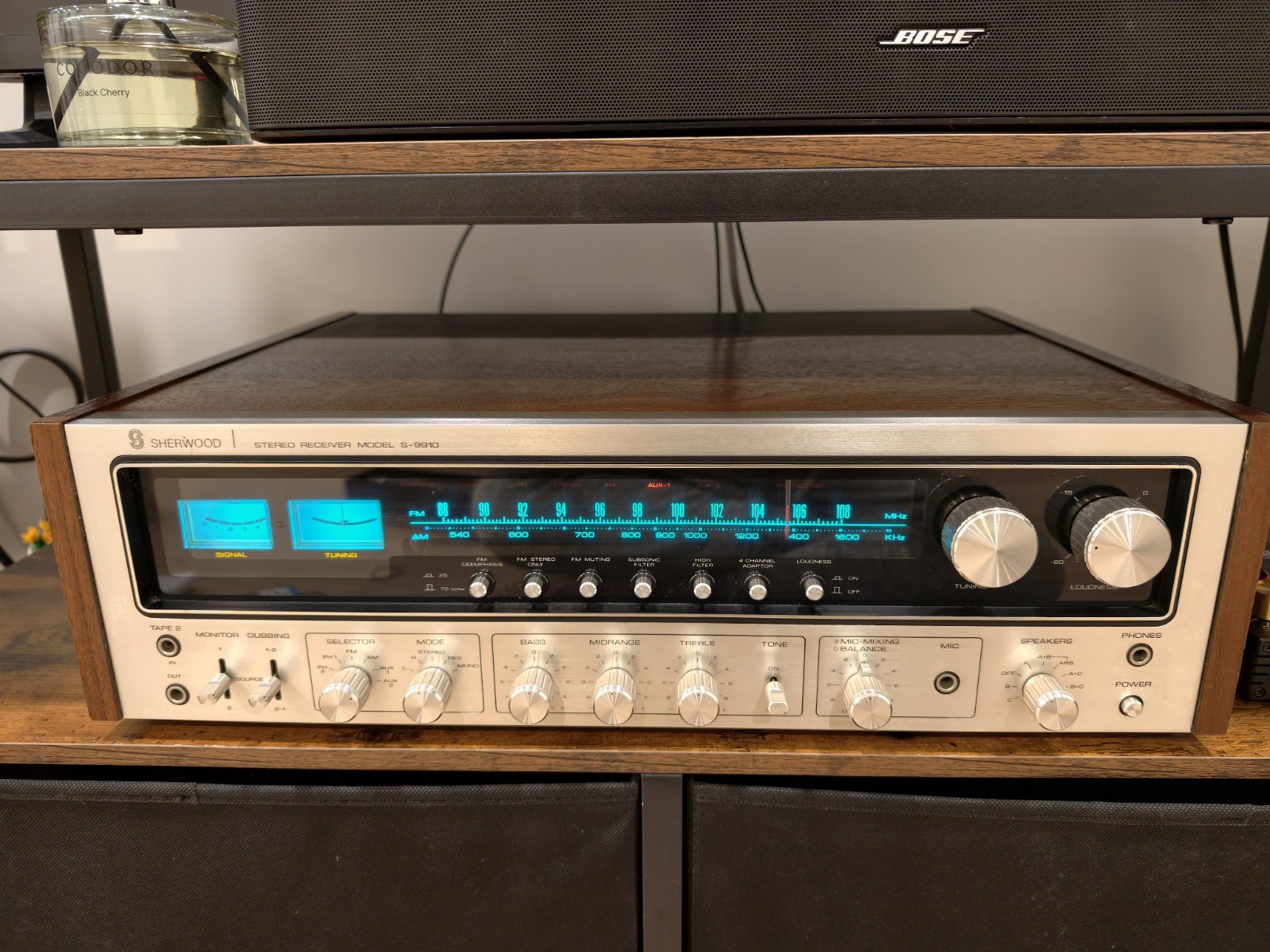
The S-4400 likely used discrete transistor circuitry rather than integrated circuits, consistent with Sherwood’s design philosophy of the time. Its build quality appears robust, with a steel chassis, quality potentiometers, and durable toggle or rotary switches. The front panel is typically minimalist, with a large central volume knob, smaller tone and balance controls, and a row of input selectors.
Sound Characteristics and Performance
While no formal listening tests exist, anecdotal reports from owners suggest that the S-4400 delivers a neutral, transparent sound with a slight warmth in the midrange—typical of well-designed transistor preamps from the era. It does not color the sound aggressively, making it a good match for both dynamic and more revealing speaker systems.
Its low noise floor and stable gain structure allowed it to pair effectively with a wide range of power amplifiers, from contemporary Sherwood models to higher-end separates. The tone controls are reported to be musical and non-invasive, allowing for room or speaker compensation without sacrificing clarity.
Given its likely role as a preamplifier, the S-4400 would have been responsible for maintaining signal integrity between sources (turntable, tuner, tape deck) and the power amplifier. Its performance in this role appears to have been solid, if not groundbreaking—offering reliable operation and clean signal path management.
Notable Features and Design Philosophy
What makes the S-4400 intriguing is not its technical prowess, but its place in Sherwood’s product evolution. At a time when many manufacturers were adding gimmicks—graphic equalizers, “spatial enhancement,” or complex metering—the S-4400 seems to have taken a purist approach. It lacks the flashy VU meters or illuminated sliders seen on competing units, focusing instead on core functionality.
One possible innovation—though unconfirmed—is the inclusion of switchable impedance settings or loading options, which would have allowed users to better match the unit to different phono cartridges or tape heads. This would have been a forward-thinking feature for a mid-tier brand in 1975.
Additionally, the S-4400 may have been designed with modular servicing in mind. Sherwood was known for designing serviceable electronics, and the S-4400’s internal layout reportedly allows for relatively easy access to circuit boards and power supply components—a boon for restorers today.
Common Issues and Maintenance
Like all vintage electronics from the 1970s, the Sherwood S-4400 is susceptible to age-related degradation. Common issues include:
- Dried-out electrolytic capacitors: The power supply and coupling capacitors may need replacement to restore proper function and prevent noise or hum.
- Noisy potentiometers: Volume, balance, and tone controls can develop crackles or dropouts. Cleaning with contact cleaner may help, but replacement with modern equivalents is often necessary.
- Oxidized switch contacts: Input selectors and power switches can become intermittent. Deoxit treatment or careful cleaning with isopropyl alcohol is recommended.
- Failing transistors or resistors: While generally reliable, some early transistors may drift in value or fail over time, especially if the unit was operated in high-heat environments.
Restoration of the S-4400 is feasible for intermediate-level technicians, thanks to its simple circuit design and lack of proprietary ICs. Schematics are not widely available, but reverse-engineering is possible due to the logical layout and standard component choices.
Current Market Value and Collectibility
The Sherwood S-4400 is rare—so rare that it does not appear in most vintage audio databases or price guides. When units do surface, they typically sell in the $75–$150 range, depending on condition and completeness. Fully functional, cleaned examples with original knobs and labeling command higher prices, especially among collectors focused on complete Sherwood systems or obscure preamp designs.
It is not considered a “grail” item like a Marantz 2270 or a McIntosh C22, but the S-4400 holds niche appeal for those interested in the evolution of American audio engineering or the history of underdog brands in the hi-fi wars of the 1970s.
Conclusion: A Quiet Survivor of a Bygone Era
The Sherwood S-4400 may never achieve legendary status, but it represents something important: the quiet, competent engineering that powered millions of home audio systems during hi-fi’s golden age. It wasn’t flashy, nor was it marketed with audiophile mystique. Instead, it offered solid performance, durability, and simplicity—values that still resonate with vintage audio enthusiasts today.
For the collector, restorer, or curious listener, the S-4400 is more than just a forgotten box of circuits. It’s a window into a time when audio gear was built to last, designed for real-world use, and priced for real people. In an era obsessed with rarity and resale value, the Sherwood S-4400 reminds us that sometimes, the most meaningful pieces are the ones that simply worked—and kept on working.
eBay Listings



As an eBay Partner, we earn from qualifying purchases. This helps support our independent vintage technology research.
Related Models
- Sherwood S-7010A (1976)
- Sherwood S-7110A (1978)
- Sherwood S-7225A (1975)
- Sherwood RX-4109 (1976)
- Sherwood AI-1110 (1978)
- Luxman L-530 (1975)
- Luxman R-404 (1975)
- Luxman RV-371 (1975)
- Luxman SQ-38U (1975)
- Luxman T-14 (1972)