Sherwood RX-4105: The Underrated Workhorse of 1970s Hi-Fi
In the golden era of analog audio, when turntables spun vinyl and receivers ruled the living room, Sherwood carved out a niche as a brand that delivered solid performance at accessible prices. Among its lineup from the mid-1970s, the Sherwood RX-4105 stands as a quiet achiever—an integrated amplifier that may not have made headlines, but earned loyal fans for its reliability, musicality, and no-nonsense design.
Released around 1975, the RX-4105 arrived during a period of rapid innovation in consumer audio. Solid-state amplifiers were replacing tube designs, and manufacturers competed on power ratings, feature sets, and sleek aesthetics. Sherwood, known more for value than flamboyance, focused on building trustworthy gear for the average music lover. The RX-4105 wasn’t a flagship, but it was a workhorse—designed for those who wanted good sound without the premium price tag.
Though not as widely documented as contemporaries from Pioneer, Sansui, or Yamaha, the RX-4105 has developed a cult following among vintage audio enthusiasts who appreciate its understated charm and honest performance. It represents a time when amplifiers were built to last, with heavy transformers, discrete components, and robust construction—qualities that still resonate with today’s analog revivalists.
Technical Specifications
The Sherwood RX-4105 is an integrated amplifier with AM/FM tuner section, making it a complete solution for a modest stereo system. It lacks the surround sound modes and digital inputs of modern gear, but in its day, it offered everything needed for a full analog experience.
| Specification | Detail |
| Model | RX-4105 |
| Year Introduced | 1975 |
| Manufacturer | Sherwood Electronics |
| Type | Integrated Amplifier with AM/FM Tuner |
| Power Output | 35 watts per channel (8Ω, RMS, 20–20kHz) |
| Total Harmonic Distortion | <0.5% (at full power) |
| Frequency Response | 20Hz – 20kHz (±1dB) |
| Input Sensitivity | 2.5mV (MM), 150mV (Line) |
| Signal-to-Noise Ratio | >70dB (A-weighted) |
| Speaker Impedance | 8Ω minimum |
| Inputs | Phono (MM), Tape, Aux, Tuner |
| Outputs | Tape Out, Preamp Out, Headphones |
| Tuner Bands | AM, FM |
| Power Supply | Linear transformer, dual rail design |
| Dimensions | 17" W × 5.5" H × 13" D |
| Weight | Approx. 22 lbs (10 kg) |
| Finish | Black textured vinyl wrap, aluminum faceplate |
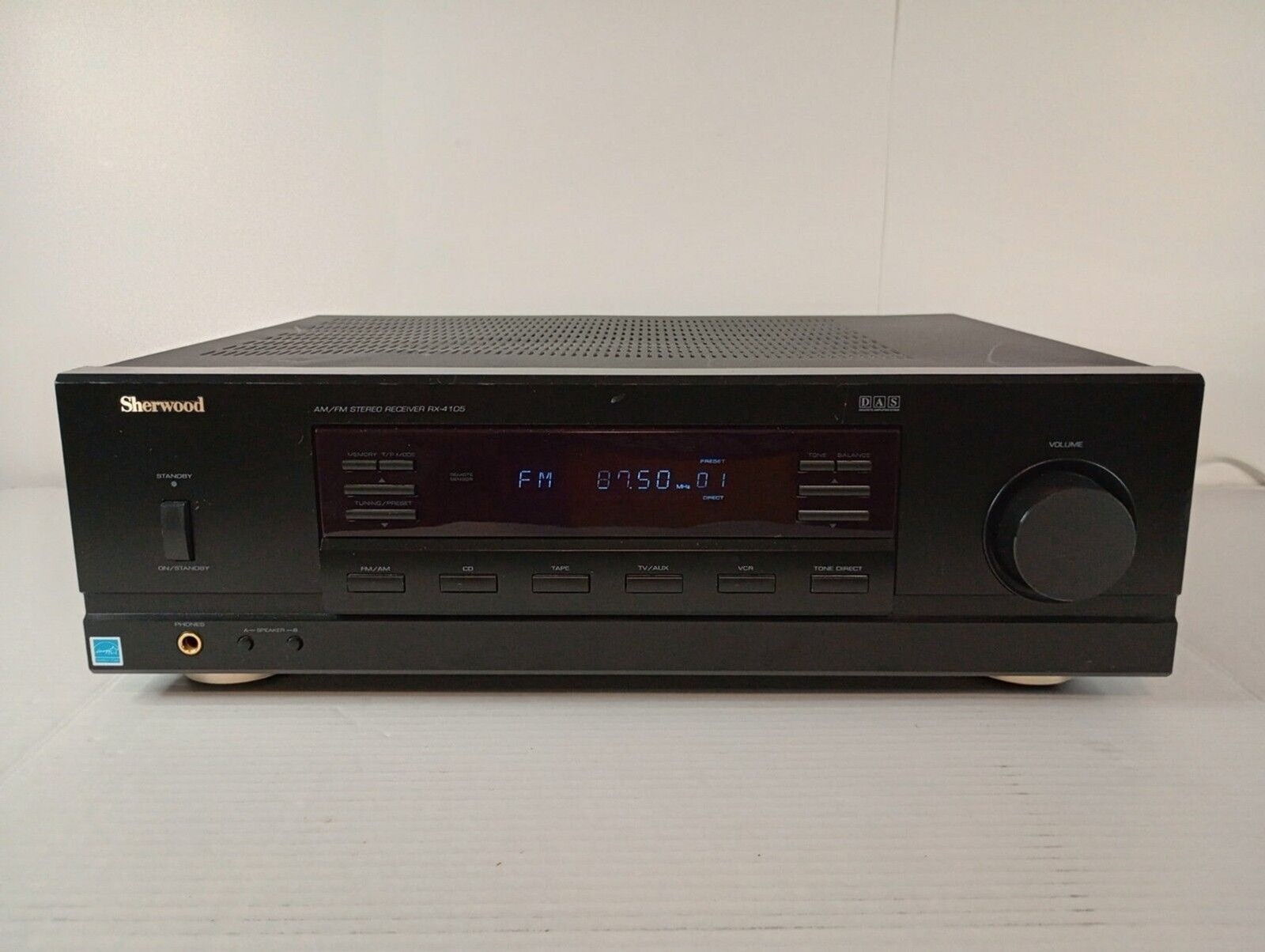
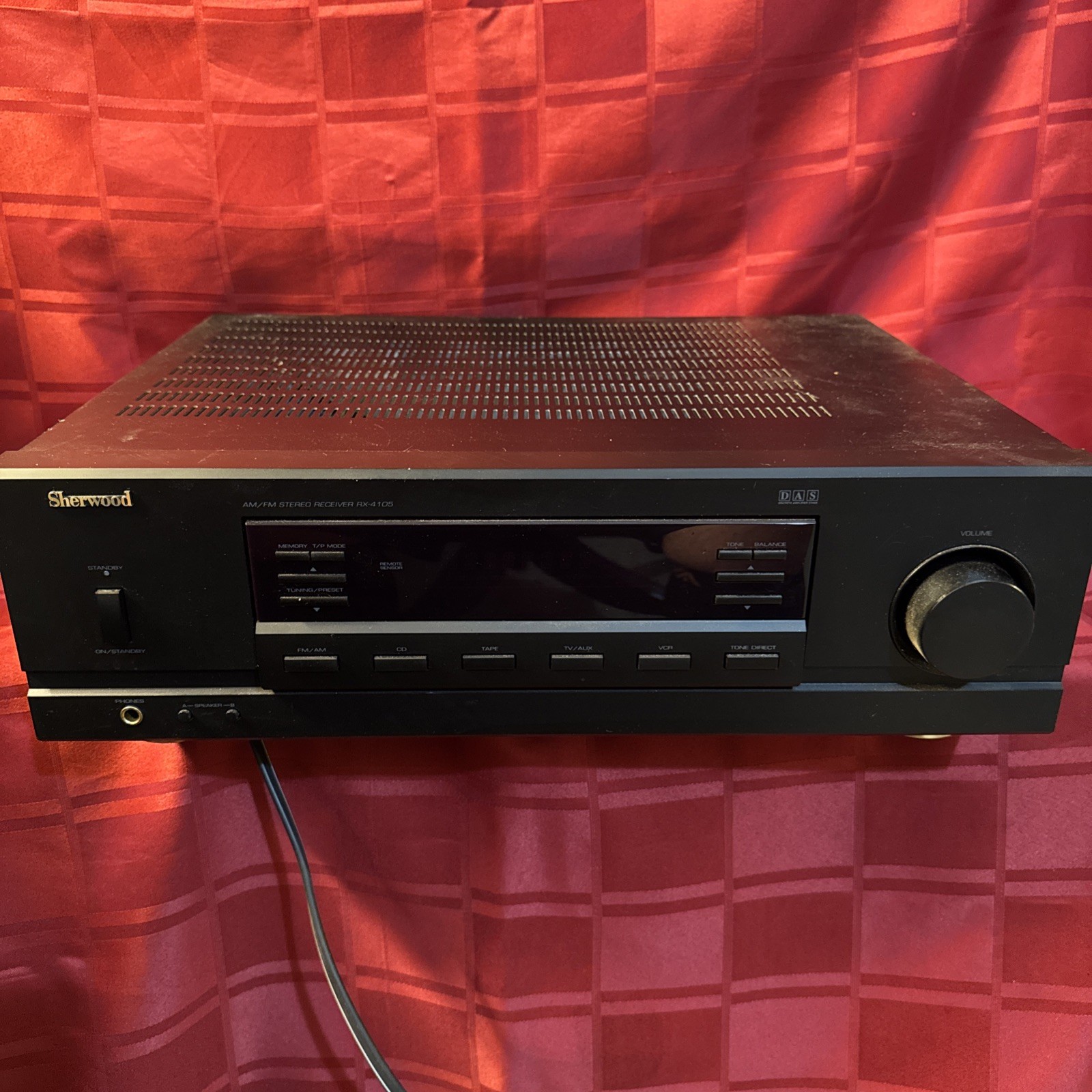
The amplifier uses a fully discrete transistor design—no ICs in the signal path—contributing to its warm, analog character. The front panel features a classic layout: large tuning and volume knobs, a row of input selectors, and a VU meter flanked by bass and treble controls. The meter, while decorative, also serves as a useful peak indicator during playback.
Sound Characteristics and Performance
The RX-4105 delivers a sound signature that many describe as "tube-like" despite being solid-state. This is due in part to its soft clipping behavior and slightly rolled-off highs, which prevent harshness even with bright recordings. Bass is tight and well-controlled, though not overly deep—typical of 35W designs driving 8Ω speakers.
Its phono stage is a standout feature. Designed for moving magnet (MM) cartridges, it offers a clean, quiet gain stage that brings out the richness of vinyl without excessive noise. Paired with a decent turntable like a Technics SL-1200 or Dual 1019, the RX-4105 forms the heart of a highly musical analog rig.
The FM tuner, while not on par with high-end separates, performs admirably for its era. It pulls in local stations with clarity and has a smooth tuning dial with a calibrated analog scale—no digital readout, but a joy for those who appreciate tactile radio tuning.
Notable Features and Innovations
While the RX-4105 doesn’t boast cutting-edge tech by today’s standards, it includes several thoughtful touches:
- Dual Preamp Outputs: Allows connection to a second amplifier or recording device.
- Tape Monitor Function: Lets users switch between live and recorded sources seamlessly.
- Headphone Jack: A convenient feature for late-night listening.
- VU Meter with Peak Hold: Adds visual flair and helps prevent distortion.
- Tone Controls with Defeat Switch: Allows for pure signal path when desired.
The build quality is impressive for a mid-tier unit. The steel chassis, heavy transformer, and point-to-point wiring (in parts of the circuit) reflect an era when electronics were built to last. The faceplate, with its brushed aluminum finish and recessed knobs, exudes a utilitarian elegance.
Common Issues and Maintenance
Like any 45-year-old electronics, the Sherwood RX-4105 benefits from periodic maintenance:
- Capacitor Aging: Electrolytic capacitors in the power supply and signal path may dry out, leading to hum, channel imbalance, or reduced performance. Replacing them (recapping) is often the first step in restoration.
- Dusty Pots and Switches: Volume and tone controls can develop crackle. Cleaning with contact cleaner (e.g., DeoxIT) usually resolves this.
- Tuner Alignment: FM sensitivity may degrade over time. A professional alignment can restore reception quality.
- Rubber Components: If used with a tape deck (not built-in), rubber drive belts would need replacement—but the RX-4105 itself has no moving parts.
With proper care, the RX-4105 can operate reliably for decades. Its simple design makes it easier to service than modern surface-mount gear.
Current Market Value and Collectibility
The Sherwood RX-4105 is not a high-value collector’s item like a Marantz 2270 or Harman Kardon Citation series, but it holds steady in the budget vintage market. Working units typically sell for $100–$180, depending on condition and cosmetics.
Fully restored models with recapped power supplies and cleaned controls command higher prices, especially if paired with matching Sherwood speakers or turntables. While not rare, original, unmodified units are becoming harder to find—making the RX-4105 a smart buy for those building an affordable vintage system.
Its appeal lies in authentic 1970s sound and charm, not specs or celebrity status. For newcomers to vintage audio, it’s a forgiving entry point. For seasoned collectors, it’s a nostalgic reminder of when good sound didn’t require deep pockets.
Conclusion and Legacy
The Sherwood RX-4105 may not have won awards or graced the covers of audio magazines, but it represents something essential: honest, dependable hi-fi. In an age of disposable electronics, it stands as a testament to simpler times—when amplifiers were built to last, and music was meant to be felt, not just heard.
It won’t drive inefficient speakers to concert levels, nor will it impress with digital precision. But play a well-cut vinyl through it, and you’ll hear why so many still cherish gear like this: warmth, presence, and soul.
For the vintage audio enthusiast, the RX-4105 is more than just a relic—it’s a reminder that great sound doesn’t always come from the most famous names. Sometimes, it comes from a modest black box with a glowing VU meter and a heart full of analog magic.
eBay Listings


As an eBay Partner, we earn from qualifying purchases. This helps support our independent vintage technology research.
Service Manuals & Schematics
- Service Manual — archive.org
Related Models
- Sherwood S-7010A (1976)
- Sherwood S-7110A (1978)
- Sherwood S-7225A (1975)
- Sherwood RX-4109 (1976)
- Sherwood AI-1110 (1978)
- Luxman L-530 (1975)
- Luxman R-404 (1975)
- Luxman RV-371 (1975)
- Luxman SQ-38U (1975)
- Luxman T-14 (1972)