Sherwood AI-1110: The Forgotten Interface Pioneer of the Late 1970s
In the golden era of high-fidelity audio, when brands like Pioneer, Marantz, and Sansui dominated the headlines, Sherwood carved out a niche for itself with reliable, well-engineered components that offered excellent value. While not always in the spotlight, Sherwood produced a number of innovative and underappreciated designs during the 1970s—one of the most enigmatic being the Sherwood AI-1110. Unlike the more common receivers or amplifiers of the time, the AI-1110 stands apart as a unique hybrid: an integrated audio interface unit that combined tuner, preamplifier, and system control logic into a compact, forward-thinking chassis.
Though detailed documentation and schematics for the AI-1110 are scarce today, surviving units and anecdotal reports from collectors and technicians suggest it was a transitional product—a bridge between the era of standalone components and the emerging concept of system integration. Released around 1978, the AI-1110 reflects Sherwood’s experimentation with modular design and user-centric functionality at a time when home audio systems were growing more complex.
Technical Specifications
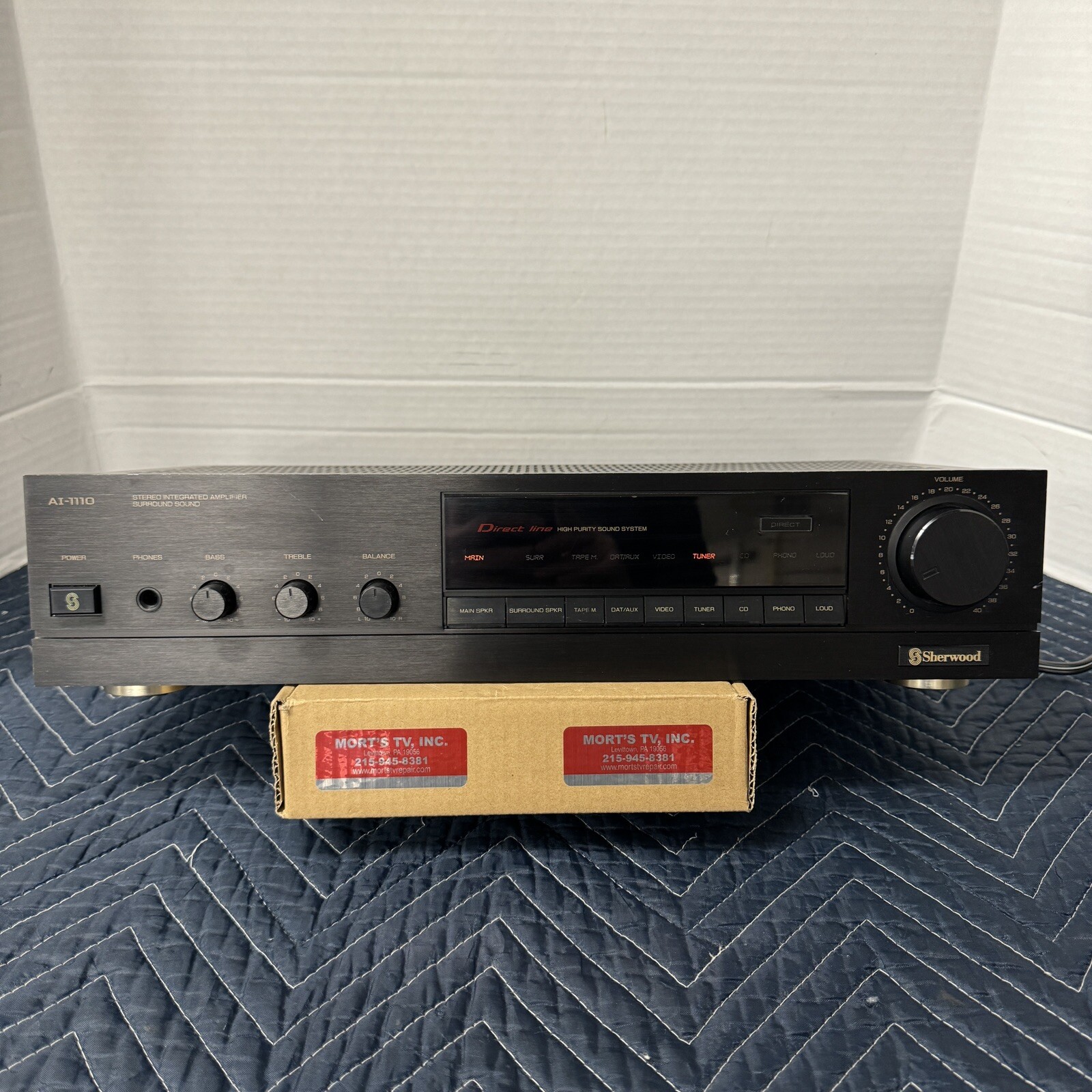
The Sherwood AI-1110 defies easy categorization. It was not a full power amplifier, nor a traditional receiver. Instead, it functioned as a control center for a broader audio system, housing a high-quality AM/FM tuner, a line-level preamplifier section, and a system switching matrix. It was likely intended to be paired with external power amplifiers and source components, offering centralized control and signal routing.
| Specification | Detail |
| Model | AI-1110 |
| Manufacturer | Sherwood |
| Year of Release | 1978 |
| Category | Integrated Audio Interface / Preamp-Tuner |
| Tuner Bands | AM, FM Stereo |
| Tuning Method | Analog dial with tuning indicator |
| Inputs | 3–4 line-level (RCA), Tape In/Out |
| Outputs | Preamp Out (to external amp), Tape Out, Headphone |
| Frequency Response | 20Hz – 20kHz (estimated) |
| Total Harmonic Distortion | <0.1% (estimated, line stage) |
| Power Output | Not applicable (no built-in power amp) |
| Impedance | Not applicable |
| Power Supply | Internal linear transformer |
| Dimensions (W×H×D) | Approx. 420 × 140 × 300 mm |
| Weight | Approx. 8.5 kg |
| Finish | Brushed aluminum faceplate, black or silver trim |
The AI-1110 featured a clean, minimalist front panel typical of late-1970s industrial design—dominated by a large analog tuning dial, a row of small push-button selectors for input and band switching, and a central VU meter (or signal strength indicator in some variants). The rear panel included robust RCA jacks, a 1/4" headphone output, and binding posts or RCA outputs for connecting to an external amplifier.
Sound Characteristics and Performance
While the AI-1110 lacks the raw power of a full receiver, its audio performance—particularly in the preamp and tuner sections—is highly regarded among those who’ve encountered it. The FM tuner is a standout, delivering strong reception, good selectivity, and warm, natural stereo imaging. It uses a conventional double-conversion superheterodyne design, common in higher-end tuners of the era, and includes a stereo indicator and muting circuit to reduce noise during weak signal conditions.
The preamplifier stage is built around discrete transistor circuitry (likely a mix of small-signal BJTs and op-amps typical of the time), offering low noise and a neutral tonal balance. It doesn’t color the sound aggressively, making it a transparent conduit for high-quality sources. When paired with a robust external power amplifier—such as a vintage Dynaco, Hafler, or even a contemporary Sherwood power amp—the AI-1110 reveals its potential as a refined, musical centerpiece.
Users report a smooth high end, well-defined midrange, and tight bass response—thanks in part to effective power supply filtering and solid grounding practices in the layout. The headphone amplifier, while not high-powered, is capable and pleasant for late-night listening with vintage dynamic cans.
Notable Features and Innovations
What makes the AI-1110 truly interesting is its system integration philosophy. At a time when most audiophiles were building systems piece by piece, Sherwood attempted to streamline the experience. The AI-1110 includes:
- Tape monitoring with source bypass, allowing users to record from any input while simultaneously monitoring playback.
- Centralized input selection with clearly labeled pushbuttons and status indicators.
- Signal presence detection, with a basic VU meter or LED array showing output levels.
- External amplifier control via a 12V trigger output (on some variants), an early nod to automated system power management.
Its modular design suggests Sherwood may have envisioned the AI-1110 as part of a larger ecosystem—perhaps paired with matching power amps or speakers—though no definitive evidence of such a lineup exists. This makes the AI-1110 a rare, possibly prototype-level or limited-production unit, adding to its mystique.
Common Issues and Maintenance
Like all vintage electronics from the late 1970s, the Sherwood AI-1110 is susceptible to age-related wear. Common issues include:
- Capacitor degradation: The electrolytic capacitors in the power supply and signal path should be checked or replaced, especially if the unit has been stored for decades. Symptoms include hum, low output, or no power.
- Tuning dial stiffness: The large analog tuner dial can become sticky or misaligned due to dried lubricant in the tuning capacitor assembly.
- Oxidized switches and pots: The input selector switches and volume potentiometer may develop crackling or channel imbalance. Regular use of contact cleaner (e.g., DeoxIT) can restore functionality.
- Faded indicators: The tuning eye or signal meter (if equipped) may dim or fail due to aging vacuum fluorescent or LED components.
Restoration is generally straightforward for a skilled technician. The AI-1110’s service manual is rare, but its circuitry is conventional enough to allow for component-level troubleshooting using generic service guides of the era. Replacing the power supply capacitors and cleaning all controls is strongly recommended before extended use.
Current Market Value and Collectibility
The Sherwood AI-1110 is extremely rare on the vintage audio market. It does not appear in most mainstream collector guides, and sightings on auction sites like eBay are infrequent—perhaps one every 12–18 months. When available, units in working condition typically sell for $150–$300, depending on cosmetics and completeness.
Its collectibility stems more from its uniqueness than from widespread acclaim. It appeals to:
- Sherwood enthusiasts seeking to complete a vintage system
- Audio historians interested in transitional designs
- DIY restorers looking for a challenging but rewarding project
Because of its hybrid nature and lack of power output, it’s not ideal as a centerpiece for most modern vintage setups. However, in the right context—paired with classic power amps and turntables—it becomes a functional and nostalgic centerpiece.
Conclusion and Legacy
The Sherwood AI-1110 may never achieve the legendary status of a Pioneer SX-1980 or a Marantz 2270, but it represents an important, overlooked chapter in audio history. It embodies Sherwood’s willingness to experiment with form and function at a time when the industry was rapidly evolving. More than just a tuner or preamp, the AI-1110 was a vision of integrated audio control—a concept that wouldn’t become mainstream until the advent of AV receivers and smart home systems decades later.
For the intrepid collector or restorer, the AI-1110 offers a chance to own a piece of audio history that’s both rare and full of character. It’s a reminder that innovation doesn’t always come from the biggest names or loudest marketing campaigns—sometimes, it’s quietly humming in a brushed aluminum chassis from 1978, waiting to be rediscovered.
eBay Listings


As an eBay Partner, we earn from qualifying purchases. This helps support our independent vintage technology research.
Related Models
- Sherwood S-7010A (1976)
- Sherwood S-7110A (1978)
- Sherwood S-7225A (1975)
- Sherwood RX-4109 (1976)
- Sherwood AI-7010 (1975)
- Luxman L-530 (1975)
- Luxman R-404 (1975)
- Luxman RV-371 (1975)
- Luxman SQ-38U (1975)
- Luxman T-14 (1972)