Scott 380 (1966)
The Scott 380 is a classic solid-state stereo amplifier introduced in 1966 by Scott, a brand synonymous with high-fidelity audio innovation during the mid-20th century. Though not as widely recognized today as some of its contemporaries from Marantz or Fisher, the Scott 380 holds a respected place among vintage audio enthusiasts for its technical excellence, clean design, and enduring performance. As one of the early high-end solid-state amplifiers, the 380 marked a pivotal moment in the transition from tube-based to transistorized audio equipment.
Historical Context and Design Philosophy
Scott Radio Laboratories, founded by electronics engineer Edward H. Scott, was a pioneer in FM radio and high-fidelity audio. The company gained acclaim in the 1950s and 1960s for its precision-tuned receivers and amplifiers that emphasized transparency, low distortion, and wide frequency response. The Scott 380 amplifier was released during a transformative era in audio technology, when manufacturers were beginning to replace vacuum tubes with transistors. This shift promised greater reliability, reduced heat, and longer component life—advantages the Scott 380 capitalized on while maintaining the sonic integrity audiophiles demanded.
The 380 was designed as a dual-mono, fully discrete solid-state power amplifier, meaning it used individual transistors rather than integrated circuits, which were still in their infancy. Its circuitry was engineered with a focus on linearity and low feedback, contributing to a natural, dynamic sound signature. The amplifier was marketed as a companion to other Scott components, such as the 390 receiver or the 340 preamplifier, forming part of a high-end audio system for discerning listeners.
Technical Specifications and Performance
The Scott 380 delivers 35 watts per channel into an 8-ohm load, a respectable output for its time. Unlike many early solid-state amplifiers that suffered from harshness or "transistor glare," the 380 was praised for its smooth, musical character. This was due in part to its carefully designed output stage and conservative feedback topology. Frequency response is rated from 20 Hz to 20 kHz with less than 0.2 dB deviation, and it extends further to 10 Hz – 60 kHz at -3 dB, indicating excellent transient response and bandwidth.
Total harmonic distortion is specified at less than 0.5% at full power, which was exceptional for a 1960s transistor amplifier. Signal-to-noise ratio exceeds 90 dB, ensuring a quiet background and strong dynamic range. The input sensitivity is approximately 1.5 volts for full output, making it compatible with most preamplifiers of the era. Input impedance is 47 kΩ, a standard value that prevents loading issues with upstream components.
The amplifier features two pairs of inputs (labeled 1 and 2), allowing connection to multiple sources such as a tuner, tape deck, or phono preamp. It includes a muting switch and a mono/stereo toggle, offering flexibility in listening configurations. The front panel is minimalist, with a large central power knob, a channel balance control, and individual level meters for the left and right channels—hallmarks of Scott’s design language emphasizing both function and elegance.
Internally, the Scott 380 uses a robust power supply with a high-quality toroidal-like transformer (though not a true toroid by modern standards) and substantial filter capacitors to ensure stable voltage delivery under dynamic loads. The output stage employs germanium power transistors, which were common in the mid-1960s before silicon devices became dominant. These germanium transistors contribute to the amplifier’s warm, slightly soft tonal balance—a characteristic many vintage audio aficionados find appealing.
Build Quality and Aesthetic
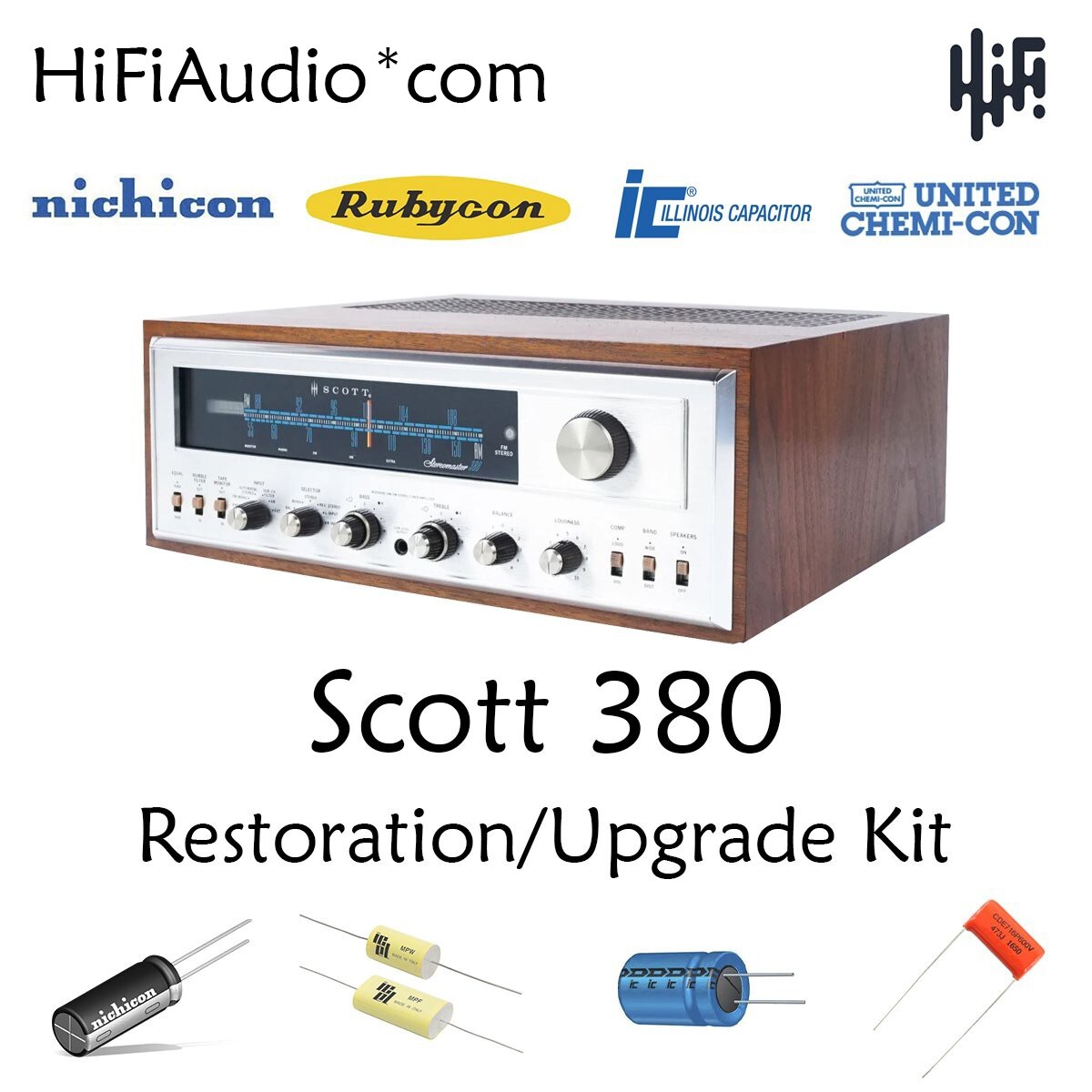
The Scott 380 is housed in a heavy-gauge steel chassis with a brushed aluminum front panel, finished in Scott’s signature gray-blue hue. The build quality is exceptional, reflecting the company’s commitment to durability and precision. Knobs are made of durable plastic with metal inserts, and the meter movements are sensitive and accurate. The rear panel includes high-quality screw-terminal speaker connectors and RCA jacks, all securely mounted.
Ventilation is provided through slotted openings on the top and sides, allowing for passive cooling without the need for fans. The unit weighs approximately 35 pounds, a testament to its substantial internal components and shielding. The overall aesthetic is understated yet authoritative—designed to sit at the center of a serious audio system without drawing attention to itself.
Legacy and Collector Appeal
While Scott eventually faded from prominence in the 1970s due to corporate acquisitions and shifting market dynamics, the legacy of its high-end models like the 380 endures. Today, the Scott 380 is sought after by vintage audio collectors and restorers. Its combination of early solid-state innovation, low measured distortion, and pleasing sonic character makes it a compelling alternative to both tube amplifiers and later, more clinical transistor designs.
Restoration of a Scott 380 typically involves replacing aging electrolytic capacitors, cleaning controls and jacks, and checking transistor bias. Due to the use of germanium devices, some units may require transistor replacement if original parts have degraded, though many original components remain functional after over 50 years. Service manuals and schematics are available through vintage audio archives, making restoration feasible for experienced technicians.
In modern systems, the 380 pairs well with efficient speakers (90 dB or higher sensitivity) and can deliver a rich, engaging sound with vinyl sources. It is particularly well-suited to jazz, classical, and vocal recordings, where its midrange clarity and smooth treble response shine.
Conclusion
The Scott 380 stands as a milestone in the evolution of solid-state audio amplification. It represents a moment when high-fidelity engineering met the promise of transistor technology, resulting in an amplifier that was both technically advanced and musically satisfying. While overshadowed in popular memory by flashier brands, the 380 remains a benchmark of 1960s audio design—respected for its precision, durability, and warm, analog character. For those exploring vintage audio, the Scott 380 offers a rewarding listening experience and a tangible connection to the golden age of hi-fi.
eBay Listings



As an eBay Partner, we earn from qualifying purchases. This helps support our independent vintage technology research.
Related Models
- Scott 200B (1960)
- Scott 210E (1956)
- Scott 222C (1972)
- Scott 233 (1972)
- Scott 260 (1964)
- Luxman L-530 (1975)
- Luxman R-404 (1975)
- Luxman RV-371 (1975)
- Luxman SQ-38U (1975)
- Luxman T-14 (1972)