Scott 370 (1973)
The Scott 370 is a solid-state preamplifier introduced in 1973 by Scott, a company renowned for its high-fidelity audio equipment throughout the mid-20th century. Though less widely documented than some of its contemporaries, the Scott 370 occupies a respected place among vintage audio enthusiasts for its minimalist design, precise engineering, and warm sonic character. As a preamplifier, the 370 was designed to serve as the control center of a high-end stereo system, managing source selection, volume, balance, and tone adjustments before passing the signal to a power amplifier.
Design and Build Quality
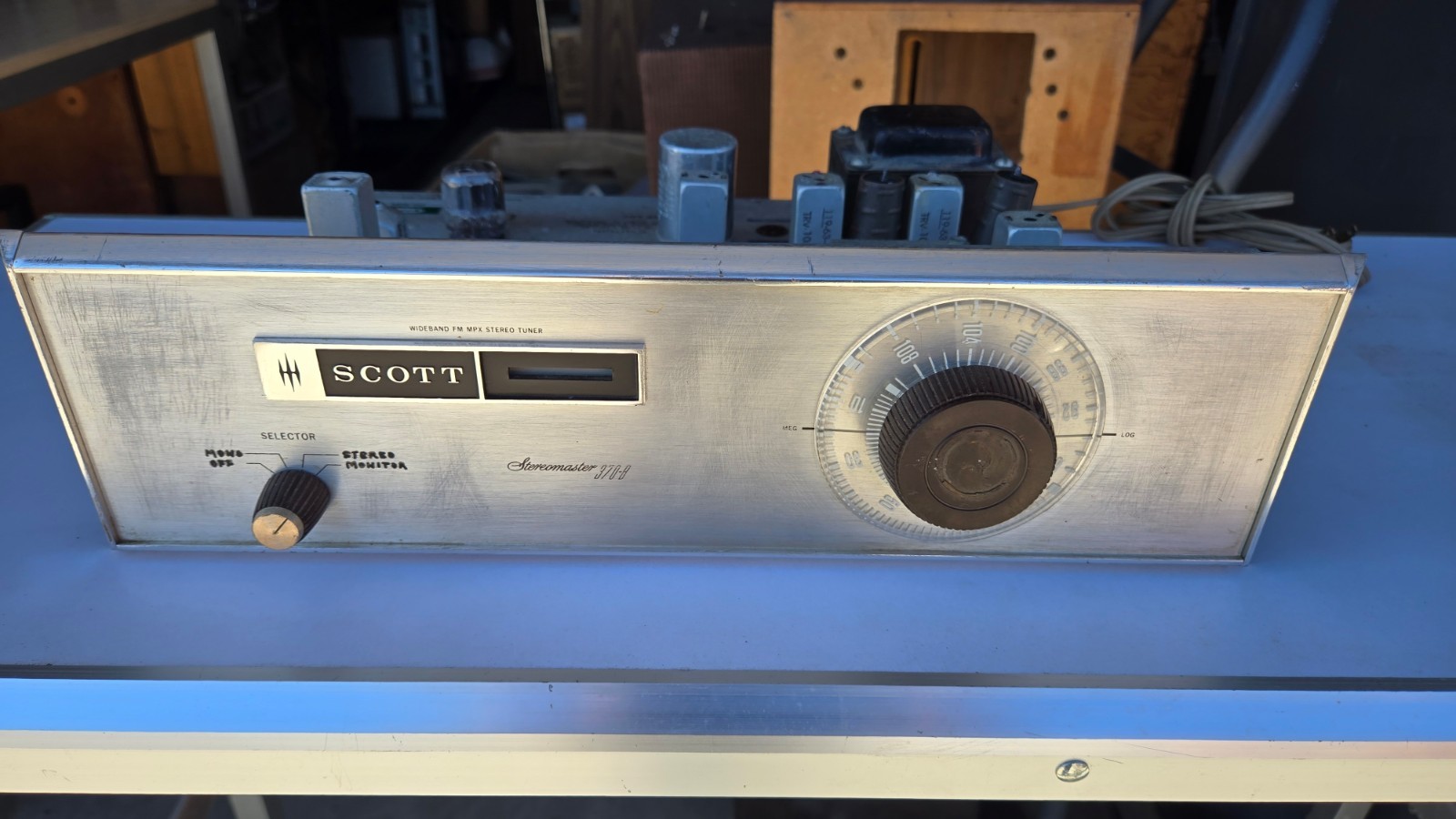
The Scott 370 reflects the design ethos of the early 1970s—functional, elegant, and built to last. Housed in a brushed aluminum chassis with a black front panel and classic Scott badging, the unit exudes a professional, no-nonsense aesthetic. The front panel features a large central volume knob flanked by smaller knobs for balance, bass, and treble. Source selection is handled via a rotary switch on the front, offering inputs for phono (MM), tape, tuner, and auxiliary sources. A prominent VU meter is centrally located, allowing users to monitor output levels—a hallmark of Scott’s commitment to both performance and visual feedback.
The build quality is exceptional for its era. The chassis is rigid and well-shielded, minimizing microphonic noise and interference. Internal construction uses point-to-point wiring with high-quality components, including metal-film resistors and polypropylene capacitors, which contribute to the unit’s clean and transparent sound. The power supply is discrete and well-regulated, ensuring stable operation even under dynamic signal loads.
Technical Specifications
The Scott 370 is a dual-mono preamplifier with separate circuitry for left and right channels, minimizing crosstalk and preserving stereo imaging. Key specifications include:
- Frequency Response: 20Hz – 20kHz ±0.5dB (line level), 20Hz – 20kHz ±1dB (phono)
- Total Harmonic Distortion (THD): <0.05% at 1kHz, 2V output
- Signal-to-Noise Ratio: >80dB (ref. 2V output, A-weighted)
- Input Sensitivity:
- Phono (MM): 5mV
- Line: 150mV
- Input Impedance: 47kΩ (phono), 100kΩ (line)
- Output Impedance: 600Ω
- Maximum Output: 8V RMS
- RIAA Equalization Accuracy: ±0.5dB
- Tone Controls: Bass ±12dB at 50Hz, Treble ±12dB at 10kHz
- Power Supply: Discrete transformer-based, regulated
- Dimensions: 17" W × 5" H × 12" D
- Weight: 14 lbs (6.35 kg)
Notably, the phono stage is designed specifically for moving magnet (MM) cartridges and features a high-quality RIAA equalization network. The circuitry is low-noise and well-shielded, making it suitable for use with all but the most low-output cartridges. The line stage is fully passive in its attenuation network, using a precision stepped attenuator for volume control—a design choice that enhances reliability and signal purity compared to potentiometer-based systems.
Sonic Performance
The Scott 370 is praised for its neutral yet engaging sound signature. It delivers a balanced frequency response with a slightly warm midrange, clear highs, and tight, well-defined bass. The preamp’s low distortion and high damping factor ensure excellent control over downstream amplifiers and speakers. Its wide bandwidth and fast transient response make it particularly well-suited for classical and acoustic recordings, where detail retrieval and spatial accuracy are paramount.
One of the unit’s standout features is its VU meter, which not only serves a functional purpose but also enhances the listening experience by providing real-time visual feedback. The meter is calibrated to reflect output levels accurately and responds smoothly to dynamic musical passages.
The tone controls are musical and non-intrusive, allowing for subtle room or speaker correction without coloring the sound excessively. When set to flat, the 370 operates in a near-transparent manner, making it a favorite among purists who prefer minimal signal manipulation.
Historical Context and Legacy
Scott was founded in the 1950s by Edward H. Scott, an engineer with a background in radio and test equipment. The company quickly gained a reputation for producing high-performance audio gear that combined laboratory-grade precision with audiophile sensibilities. The Scott 370 was part of a broader line of preamplifiers and amplifiers released in the early 1970s, a golden era for high-fidelity audio.
While not as commercially prominent as brands like Marantz or McIntosh, Scott earned a loyal following among engineers and serious listeners. The 370 was positioned as a mid-to-high-tier model, offering many of the features of more expensive units at a competitive price. It was often paired with Scott’s own power amplifiers, such as the 2200 series, to form a complete high-end system.
Production of the Scott 370 was relatively limited, and original units in good condition are now sought after by collectors. The company changed hands several times in the 1980s, and the Scott brand eventually faded from the high-end market, though it has seen occasional revivals in budget audio products.
Restoration and Modern Use
Today, the Scott 370 is prized by vintage audio enthusiasts for its build quality and sonic performance. However, like all electronics of its age, it may require servicing to return to optimal condition. Common restoration steps include:
- Replacing aging electrolytic capacitors in the power supply
- Cleaning switches and potentiometers with contact cleaner
- Checking for cold solder joints or cracked traces
- Verifying RIAA equalization accuracy with test equipment
Once restored, the 370 performs admirably in modern systems. It pairs well with high-efficiency speakers and tube power amplifiers, though it is equally at home driving solid-state amps. Its line-level outputs are robust enough to interface with modern digital-to-analog converters (DACs), provided appropriate cabling and grounding are used.
Conclusion
The Scott 370 is a testament to the engineering excellence of 1970s American audio design. While it may not carry the same name recognition as some of its peers, it delivers performance that rivals far more expensive equipment of the era. Its combination of precision, musicality, and durability makes it a compelling choice for anyone building a vintage high-fidelity system.
For collectors and audiophiles alike, the Scott 370 represents more than just a piece of hardware—it’s a window into a time when audio equipment was built to last, designed with care, and engineered for the love of music. Whether used as a centerpiece in a classic stereo setup or restored as a collector’s item, the Scott 370 remains a worthy ambassador of its era’s audio craftsmanship.
eBay Listings


As an eBay Partner, we earn from qualifying purchases. This helps support our independent vintage technology research.
Related Models
- Scott 200B (1960)
- Scott 210E (1956)
- Scott 222C (1972)
- Scott 233 (1972)
- Scott 260 (1964)
- Luxman L-530 (1975)
- Luxman R-404 (1975)
- Luxman RV-371 (1975)
- Luxman SQ-38U (1975)
- Luxman T-14 (1972)