Scott 340B (1969)
The Scott 340B is a classic solid-state stereo power amplifier introduced in 1969 by H.H. Scott, Inc., a company renowned for its commitment to high-fidelity audio reproduction. As part of Scott’s mid-tier amplifier lineup during the late 1960s and early 1970s, the 340B represented a balance between performance, reliability, and affordability, making it a favorite among audiophiles and music enthusiasts of the era. Though not as widely documented as some of its contemporaries, the 340B has developed a cult following due to its warm, musical sound and robust engineering.
Design and Engineering
The Scott 340B is a dual-mono, solid-state power amplifier delivering 45 watts per channel into 8 ohms with less than 0.5% total harmonic distortion (THD), a respectable figure for its time. It operates in class AB, offering a good compromise between efficiency and linearity. The amplifier was designed during the transitional period when manufacturers were moving from tube-based designs to solid-state technology, and the 340B exemplifies the maturity Scott had achieved in transistor amplifier design.
One of the hallmarks of H.H. Scott’s engineering philosophy was the use of discrete components and conservative circuit topologies that prioritized sonic accuracy and long-term reliability. The 340B features a fully discrete design—no integrated circuits—which was standard for high-end amplifiers of the period. It uses a complementary symmetry output stage with multiple output transistors per channel, contributing to its stable performance under load and excellent current delivery.
The power supply is robust, featuring a large toroidal or EI-core transformer (depending on production batch), substantial filter capacitance, and well-regulated voltage rails. This ensures consistent power delivery even during dynamic musical passages. The amplifier’s frequency response is typically rated from 20 Hz to 20 kHz, with minimal deviation, and it maintains excellent channel separation (greater than 60 dB), reducing crosstalk and preserving stereo imaging.
Input sensitivity is around 1.5 volts, making it compatible with most preamplifiers and line-level sources of the era. It has both unbalanced RCA and balanced XLR inputs—a rare and commendable feature for a consumer amplifier in the late 1960s—highlighting Scott’s commitment to professional-grade signal handling. The balanced input stage helps reject common-mode noise, especially beneficial in environments with electrical interference or longer cable runs.
Build Quality and Aesthetics
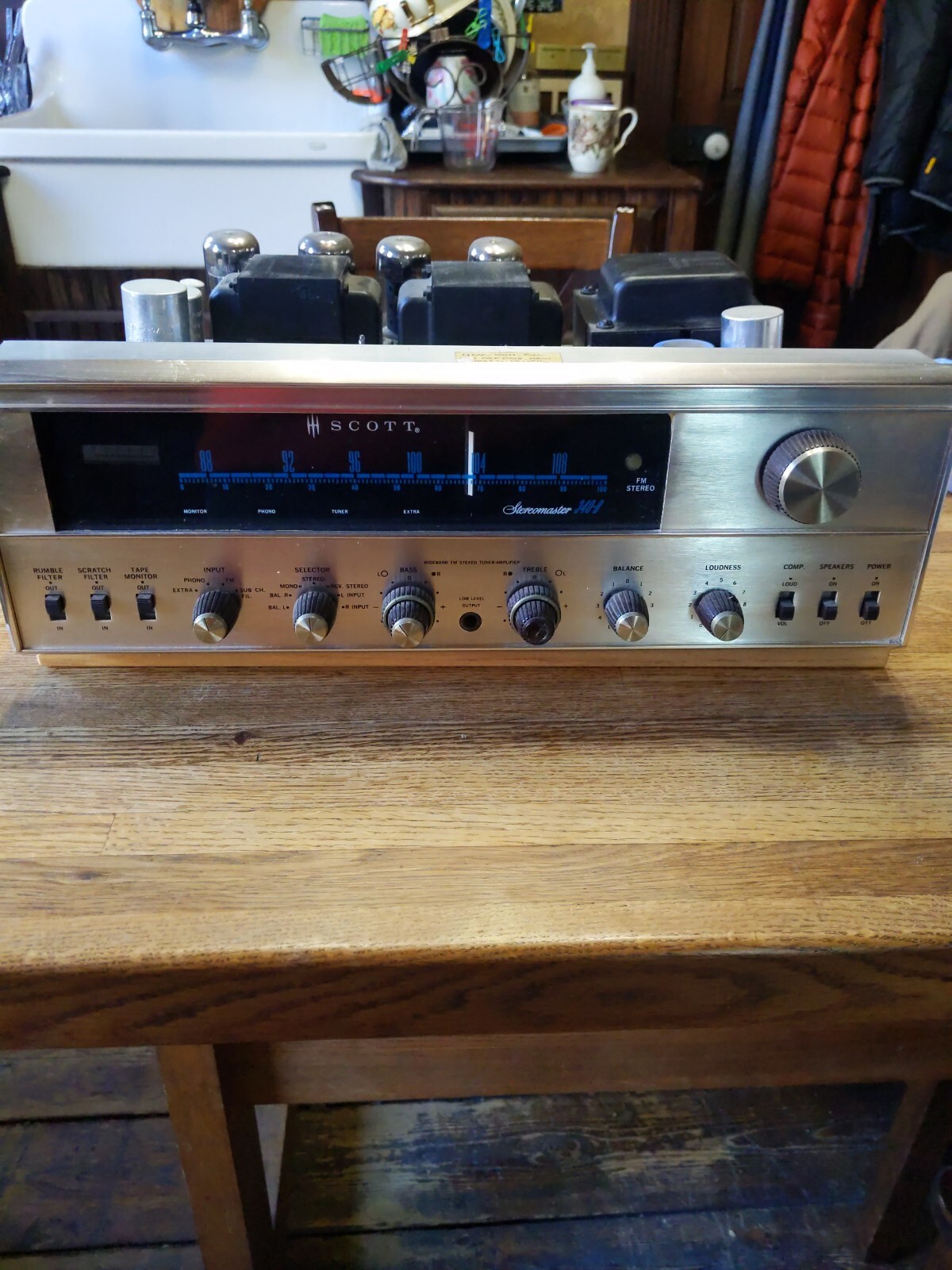
The Scott 340B is housed in a classic brushed aluminum front panel with a minimalist design, featuring a central power indicator lamp, channel status LEDs, and large, knurled aluminum volume and balance knobs (though as a power amplifier, these may pertain to internal test or calibration settings). The rear panel includes gold-plated binding posts for speaker connections, ensuring low resistance and good connectivity with a variety of speaker cables.
The chassis is constructed from heavy-gauge steel, providing excellent electromagnetic shielding and mechanical rigidity. Ventilation is achieved through side-mounted heat sinks, which are both functional and aesthetically integrated into the design. The overall build reflects the high standards of American hi-fi manufacturing in the late 1960s—durable, serviceable, and designed to last.
Internally, the circuit layout is clean and methodical, with point-to-point wiring and high-quality components throughout. Resistors and capacitors are sourced from reputable manufacturers of the time, and the PC board (where used) is phenolic or fiberglass with clear labeling and service documentation. This attention to serviceability made the 340B a favorite among technicians and hobbyists alike.
Sonic Characteristics
The Scott 340B is often praised for its “musical” sound signature—detailed yet smooth, with a natural midrange and well-controlled bass. Unlike some early solid-state amplifiers that could sound harsh or clinical, the 340B manages to retain a warmth and tonal richness that many associate with tube amplifiers, while offering the precision and dynamics of transistor design.
Its midrange clarity makes it particularly well-suited for vocal and acoustic recordings, rendering instruments with lifelike presence and texture. The treble is extended but not overemphasized, avoiding the sibilance or glare that plagued some contemporaneous designs. Bass response is tight and articulate, with good grip on difficult speaker loads, thanks to its low output impedance and high damping factor (typically around 50 at 8 ohms).
Many users report that the 340B pairs exceptionally well with high-sensitivity speakers such as vintage AR, Klipsch, or JBL models, which were popular during the same era. Its ability to drive 4-ohm loads (with some derating) also makes it compatible with a wide range of speakers, though extended operation at low impedances is not recommended without proper ventilation.
Historical Context and Legacy
H.H. Scott, Inc. was founded by Hermon Hosmer Scott in the 1950s and quickly gained a reputation for engineering excellence in the burgeoning hi-fi market. The company was one of the first to introduce FM stereo tuners and high-performance integrated systems. By the late 1960s, Scott was competing with brands like Marantz, Fisher, and Harman Kardon, offering products that combined technical innovation with conservative, audiophile-focused design.
The 340B was part of a broader family of Scott amplifiers, including the higher-powered 350B (60W) and the lower-powered 330B (30W). It was often paired with the Scott 270 or 280 preamplifiers to form a complete amplifier system. While not as powerful as some of its competitors, the 340B was engineered for real-world listening conditions, emphasizing long-term stability and sonic coherence over peak power ratings.
Production of the 340B lasted into the early 1970s before being succeeded by updated models with different styling and circuit refinements. As with many vintage Scott products, original units in good working condition are highly sought after. However, due to their age, many require servicing—common issues include dried-up electrolytic capacitors, failing transistors, and worn input jacks.
Restoration and Modern Use
For vintage audio enthusiasts, restoring a Scott 340B can be a rewarding project. Reputable technicians often recommend a full recapping, transistor testing, and cleaning of all connectors and controls. Once refurbished, the 340B can hold its own in modern systems, especially when paired with efficient speakers and a high-quality source.
It is important to note that while the 340B lacks modern conveniences like remote control or digital inputs, its pure analog signal path and absence of negative feedback (in some stages) contribute to its enduring appeal. In an age of digital processing and compressed audio, the 340B offers a refreshing return to transparency and simplicity.
Conclusion
The Scott 340B stands as a testament to the golden age of American hi-fi. Though not the most powerful or flashy amplifier of its time, it embodies the principles of thoughtful engineering, high build quality, and musical fidelity. For collectors, restorers, and analog lovers, the 340B remains a compelling choice—a vintage workhorse that continues to deliver engaging, heartfelt sound more than five decades after its introduction.
eBay Listings



As an eBay Partner, we earn from qualifying purchases. This helps support our independent vintage technology research.
Related Models
- Scott 200B (1960)
- Scott 210E (1956)
- Scott 222C (1972)
- Scott 233 (1972)
- Scott 260 (1964)
- Luxman L-530 (1975)
- Luxman R-404 (1975)
- Luxman RV-371 (1975)
- Luxman SQ-38U (1975)
- Luxman T-14 (1972)