Scott 335 (1969)
The Scott 335 is a legendary solid-state stereo power amplifier introduced in 1969 by H.H. Scott, Inc., a company renowned for its commitment to high-fidelity audio engineering and precision design. Though not as widely documented as some of its contemporaries, the Scott 335 occupies a respected niche among vintage audio enthusiasts for its clean, transparent sound, conservative yet effective power output, and the hallmark build quality associated with the Scott brand during its golden era.
H.H. Scott, founded by Hermon Hosmer Scott in the late 1940s, was one of the pioneering American companies in the high-fidelity movement. Known for innovations such as the first FM stereo tuner and a strong emphasis on measured performance and stability, Scott products were engineered with a scientific approach that balanced technical rigor with sonic refinement. The Scott 335 emerged during a transitional period in audio history—the late 1960s—when solid-state amplification was beginning to supplant vacuum tube designs, offering greater reliability, lower maintenance, and improved frequency response.
Design and Engineering
The Scott 335 is a dual-mono, solid-state power amplifier rated at 35 watts per channel into 8 ohms, with specifications indicating low distortion (typically less than 0.1% THD) and a wide frequency response from 20 Hz to 20 kHz, ±0.5 dB. Some units may have been capable of slightly higher output into lower impedances, but the design was optimized for stable performance with a variety of speaker loads without entering thermal stress.
One of the defining features of the Scott 335 is its use of discrete transistor circuitry—no integrated circuits—reflecting the state of the art in the late 1960s. The amplifier employed a fully complementary symmetry design in its output stage, a topology that was considered advanced at the time and contributed to its low distortion and excellent damping factor. The damping factor, reportedly around 50 at 8 ohms, allowed the amplifier to exert good control over speaker drivers, particularly in the bass region, resulting in tight, well-defined low-frequency response.
The power supply was robust for its class, featuring a high-quality toroidal or EI-core transformer (depending on production batch), substantial filter capacitance, and well-regulated voltage rails. This contributed to the amplifier’s ability to deliver dynamic headroom beyond its rated power, a trait often praised by listeners who noted its ability to handle musical transients with ease despite the modest wattage.
Build Quality and Aesthetics
True to Scott’s reputation, the 335 was built to last. The chassis was constructed from heavy-gauge steel, finished in a matte black or charcoal gray coating, with a brushed aluminum front panel that bore the classic Scott logo and minimalistic control layout. The front panel featured dual VU meters—centered and prominently displayed—which monitored output levels on both channels. These meters were not only functional but also added to the unit’s visual appeal, making it a centerpiece in any vintage audio rack.
The rear panel included gold-plated binding posts for speaker connections (a rarity at the time), high-quality input jacks, and a three-position input sensitivity switch, allowing the amplifier to be paired with a wide range of preamplifiers or integrated systems. A rear-mounted power switch and a heavy-duty IEC power inlet (on later production runs) improved usability and serviceability.
Ventilation was handled through discreet side-panel louvers, avoiding the need for noisy fans while ensuring adequate heat dissipation. The internal layout was clean and service-friendly, with point-to-point wiring or turret board construction in early units, and later models possibly incorporating printed circuit boards as manufacturing evolved.
Sonic Characteristics
Despite its relatively modest power rating by modern standards, the Scott 335 is celebrated for its musical and engaging sound. It delivers a neutral tonal balance with a slight warmth in the midrange, often described as “liquid” or “organic.” High frequencies are smooth and extended without harshness, while the bass remains articulate and controlled. This combination makes the 335 particularly well-suited for acoustic, jazz, and vocal recordings, where clarity and tonal accuracy are paramount.
Many users report that the amplifier pairs exceptionally well with high-efficiency speakers, such as vintage AR (Acoustic Research) models, Altec Lansing, or certain JBL bookshelf monitors. When matched appropriately, the Scott 335 can produce a spacious soundstage, precise imaging, and a sense of realism that belies its age.
Unlike many solid-state amplifiers of the era that could sound clinical or sterile, the Scott 335 retains a sense of analog richness. This is likely due to careful circuit design, high-quality components, and a feedback topology that prioritizes stability without over-correction—a hallmark of H.H. Scott’s engineering philosophy.
Market Position and Legacy
The Scott 335 was positioned as a mid-to-high-tier amplifier in Scott’s lineup during the late 1960s. It was often paired with Scott preamplifiers such as the 235 or 245 to form a complete high-fidelity system. While not as powerful as some of the “monster” amplifiers that would emerge in the 1970s, the 335 was designed for accuracy and long-term reliability rather than raw power.
Today, the Scott 335 is sought after by collectors and audiophiles interested in vintage solid-state gear. It represents a pivotal moment in audio history—the transition from tubes to transistors—and does so with a level of refinement that few manufacturers achieved at the time. Units in good working condition can command prices ranging from $400 to $800, depending on cosmetic condition, functionality, and originality.
Restoration and Maintenance
As with any vintage electronic equipment, proper maintenance is essential for optimal performance. Common issues with aging Scott 335 units include dried-out electrolytic capacitors, oxidized potentiometers, and degraded insulation on internal wiring. A full recapping of the power supply and signal path capacitors is often recommended for units that have not been serviced in decades.
Bias adjustment is another critical maintenance task, as improper bias can lead to crossover distortion or thermal runaway in the output transistors. Due to the complexity of the circuitry, servicing should be performed by a technician experienced with vintage solid-state amplifiers.
Original parts, such as the VU meters and front panel, are valuable for preserving collector value. Replacement meters or scratched panels can significantly reduce desirability in the vintage market.
Conclusion
The Scott 335 stands as a testament to the engineering excellence of H.H. Scott, Inc. during the formative years of solid-state audio. With its 35 watts per channel, low distortion, and exceptional build quality, it remains a compelling choice for listeners who appreciate the marriage of technical precision and musicality. While it may not drive inefficient speakers to concert levels, it excels in medium-sized rooms with well-matched components, delivering a listening experience that is both accurate and emotionally engaging.
For those exploring the world of vintage amplifiers, the Scott 335 offers a rare combination of historical significance, sonic refinement, and timeless design. It is not merely a relic of the past, but a living piece of audio history that continues to inspire and satisfy discerning ears more than five decades after its introduction.
eBay Listings
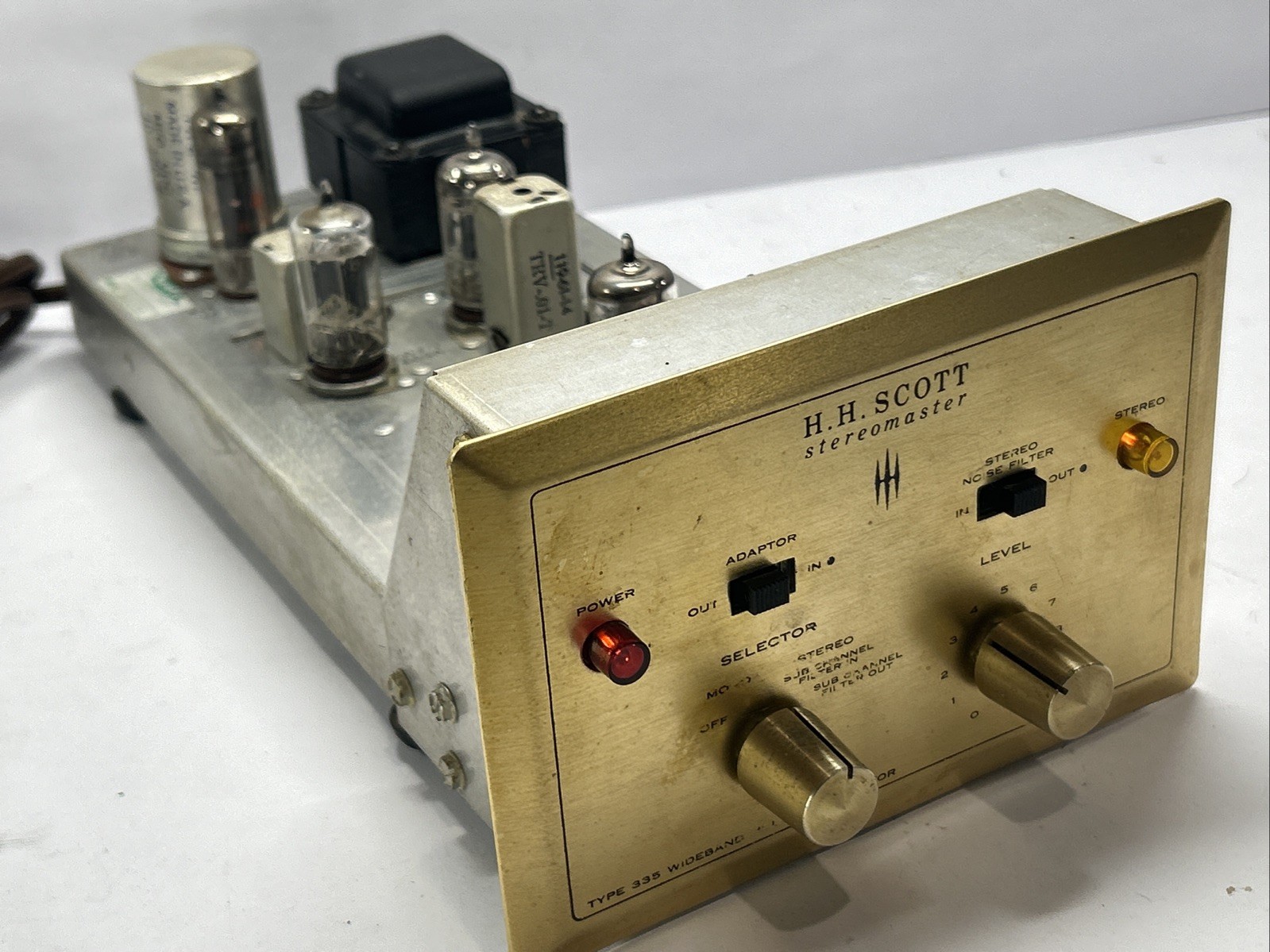


As an eBay Partner, we earn from qualifying purchases. This helps support our independent vintage technology research.
Related Models
- Scott 200B (1960)
- Scott 210E (1956)
- Scott 222C (1972)
- Scott 233 (1972)
- Scott 260 (1964)
- Luxman L-530 (1975)
- Luxman R-404 (1975)
- Luxman RV-371 (1975)
- Luxman SQ-38U (1975)
- Luxman T-14 (1972)