Scott 330D: The Quiet Master of High-Fidelity Preamplification
In the golden age of American high-fidelity audio, few names carried the prestige and engineering rigor of Scott. Renowned for their commitment to transparency, accuracy, and build quality, Scott products became benchmarks in the 1950s and 1960s. Among their most revered offerings was the Scott 330D, a passive preamplifier introduced in the mid-1960s that defied convention by delivering exceptional performance without active gain stages. While not as flashy as its contemporaries with glowing tubes and complex circuitry, the 330D earned a cult following among purists for its uncolored signal path, minimalist design, and remarkable musicality.
Released in 1965, the 330D was part of Scott’s elite series of components that included the legendary 299 and 300 series amplifiers. At a time when many preamplifiers were beginning to incorporate active circuitry to boost weak signals and offer more features, Scott took a bold step in the opposite direction. The 330D was designed as a passive attenuator, relying on high-quality resistive networks and precision switches to control volume and source selection—without any amplification. This design philosophy was rooted in the belief that the fewer stages a signal passes through, the more faithful the reproduction.
Technical Specifications
The Scott 330D’s engineering reflects the company’s obsession with measurement-based performance and sonic neutrality. Unlike many preamps of its era, Scott published detailed specifications backed by rigorous testing, a practice pioneered by founder Ed Scott, a former engineer at the National Bureau of Standards.
| Specification | Detail |
| Model | 330D |
| Year Introduced | 1965 |
| Type | Passive Preamplifier |
| Circuit Topology | Passive Attenuator (No active gain stages) |
| Volume Control | Precision wire-wound resistor ladder, dual-gang |
| Source Selection | 4-input rotary switch (phono, tuner, tape, auxiliary) |
| Impedance (Input) | 1MΩ (high impedance for minimal loading) |
| Impedance (Output) | 10kΩ |
| Frequency Response | 10Hz – 100kHz (±0.2dB) |
| Total Harmonic Distortion | <0.01% (well below measurable threshold) |
| Signal-to-Noise Ratio | >90dB (limited only by external components) |
| Power Requirements | None (passive design) |
| Dimensions | 19" W × 5.5" H × 9" D |
| Weight | 12 lbs |
| Finish | Brushed aluminum front panel, black chassis |
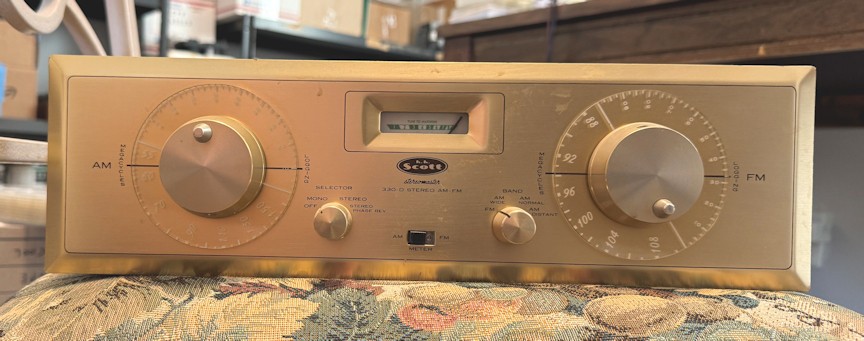
The 330D features a clean, utilitarian front panel with a large central volume knob, a smaller source selector, and minimal labeling—consistent with Scott’s “measure twice, listen once” ethos. The internal construction uses point-to-point wiring and high-quality components, including carbon composition resistors and heavy-duty switches known for their durability and low contact noise.
Sound Characteristics and Performance
The sonic signature of the Scott 330D is best described as transparent, neutral, and exceptionally detailed. Because it contains no active circuitry, there is no coloration introduced by tubes or transistors. The signal passes through with minimal phase shift and distortion, preserving the original tonal balance and dynamics of the source.
Listeners often describe the 330D as “invisible”—it doesn’t call attention to itself but instead allows the source components and speakers to shine. When paired with high-output tube phono stages or modern solid-state gear, the 330D excels at revealing subtle textures, spatial cues, and microdynamics. Its wide frequency response and flat amplitude characteristics make it particularly well-suited for classical and acoustic recordings, where accuracy and timbral realism are paramount.
One of the most remarkable aspects of the 330D is its black background and low noise floor. Without amplification stages, there is no inherent hiss or hum, resulting in a silent canvas upon which music unfolds. This makes it especially effective in low-gain systems where noise accumulation is a concern.
Notable Features and Innovations
The Scott 330D stands out for several groundbreaking design choices:
- True Passive Design: At a time when most preamplifiers included at least one gain stage, the 330D’s passive approach was radical. It required users to have strong signal sources (e.g., high-output phono cartridges or line-level devices), but rewarded them with unmatched clarity.
- Precision Attenuation Ladder: The volume control uses a stepped resistor network instead of a potentiometer, ensuring precise, repeatable attenuation and excellent channel balance across the entire range.
- High Input Impedance: With a 1MΩ input impedance, the 330D places minimal load on upstream components, preserving signal integrity—especially important when driving from tube equipment.
- No Power Supply Required: As a completely passive device, the 330D requires no power cord or internal transformers, eliminating potential sources of interference and hum.
- Build Quality: Housed in a heavy-gauge steel chassis with a brushed aluminum front panel, the 330D was built to last. Its switches and knobs are robust and engineered for tens of thousands of cycles.
Common Issues and Maintenance
While the Scott 330D is mechanically and electrically simple, it is not immune to age-related issues:
- Switch Contact Oxidation: The rotary source selector and internal switches can develop oxidation over decades of inactivity, leading to crackling or intermittent signals. Regular use and occasional contact cleaning with non-residue electronics cleaner can prevent this.
- Resistor Drift: Although rare, carbon composition resistors can drift in value over time, potentially affecting channel balance. Replacing them with modern metal-film equivalents can restore original performance—but purists often prefer to preserve originality.
- Cable and Connector Wear: Original RCA jacks and internal wiring may degrade. Upgrading to modern, high-quality interconnects and replacing jacks can improve reliability without altering the circuit’s integrity.
Because the 330D has no tubes, capacitors, or power supply, it is one of the most reliable vintage preamps—assuming it’s been stored properly and used occasionally.
Current Market Value and Collectibility
The Scott 330D is a sought-after component among vintage audio collectors and minimalist audiophiles. Its rarity, historical significance, and unique passive design contribute to its desirability. As of 2024, a fully functional 330D in good cosmetic condition typically sells for $400–$700, with pristine, original units commanding higher prices at auction or through specialty dealers.
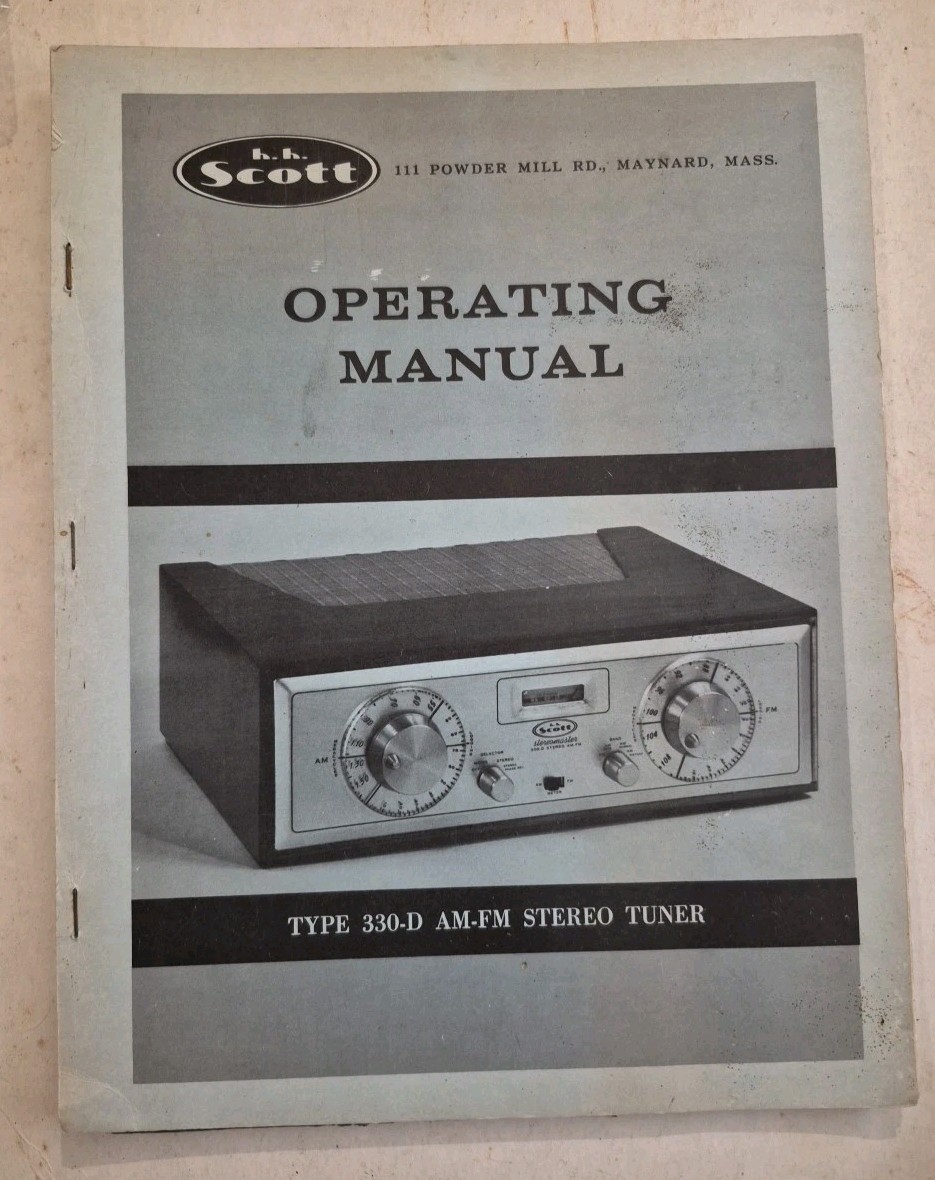
Collectors value the 330D not only for its sound but as a historical artifact of Scott’s engineering philosophy. It represents a time when high fidelity was defined by measurement and precision, not marketing hype. Units with original packaging, manuals, or factory test reports can fetch premiums.
Conclusion and Legacy
The Scott 330D remains a quiet icon in the world of vintage audio. While it may lack the visual drama of tube-lit preamps or the feature set of modern processors, its purity of purpose and sonic transparency continue to inspire admiration. It embodies a design philosophy that prioritizes signal integrity over convenience—a philosophy that resonates more than ever in today’s high-resolution audio landscape.
For the discerning listener who values neutrality, simplicity, and engineering excellence, the Scott 330D is not just a preamplifier—it’s a statement. Over half a century since its introduction, it stands as a testament to the enduring power of minimalist, measurement-driven design. In a world of ever-increasing complexity, the 330D reminds us that sometimes, the best sound comes from getting out of the way.
eBay Listings

As an eBay Partner, we earn from qualifying purchases. This helps support our independent vintage technology research.
Related Models
- Scott 200B (1960)
- Scott 210E (1956)
- Scott 222C (1972)
- Scott 233 (1972)
- Scott 260 (1964)
- Luxman L-530 (1975)
- Luxman R-404 (1975)
- Luxman RV-371 (1975)
- Luxman SQ-38U (1975)
- Luxman T-14 (1972)