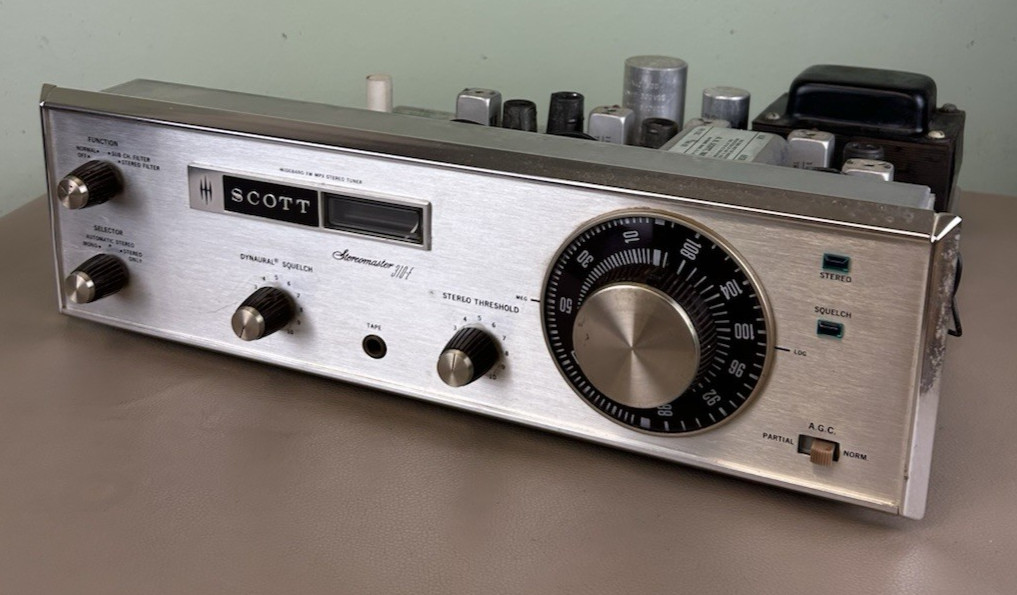
Scott 310E (1969)
The Scott 310E is a classic solid-state stereo power amplifier introduced in 1969 by H.H. Scott, Inc., a company renowned for its commitment to high-fidelity audio reproduction. As part of Scott's mid-tier amplifier lineup during the late 1960s, the 310E exemplifies the transitional period in audio engineering when solid-state technology was beginning to replace vacuum tubes, offering improved reliability and lower maintenance while striving to preserve the warm, natural sound associated with tube-based designs.
The 310E delivers 35 watts per channel into 8 ohms with less than 0.1% total harmonic distortion (THD), a remarkable specification for its time. This power output was more than sufficient to drive the high-efficiency speakers commonly used in the era, such as models from AR (Acoustic Research), Advent, and KLH. The amplifier features a dual-channel design with fully discrete circuitry—no integrated circuits—which was standard for quality audio equipment of the period. Its circuit topology emphasizes wide bandwidth, low noise, and excellent channel separation, contributing to a transparent and detailed sound signature.
One of the defining characteristics of the Scott 310E is its use of the Scott proprietary "Autobias" circuitry. This innovative system automatically maintains optimal bias current in the output transistors, ensuring stable Class AB operation across varying temperatures and usage conditions. This eliminated the need for periodic manual bias adjustments, a common maintenance task in many early solid-state amplifiers, and contributed to the 310E’s reputation for reliability and consistent performance over time.
The frequency response of the 310E is rated from 10 Hz to 60 kHz, with a tolerance of ±1 dB, indicating an exceptionally flat response across the audible spectrum and well beyond. This wide bandwidth allowed the amplifier to reproduce transient details with precision, contributing to a lively and dynamic presentation. The signal-to-noise ratio exceeds 90 dB, ensuring a quiet background even at high gain settings. Input sensitivity is approximately 1.5 volts for full output, making it compatible with most preamplifiers and tuners of the era.
The 310E features two line-level inputs per channel (labeled 1 and 2), allowing users to connect multiple sources directly to the amplifier without a preamplifier—though it was typically used in conjunction with a Scott preamp such as the 210 or 220 series for optimal system matching. Input selection is managed via a front-panel toggle switch, and a sturdy volume control (used only when operating in preamp-coupled mode) is also provided. The amplifier includes a muting switch and a pilot light, both mounted on the brushed aluminum front panel, which bears the classic Scott styling of the period: minimalist, functional, and elegant.
Construction quality is outstanding. The chassis is made of heavy-gauge steel with a robust heat sink integrated into the rear panel, essential for dissipating heat from the output transistors. The internal layout is clean and well-organized, with point-to-point wiring and high-quality components throughout, including metal-film resistors, polypropylene capacitors, and heavy-duty terminal strips. The power supply uses a large toroidal-style transformer (for the era) and substantial filter capacitance to ensure stable voltage delivery under dynamic load conditions.
H.H. Scott, Inc., founded by Edmund H. Scott in the 1950s, built its reputation on engineering excellence and a philosophy of measured performance. The company was one of the first to emphasize laboratory testing and published specifications as a means of demonstrating audio quality, a practice that set Scott apart from many competitors who relied more on subjective claims. The 310E continues this tradition, with all performance claims backed by independent test data published in contemporary audio magazines such as Stereo Review and Audio Engineering.
In reviews from the late 1960s, the 310E was praised for its clarity, neutrality, and absence of harshness—qualities that contrasted favorably with some early solid-state amplifiers that were criticized for a "transistor sound" characterized by edgy highs and brittle dynamics. The 310E managed to avoid these pitfalls through careful circuit design and component selection, resulting in a sound that many describe as smooth, balanced, and musically engaging. It performed particularly well with acoustic and classical recordings, where its ability to render fine detail and spatial cues was most evident.
While not as powerful as some of its contemporaries—such as the Fisher 500C or the Marantz 2270—the 310E was never intended to be a high-wattage beast. Instead, it was designed as a precision instrument for listeners who valued accuracy and tonal balance over raw power. It pairs exceptionally well with efficient bookshelf and floor-standing speakers of the era, especially those with benign impedance curves.
Today, the Scott 310E is sought after by vintage audio enthusiasts and collectors. Units in good working condition are relatively rare but can still be found through online marketplaces, audio forums, and specialty dealers. Restoring a 310E typically involves checking the electrolytic capacitors, cleaning the controls, verifying the Autobias circuit, and ensuring the output transistors are matched and functioning properly. Due to its solid build and serviceable design, most units can be brought back to original performance with careful maintenance.
In the broader context of audio history, the Scott 310E represents a pivotal moment: the maturation of solid-state amplifier design. It bridges the gap between the tube era and the modern high-power transistor amplifiers of the 1970s and beyond. Its enduring appeal lies not only in its sound quality but also in its embodiment of a design philosophy that prioritized fidelity, reliability, and measured performance over marketing hype.
For the vintage audio collector or audiophile seeking a transparent, well-balanced amplifier with historical significance, the Scott 310E remains a compelling choice. It stands as a testament to H.H. Scott’s engineering legacy and the enduring value of thoughtful, well-executed audio design.
eBay Listings


As an eBay Partner, we earn from qualifying purchases. This helps support our independent vintage technology research.
Service Manuals & Schematics
- Service Manual — archive.org
Related Models
- Scott 200B (1960)
- Scott 210E (1956)
- Scott 222C (1972)
- Scott 233 (1972)
- Scott 260 (1964)
- Luxman L-530 (1975)
- Luxman R-404 (1975)
- Luxman RV-371 (1975)
- Luxman SQ-38U (1975)
- Luxman T-14 (1972)