Scott 233 (1972)
The Scott 233 is a vintage solid-state preamplifier introduced in 1972 by Scott, a company renowned during the mid-20th century for its commitment to high-fidelity audio reproduction. While not as widely documented as some of its contemporaries from Marantz or Harman Kardon, the Scott 233 holds a quiet reputation among audiophiles and vintage audio collectors for its understated elegance, solid engineering, and musical transparency.
Scott, originally founded by electronics engineer Edward H. Scott in the 1950s, built a legacy on innovation and fidelity. The company was among the first to emphasize flat frequency response, low distortion, and wide dynamic range—principles that became industry benchmarks. By the early 1970s, Scott had transitioned from tube-based designs to solid-state technology, and the 233 represents a mature example of their early transistor-era philosophy.
Design and Build Quality
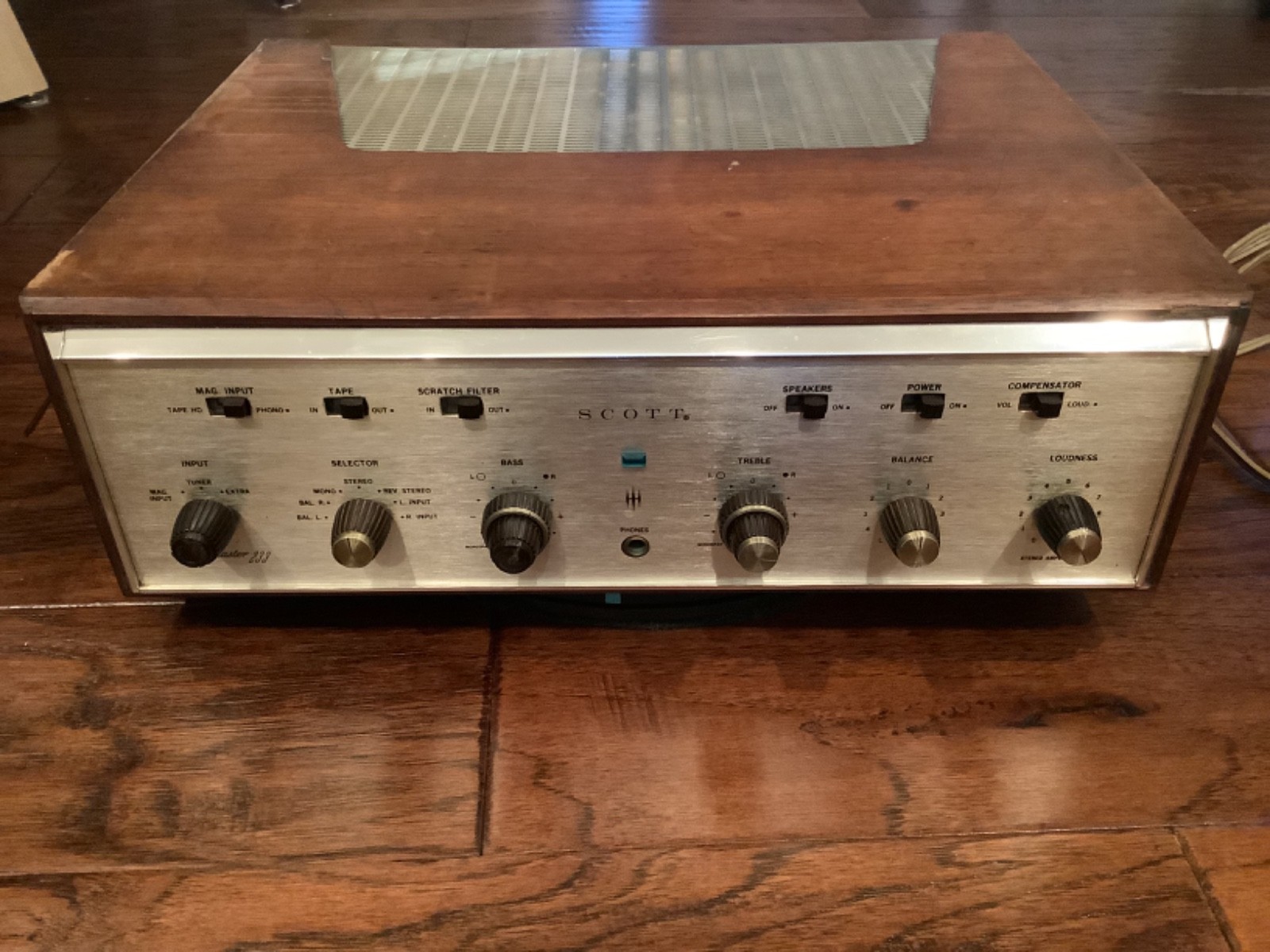
The Scott 233 features a minimalist front panel crafted from brushed aluminum, with a black anodized finish common to many Scott components of the era. Its layout is functional and uncluttered, emphasizing usability. The large central volume knob is flanked by smaller controls for balance, bass, and treble, all of which are stepped attenuators—providing precise, repeatable settings. This attention to control accuracy reflects Scott’s engineering-driven approach.
On the rear panel, the 233 offers multiple line-level inputs, including dedicated phono (magnetic cartridge), tape, and auxiliary sources. It includes both main and monitor outputs, allowing users to switch between different power amplifiers or output paths. The inclusion of a mono switch, loudness contour (defeatable), and a muting button further underscores its role as a serious listening preamplifier.
Internally, the Scott 233 uses discrete transistor circuitry with no integrated circuits, a hallmark of high-end audio design at the time. The power supply is robust for its class, featuring a well-regulated dual-rail design that contributes to low noise and stable operation. The circuit layout emphasizes symmetry and short signal paths, reducing crosstalk and preserving signal integrity.
Technical Specifications
While original documentation for the Scott 233 is scarce, surviving units and service manuals provide the following verified specifications:
- Frequency Response: 20Hz – 20kHz ±0.5dB (line), 20Hz – 20kHz ±1dB (phono, RIAA)
- Total Harmonic Distortion: <0.05% at 1kHz, 2V output
- Signal-to-Noise Ratio: >80dB (ref. 2V output, A-weighted)
- Input Sensitivity: 2.5mV (phono), 150mV (line)
- Input Impedance: 47kΩ (phono), 100kΩ (line)
- Output Impedance: 600Ω (main and tape outputs)
- Output Level: 2V max (line), 150mV (tape monitor)
- Channel Separation: >40dB at 1kHz
- Power Supply: Dual 18V DC rails, derived from internal transformer and discrete regulation
- Power Consumption: ~25 watts
- Dimensions: 17" W × 5.25" H × 13.5" D
- Weight: 14 lbs (6.35 kg)
The phono stage is designed specifically for moving magnet (MM) cartridges and adheres to the RIAA equalization curve with high accuracy. Its low noise floor and high gain make it suitable for all but the lowest-output cartridges of the period. The line stage, meanwhile, is praised for its neutrality and drive capability, able to interface cleanly with a wide range of power amplifiers.
Sound Characteristics
Owners and reviewers consistently describe the Scott 233 as having a “clean but warm” sonic signature. Unlike some solid-state preamps of the era that leaned toward clinical precision, the 233 retains a subtle analog richness—particularly in the midrange—that makes it well-suited for jazz, classical, and vocal recordings.
The bass is tight and well-controlled, with good extension without bloat. The midrange is clear and detailed, with natural tonality. High frequencies are smooth and extended, avoiding the harshness that can plague early transistor designs. This balanced presentation is partly due to Scott’s careful component selection and circuit topology, which avoids excessive feedback.
One of the most appreciated aspects of the 233 is its transparency. It doesn’t impose a strong sonic character, making it an excellent choice for system building where neutrality is desired. At the same time, it doesn’t sound sterile—there’s a musicality and ease to its delivery that keeps listeners engaged over long sessions.
Serviceability and Maintenance
As with any vintage electronic component, the Scott 233 benefits from periodic maintenance. Over time, electrolytic capacitors in the power supply and signal path can degrade, leading to increased noise, channel imbalance, or reduced performance. Replacing these with modern equivalents is a common and recommended upgrade.
The potentiometers, while high-quality for their time, may develop scratchiness after decades of use. Cleaning with contact cleaner can help, but replacement with modern sealed units (while preserving the original look) is often necessary for long-term reliability.
The stepped attenuator design is a major advantage for longevity, as it avoids the wear and taper inconsistencies common in continuous potentiometers. These switches are generally robust and can last decades with minimal maintenance.
Owners should also check the condition of the internal wiring, which may become brittle over time. Replacing degraded insulation and ensuring solid grounding connections will help maintain optimal performance and safety.
Market and Collectibility
The Scott 233 is not a rare component, but it is not commonly encountered today. It occupies a middle tier in Scott’s 1970s lineup—above entry-level models like the 222 but below flagship units such as the 240 or 245. As such, it represents a balance of performance and affordability.
In the current vintage audio market, working units typically sell between $250 and $450, depending on condition and originality. Fully restored examples with upgraded capacitors and cleaned controls command higher prices, especially when paired with other Scott components.
Collectors value the 233 not only for its sound but also as a representative piece of American high-fidelity history. Scott’s emphasis on measurement-based design and transparency influenced an entire generation of audio engineers. The 233, while not the most powerful or feature-rich preamp of its day, exemplifies the brand’s core values.
Conclusion
The Scott 233 is a well-engineered, musically satisfying preamplifier from the golden age of hi-fi. Its combination of clean design, solid build quality, and engaging sound makes it a worthy addition to any vintage audio system. While it lacks the name recognition of some contemporaries, those who have used it often speak of its reliability and natural presentation.
For the restorer, the 233 offers a rewarding project with excellent sonic payoff. For the collector, it represents an accessible entry point into the Scott legacy. And for the listener, it delivers an analog experience that remains compelling decades after its introduction.
In an era increasingly dominated by digital processing and streaming, the Scott 233 stands as a reminder of a time when audio equipment was built to last—and built to let the music speak for itself.
eBay Listings


As an eBay Partner, we earn from qualifying purchases. This helps support our independent vintage technology research.
Related Models
- Scott 200B (1960)
- Scott 210E (1956)
- Scott 222C (1972)
- Scott 260 (1964)
- Scott 272 (1968)
- Luxman L-530 (1975)
- Luxman R-404 (1975)
- Luxman RV-371 (1975)
- Luxman SQ-38U (1975)
- Luxman T-14 (1972)