Scott 222C (1972)
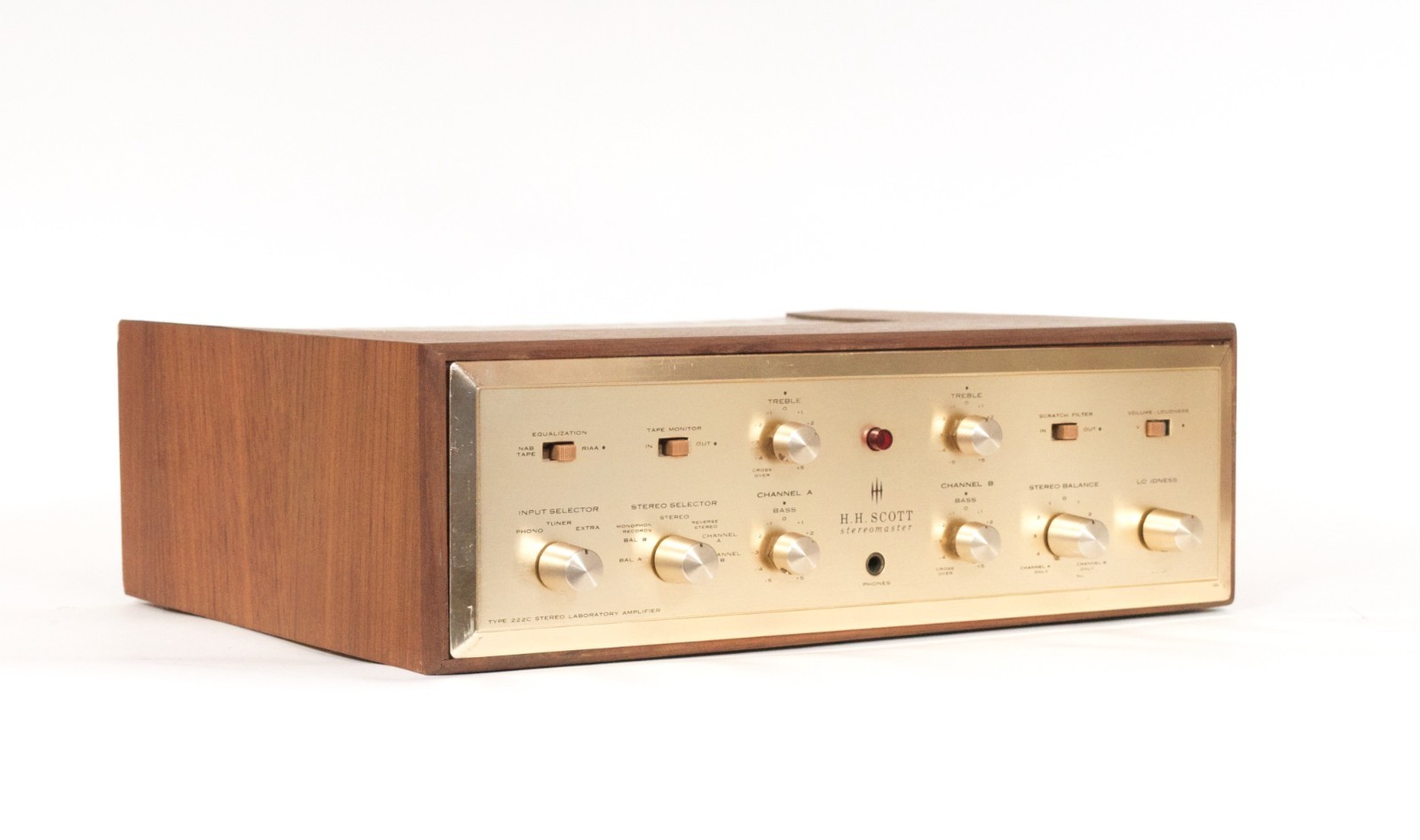
The Scott 222C is a vintage solid-state preamplifier produced by Scott (officially H.H. Scott, Inc.), a respected American audio company renowned for its commitment to high-fidelity engineering and innovation during the mid-20th century. Introduced in 1972, the 222C stands as a refined example of early 1970s preamp design, combining minimalist functionality with high performance and exceptional build quality. While not as widely discussed as some of its contemporaries from Marantz or Fisher, the Scott 222C has earned a loyal following among audiophiles who appreciate its transparent sound, robust construction, and elegant aesthetic.
Design and Build Quality
The Scott 222C features a clean, understated front panel typical of Scott’s design language during the early 1970s. It is housed in a sleek, brushed aluminum chassis with a black anodized finish, accented by precision-machined aluminum knobs for volume, balance, and input selection. The layout is intuitive and functional, with clearly labeled controls and a large VU meter centered on the panel. This meter, a hallmark of Scott equipment, not only serves as a visual indicator of signal level but also contributes to the unit’s classic aesthetic.
The build quality is exceptional by any standard. Scott was known for its rigorous engineering practices, and the 222C is no exception. Components were carefully selected for longevity and performance, and the circuit layout reflects a thoughtful approach to signal integrity. The use of discrete transistors—rather than integrated circuits—was typical of the era and contributes to the unit’s reputation for musicality and low distortion.
Technical Specifications
The Scott 222C is a dual-mono, line-level preamplifier designed for use with high-fidelity audio systems. It offers four line-level inputs: two for stereo sources such as a tuner and tape deck, and two additional inputs typically labeled “Tuner” and “Aux.” Each input is selected via a high-quality rotary switch, ensuring reliable contact and minimal signal degradation.
Frequency response is rated at 10 Hz to 100 kHz, ±0.5 dB, which was exceptionally wide for its time and indicative of Scott’s pursuit of extended bandwidth and low phase shift. This wide bandwidth contributes to a sense of openness and detail in the sound. Total harmonic distortion is less than 0.05% across the audible spectrum, a figure that rivals many modern preamplifiers.
Input impedance is 100kΩ, making the 222C compatible with a wide range of source components, including tube-based equipment. The output impedance is a low 600Ω, allowing it to drive long interconnects and power amplifiers with high input sensitivity without signal loss or degradation.
The preamplifier features a passive tone control section with bass and treble adjustments, each offering ±15 dB of control at 50 Hz and 10 kHz, respectively. These controls are implemented with high-quality potentiometers and are designed to minimize sonic coloration when set to the flat (center) position.
A balance control allows for precise adjustment between left and right channels, useful for compensating for room acoustics or speaker placement. The unit also includes a mono switch, which sums the left and right channels—a feature appreciated by listeners with mono recordings or those seeking a more centered soundstage.
One of the most distinctive features of the 222C is its dual VU meters. These meters display signal levels for both left and right channels and are driven by a dedicated circuit that ensures accurate and responsive readings. Beyond their functional purpose, the meters add a dynamic visual element to the listening experience and are a signature of Scott’s design philosophy—where form and function coexist harmoniously.
Sound Characteristics
The sonic signature of the Scott 222C is often described as neutral, transparent, and detailed. Unlike some preamplifiers of the era that impart a “warm” or “colored” character, the 222C aims for accuracy and fidelity. This makes it an excellent choice for listeners who value realism and want their system to reproduce recordings as faithfully as possible.
Its wide frequency response and low distortion contribute to a spacious soundstage with precise imaging. Instruments are rendered with clarity and separation, and the preamp handles complex musical passages with ease. The bass is tight and well-controlled, while the treble remains smooth and extended without harshness.
Because it uses discrete transistor circuitry, the 222C avoids the grain or hardness sometimes associated with early solid-state designs. Instead, it delivers a balanced presentation that can complement both tube and solid-state power amplifiers. When paired with high-quality sources and speakers, the 222C reveals subtle nuances in recordings that lesser preamps might obscure.
Historical Context and Legacy
H.H. Scott, Inc. was founded in 1957 by Hermon Hosmer Scott, an MIT-trained engineer with a passion for high-fidelity audio. The company quickly gained a reputation for innovation, introducing features such as the first FM stereo tuner with a quartz-locked oscillator and pioneering the use of negative feedback in amplifier design to reduce distortion.
The 222C was part of Scott’s upper-tier product line in the early 1970s, positioned between the more basic 212 series and the flagship 230 series. It was often paired with Scott’s 210-series power amplifiers, such as the 210B or 212D, to form a complete high-performance system.
While Scott ceased U.S. manufacturing in the late 1970s and the brand changed hands several times, the legacy of its classic models endures. The 222C, in particular, is prized by collectors and vintage audio enthusiasts for its engineering integrity and timeless design.
Maintenance and Availability Today
Today, the Scott 222C is considered a sought-after vintage component, though not as commonly found as models from Marantz or Pioneer. Units in good working condition typically command prices between $300 and $600, depending on cosmetic and functional condition.
As with any vintage electronics, proper maintenance is essential. Capacitors may need to be replaced, especially if the unit has been stored for long periods. The VU meter circuitry, while robust, can also benefit from inspection and calibration. Cleaning the controls and switches with contact cleaner is recommended to restore smooth operation.
Original documentation, including service manuals and user guides, is available through online archives and enthusiast forums, making restoration more accessible.
Conclusion
The Scott 222C is a standout example of early 1970s American audio engineering. It combines technical excellence, elegant design, and a neutral sonic character that continues to impress audiophiles decades after its release. While it may not have the name recognition of some of its competitors, those familiar with the 222C often regard it as one of the most transparent and well-built preamplifiers of its era. For collectors, restorers, or listeners building a vintage high-fidelity system, the Scott 222C remains a compelling and rewarding choice.
eBay Listings



As an eBay Partner, we earn from qualifying purchases. This helps support our independent vintage technology research.
Related Models
- Scott 200B (1960)
- Scott 210E (1956)
- Scott 233 (1972)
- Scott 260 (1964)
- Scott 272 (1968)
- Luxman L-530 (1975)
- Luxman R-404 (1975)
- Luxman RV-371 (1975)
- Luxman SQ-38U (1975)
- Luxman T-14 (1972)