Sanyo RD-S40: The Compact Dual Cassette Workhorse of the 1980s
In the mid-1980s, when cassette tapes ruled home audio and mixtapes were the currency of personal expression, Sanyo carved out a reputation for producing reliable, feature-packed, and affordably priced audio equipment. Among their lineup of cassette decks, the Sanyo RD-S40 stands as a modest yet representative example of the era’s mass-market dual-cassette technology. While not a high-end audiophile machine like those from Nakamichi or even Technics, the RD-S40 served a practical purpose: copying tapes, building mixtapes, and playing pre-recorded cassettes with dependable performance.
Released around 1985, the RD-S40 arrived at the height of cassette popularity, just before the CD began its slow ascent. It was designed for the average consumer who wanted convenience and functionality without the premium price tag. Positioned as a compact, all-in-one solution, the RD-S40 featured dual cassette transport, auto-reverse playback, and a straightforward digital display—hallmarks of the era’s home audio design philosophy.
Though Sanyo never achieved the same cult status as some of its Japanese rivals, the company was known for solid build quality and clever engineering. The RD-S40 reflects this ethos: it wasn’t flashy, but it worked well and offered good value for its time.
Technical Specifications
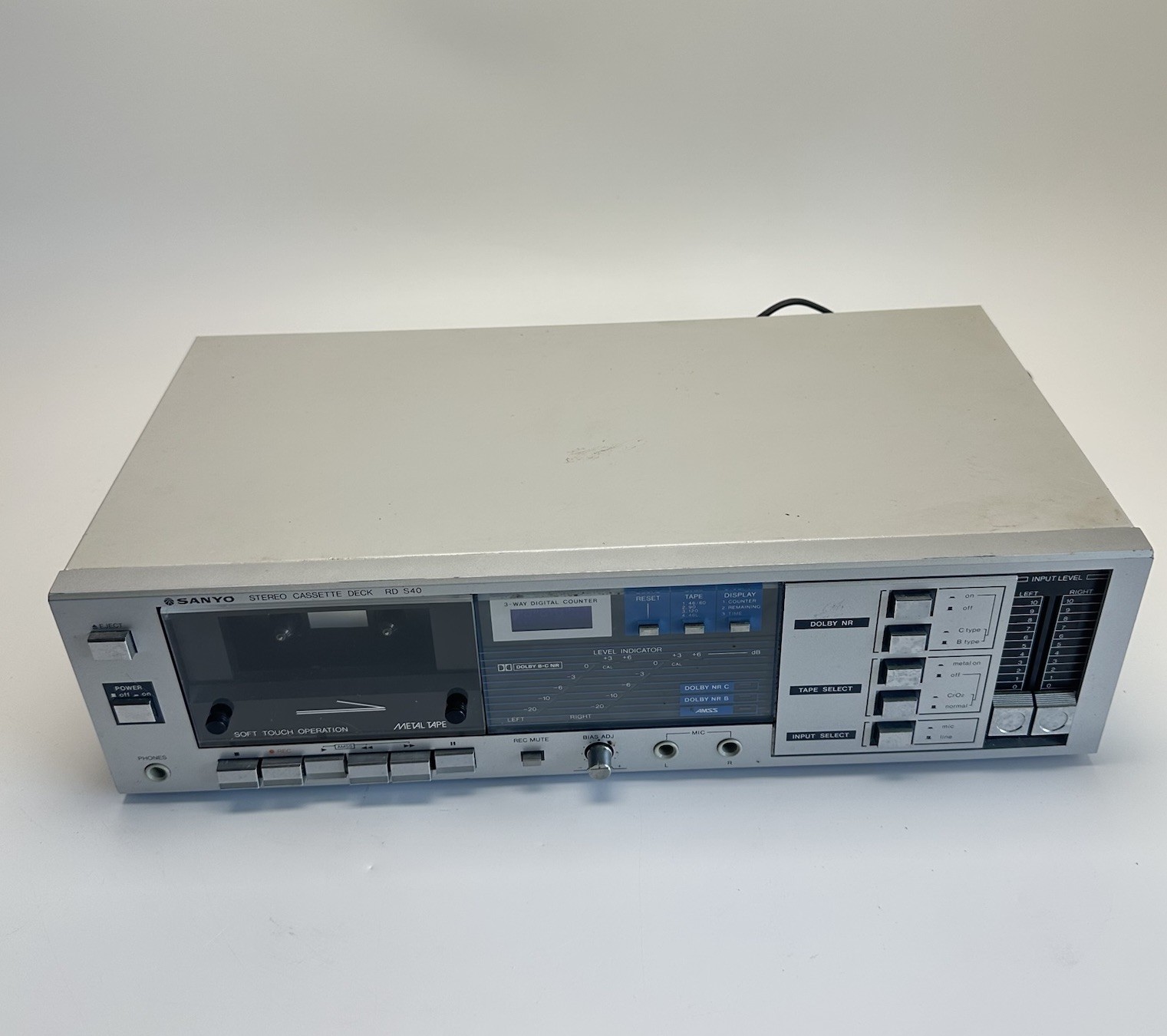
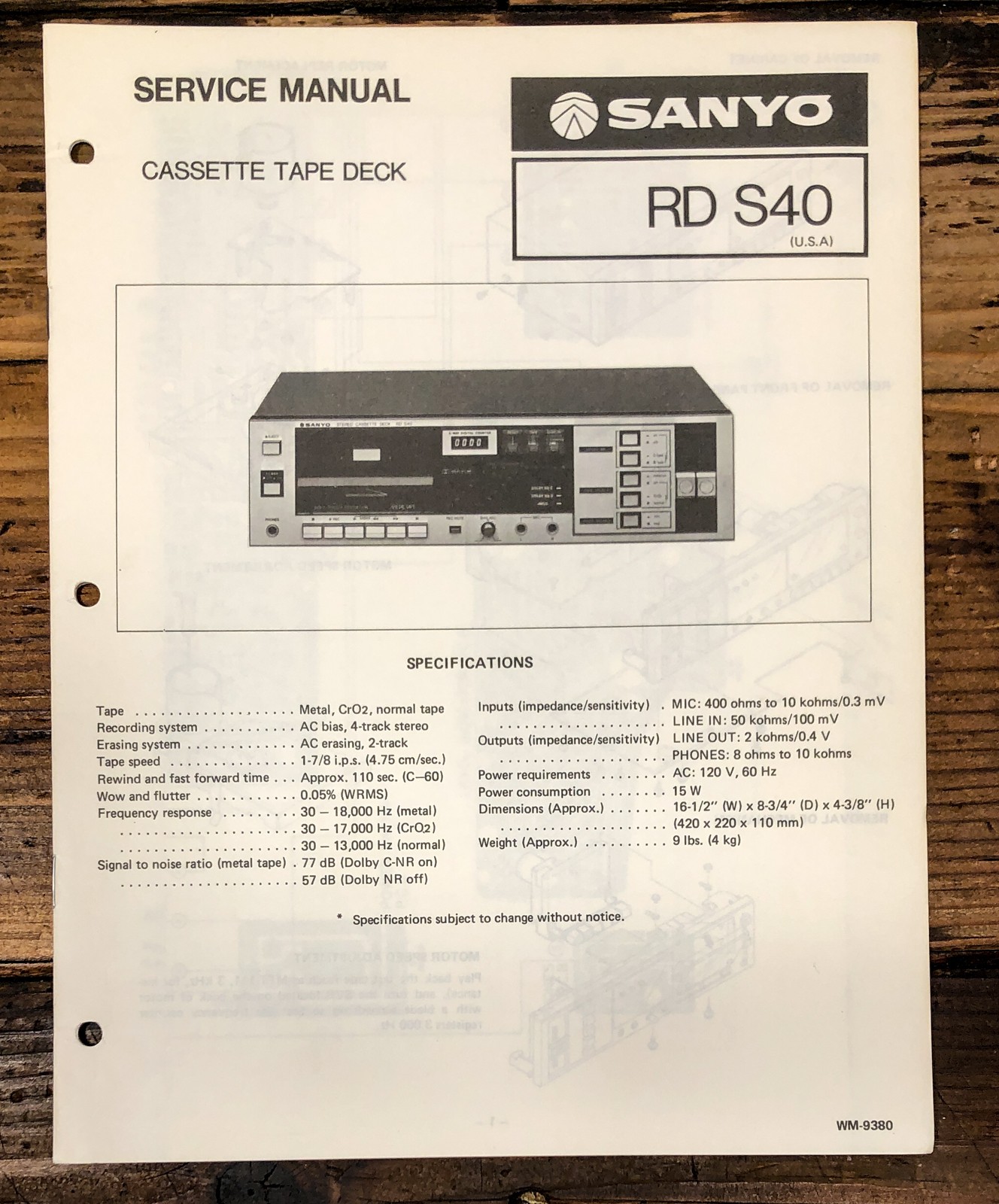
The Sanyo RD-S40 was built around dual cassette mechanisms, allowing users to record from one tape to another—a feature that made it a favorite for tape duplication and mixtape creation. While not equipped with advanced noise reduction systems or professional-grade tape heads, it delivered acceptable audio fidelity for casual listening.
| Specification | Detail |
| Model | RD-S40 |
| Manufacturer | Sanyo Electric Co., Ltd. |
| Year of Release | 1985 |
| Cassette Mechanism | Dual cassette deck (Deck A and B) |
| Tape Playback Direction | Auto-reverse (both decks) |
| Display | 2-digit LED or digital fluorescent |
| Recording Modes | Standard (Type I ferric only) |
| Noise Reduction | None (Dolby not supported) |
| Playback Features | Play, Record, Pause, Stop, Fast Forward, Rewind |
| Copy Function | One-touch dubbing (A to B or B to A) |
| Inputs/Outputs | Line In (RCA), Line Out (RCA) |
| Power Supply | AC adapter (external, model not known) |
| Dimensions | Approx. 430 x 140 x 300 mm (WxHxD) |
| Weight | Approx. 5.2 kg |
The RD-S40’s design emphasized usability. The front panel featured clearly labeled buttons for each function, with dedicated controls for each deck. The digital display—likely a vacuum fluorescent or basic LED type—showed the current mode (play, record, etc.) and sometimes the tape side (A/B). Its compact footprint made it suitable for small shelves or entertainment centers, fitting neatly alongside other components of the era like turntables, AM/FM tuners, or compact disc players.
Sound Characteristics and Performance
As a budget-to-midrange dual cassette deck, the Sanyo RD-S40 was never intended for critical listening. Its audio performance was adequate for home use, with a frequency response likely in the range of 80 Hz – 14 kHz, typical for non-Dolby, non-metal capable decks of the time. Bass response was modest, and high frequencies lacked the crispness of higher-end models.
The lack of Dolby noise reduction meant that tape hiss was noticeable, especially on quieter passages or when using lower-grade tapes. However, for playing commercially pre-recorded tapes or making copies of mixtapes, the sound was generally acceptable. The auto-reverse function worked reliably, flipping the playback direction electronically by reversing the capstan motor—common in budget decks of the era, though not as smooth as mechanical flip mechanisms.
Tape transport was driven by a rubber pinch roller and capstan, with typical belt-driven mechanics. While durable, these components are now prone to wear after decades of disuse, which can affect playback stability.
Notable Features and Innovations
What made the RD-S40 stand out in its class was its one-touch dubbing function. With the press of a single button, users could copy a tape from Deck A to Deck B (or vice versa), a feature that was highly desirable before digital music and MP3s. This made it a favorite among teenagers and families who wanted to archive records, duplicate rental tapes, or compile custom playlists.
Other notable features included:
- Auto-reverse on both decks, allowing uninterrupted playback of both sides of a tape.
- Independent operation—each deck could be used separately for playback or recording.
- Simple line-level inputs and outputs, enabling connection to a stereo system or external tuner.
While it lacked advanced features like azimuth adjustment, bias control, or metal tape compatibility, the RD-S40 was never meant to be a studio tool. It was a practical, user-friendly appliance for everyday audio tasks.
Common Issues and Maintenance
Like all vintage cassette equipment, the Sanyo RD-S40 is now over 35 years old, and several common issues may arise:
- Deteriorated rubber parts: The pinch rollers and drive belts often harden or crack over time, leading to poor tape contact, speed instability, or complete transport failure. Replacing these with fresh rubber components is essential for reliable operation.
- Dirty or oxidized tape heads: The playback and record heads can accumulate oxide buildup, causing muffled sound or dropouts. Regular cleaning with isopropyl alcohol and cotton swabs is recommended.
- Sticky mode switches or worn gears: Mechanical switches and plastic gears may degrade, especially if the unit was heavily used. Lubrication or replacement may be necessary.
- Failing capacitors: The power supply or internal circuitry may contain dried-out electrolytic capacitors, which can cause power issues or noise.
Restoration typically involves a full clean, demagnetize, and service (CD&V) routine. While parts for Sanyo decks are not as widely available as for brands like Sony or Panasonic, many generic or compatible components can be sourced from online audio restoration suppliers.
Current Market Value and Collectibility
The Sanyo RD-S40 is not a highly sought-after collector’s item. It lacks the prestige of high-end decks and doesn’t have a significant following among audiophiles. As of 2024, working units typically sell for $30 to $70 on secondary markets like eBay or vintage audio forums. Non-working units may go for as little as $15–$25.
However, it holds nostalgic value for those who grew up in the 1980s, and its compact design makes it a charming addition to retro-themed setups. It may also appeal to cassette revival enthusiasts who enjoy the tactile experience of tape recording in the digital age.
Conclusion and Legacy
The Sanyo RD-S40 may not be a legendary machine, but it represents an important chapter in home audio history. It embodies the democratization of music recording—a time when anyone could make a copy of a favorite album or craft a heartfelt mixtape for a friend. While overshadowed by more advanced contemporaries, the RD-S40 delivered solid performance, thoughtful design, and everyday utility.
Today, it serves as a reminder of a simpler era in audio technology—one where the whir of tape motors and the smell of magnetic oxide were part of the listening experience. For the vintage audio enthusiast, the RD-S40 is a functional, nostalgic piece of 1980s tech that, with a little care, can still spin tapes and spark memories.
eBay Listings


As an eBay Partner, we earn from qualifying purchases. This helps support our independent vintage technology research.
Related Models
- Sanyo DCX-233L (1978)
- Sanyo DCX-3400 (1979)
- Sanyo RD-W40 (1982)
- Sanyo RD-W50 (1983)
- Sanyo RD-W685 (1979)
- Sony TC-2050SD (1978)
- Aiwa AD-F990 (1993)
- Kenwood KX-3060 (1982)
- Sony TC-2130A (1974)
- Sony TC-2220 (1972)